Leadership Coherence

A guided reading pathway that explains why leadership failure is often invisible while it is happening, then uses sports as a high-visibility laboratory to understand how systems break, how misdiagnosis compounds failure, and what coherent leadership actually looks like under real constraints.

Suggested flow: Invisibility → Legibility → Systems → Misdiagnosis → Governance → Signals → Ownership → Diagnostic

0

Orientation: How to Read Leadership as a System

Use this quick primer before you start the series

  Leadership Is a System (PDF Overview)

A visual map of the core lens used throughout this series: performance emerges from system design, not individual talent alone. Skim this first if you want the big picture before diving into the articles.

  2-Minute Audio Brief: Leadership Systems & Coherence

A fast audio warm-up that reinforces the same core ideas: attribution error, coherence, capability traps, and why outcomes are often the wrong signal during change.

  What you should be looking for as you read

✓

System signals instead of personality narratives: goals, constraints, decision rights, and feedback loops.

✓

Lag vs lead: what looks like “progress” now may be capacity cannibalization that shows up later.

✓

Coherence over headlines: whether decisions align over time given the environment’s constraints.

Suggested pace: 3–5 minutes total. Then move to Section 1.

1

Foundations: Leadership Is a System, Not a Person

Reframing leadership failure before diagnosing leaders

This section establishes the core premise of the series: performance is an emergent property of systems. Before evaluating leaders, owners, or executives, you need to understand how goals, constraints, feedback, and decision rights shape outcomes over time.

   Why Leadership Failure Is Hard to See While It’s Happening

The opening lens for the entire series. Explains why failure rarely announces itself as failure, how pressure distorts judgment, and why leaders often appear competent right up until the system runs out of capacity.

  Long-Form Audio Debate: Leadership as a System

A candid back-and-forth conversation unpacking leadership as a system rather than a trait. Explores attribution error, coherence, governance vs execution, and why organizations keep cycling through leaders without fixing the underlying design.

  Key ideas to anchor before moving on

✓

Performance emerges from system design, not effort or intent alone.

✓

The same leader can look brilliant or incompetent depending on coherence.

✓

Replacing leaders without changing decision conditions usually repeats the failure.

2

Why Sports Make Leadership Failure Visible

Use sports as a diagnostic lens, not a metaphor

  Why Sports Ownership Is the Clearest Case Study for Leadership Failure in Business

Sports make outcomes public, constraints explicit, and feedback fast. Business hides the same failures behind layers of metrics and narrative. This article establishes the lens that the rest of the pathway builds on.

  Key Takeaways

✓

Sports remove ambiguity. They reveal how leadership systems behave under pressure.

✓

The goal is pattern recognition, not fandom or hot takes.

3

Reframe Performance: It’s the System, Not the Person

Replace personality narratives with system explanations

  The False Choice

Breaks the default debate pattern: blaming individuals versus blaming systems. Most real failures are interactions between the two.

  Performance as a System: The Data-Informed Framework Behind Wins and Losses

A structured way to analyze performance without collapsing into outcome worship. Sets up the system-first lens used throughout the pathway.

  What Organizations Get Wrong About Performance: It’s the System, Not the Person

The business translation: why organizations repeatedly misdiagnose performance as a talent issue when the system design is the constraint.

  Key Takeaways

✓

Outcomes are noisy. Systems are persistent.

✓

Most “execution problems” are predictable system design failures.

4

The Real-Time Trap: Why Smart Leaders Misdiagnose Problems

Understand how pressure and delayed feedback create rational-looking mistakes

  From Insight to Misdiagnosis: Why Smart Leaders Keep Fixing the Wrong Problem

Explains why symptom-fixing feels like leadership, how short-term “proof” confirms bad diagnoses, and why churn resets learning.

  Key Takeaways

✓

Misdiagnosis is a structural default in delayed-feedback systems.

✓

Short-term relief is often symptom compensation, not system repair.

5

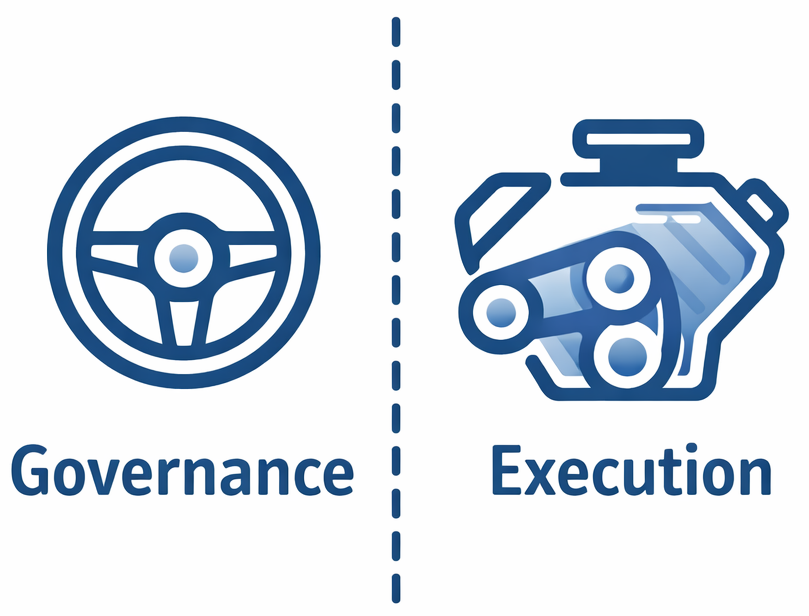
Governance vs Execution: The Silent Performance Killer

Stabilize decision rights before you try to “fix execution”

  The Most Expensive Leadership Mistake: Confusing Governance with Execution

Shows how interference happens indirectly through metrics, incentives, and pressure. A mirror for boards, owners, and senior leaders.

  Key Takeaways

✓

Accountability without authority creates defensive systems, not better performance.

✓

Decision rights stability is a performance asset.

6

Signals Over Outcomes: What to Measure When Results Lie

Learn how to interpret progress by system stage

  What to Measure When Results Are the Wrong Signal

A non-KPI approach to measurement. Focuses on capability, coherence, and learning velocity so leaders do not kill change during turbulence.

  Key Takeaways

✓

Early-stage improvement often looks worse before it looks better.

✓

Capability and learning are often more predictive than current outcomes.

7

Ownership as the Ultimate Systems Test

Apply goals, constraints, coherence, and patience to the most persistent leadership role

  What Makes a Good Sports Owner? A Framework for Evaluating Leadership (Brief)

A compact entry point: four endgames, constraint awareness, and the five execution dimensions that separate coherence from noise.

  What Makes a Good Sports Owner? (Full Analysis)

The deep dive: how ownership goals, constraints, and governance choices compound over time and reshape performance.

  The Brady–Belichick Split: What the Data Really Says About Performance and Leadership

A concrete system experiment: why attribution to a single person fails and what the split reveals about system dependency.

  One Owner, Three Systems

Shows how the same owner can produce excellence in one era and dysfunction in another, as coherence rises or collapses.

  Key Takeaways

✓

Ownership is governance over decades, not decision-making in moments.

✓

Goal clarity + constraint realism + execution coherence are multiplicative, not additive.

8

Capstone: The Leadership Coherence Diagnostic

Turn the series into a repeatable evaluation lens

  The Leadership Coherence Diagnostic

A structured way to evaluate leadership coherence across goals, constraints, execution, learning, narrative integrity, and patience discipline.

  Key Takeaways

✓

This is a diagnostic, not a ranking. The goal is disciplined disagreement grounded in shared criteria.

✓

Use it to evaluate systems you can influence, not just leaders you want to judge.

Estimated Total Time: 2.5–4 hours reading

The full pathway is designed to be completed as a focused sprint or spread across a week. Most articles are 10–18 minutes. The capstone diagnostic benefits from a slower read and a second pass after you apply it to a real situation.

Great! You’ve successfully signed up.

Welcome back! You've successfully signed in.

You've successfully subscribed to Turning Data Into Wisdom.

Success! Check your email for magic link to sign-in.

Success! Your billing info has been updated.

Your billing was not updated.