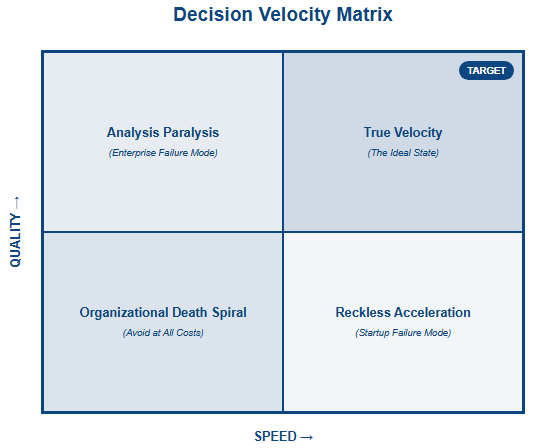
Organizations that can't make smart decisions quickly risk irrelevance as competitors launch products in weeks and markets shift overnight. Most companies operate with the "Bureaucracy-Industrial Complex": systems that reward process over progress and certainty over action.
Decision velocity (combining speed, quality, and adaptability) emerges as the critical differentiator. However, leaders often kill velocity through ten common behaviors: chasing perfect data, confusing consensus with alignment, micromanaging analysis, holding meetings without decisions, ignoring cognitive biases, blindly following AI, treating dissent as disloyalty, overvaluing hierarchy, rigidly sticking to annual plans, and measuring wrong metrics.
These behaviors persist because they feel safe in traditional corporate cultures, even though they accumulate "decision debt", a hidden liability that compounds over time. The 70% confidence rule offers a solution: act when you have sufficient information rather than waiting for certainty that arrives too late.
True decision velocity requires building cognitive capacity through data-informed, bias-mitigating processes. Leaders must distinguish between alignment and unanimity, push authority closer to expertise, and treat strategy as a living process. Remote work environments accelerate decision debt accumulation through longer correction cycles and faster context loss.
The companies that survive won't have the best strategies, they'll have the fastest strategy adaptation cycles. Speed isn't optional, it's existential.
Key Takeaways
1. Decision velocity equals speed + quality + adaptability, not just speed alone. Many leaders confuse rapid decision-making with effective decision-making. True competitive advantage requires all three components working together.
2. The 70% confidence rule optimizes decision timing. Waiting for perfect data creates an inverse relationship where delay costs accelerate faster than confidence increases. The sweet spot for most business decisions is acting with 70% confidence, then adapting as new information emerges.
3. Alignment doesn't require unanimous agreement. Leaders should focus on getting teams to "commitment" level (willing to execute regardless of personal agreement) rather than trying to achieve consensus. This prevents endless alignment meetings that stall progress.
4. Decision debt compounds like financial debt. Every delayed decision accumulates hidden costs like lost context, eroded trust, missed opportunities, that become exponentially harder to resolve over time. Remote work environments accelerate this compounding effect.
5. Organizations systematically reward behaviors that kill velocity. The "Bureaucracy-Industrial Complex" promotes process over progress through ten common leadership moves: chasing perfect data, endless consensus-building, micromanaging analysis, pointless meetings, ignoring bias, outsourcing judgment to AI, punishing dissent, overvaluing hierarchy, rigid planning, and measuring wrong metrics.