AI did not end the data literacy crisis. It changed it. As machines move from providing information to interpreting it and recommending what to do, the scarce skill is becoming judgment: knowing what to trust, what to question, and what decisions are still ours to make.
Evidence does not make decisions. People interpret it, weigh it, challenge it, and make judgments. A courtroom reveals what leaders can learn about evidence, expertise, confidence, and data-informed decision-making.
Feeling sure doesn't mean you're right. Learn five simple ways to question what feels true, spot what might be influencing you, and make better decisions about what to believe.
AI Can Give You an Answer. Did You Earn the Right to Believe It?
We teach data literacy as a ladder: data at the bottom, wisdom at the top, climb step by step. But the rungs are not where the work happens. The judgment lives in the gaps between them, and that is exactly where AI now carries us straight past.
AI made answers cheap. Judgment just became more valuable.
TL;DRWhy AI can climb the ladder in seconds and still get you nowhere
What you need to know
Data literacy is usually taught as a ladder: data at the bottom, wisdom at the top, climb one rung at a time. The rungs are not where the work happens. Each step up requires a judgment the ladder never shows you: which question to ask, what actually matters, which explanation the evidence earns, what action the stakes justify. The states get the attention. The transitions between them are where the thinking lives, and where it usually goes wrong.
Why this matters now
AI can now operate at every rung. It organizes data, finds patterns, generates fluent explanations, and recommends actions, in seconds. So the old comfort that machines do the low work while humans do the high work is finished. The instant climb is the danger, because it carries you from a number to an action before anyone has crossed a single gap on purpose. A plausible explanation is a hypothesis about the evidence, not evidence for it, and fluency makes that easy to forget.
The reframe
The ladder was never a ladder. Every action changes the system and writes new evidence about whether the thinking behind it held up, which loops back to the start. Wisdom is not the top of the staircase. It is the discipline of closing the loop: connecting what you believed, what you did, what happened, and what you now believe, then running it again. Most organizations are far better at making decisions than at learning from them, so the loop stays open.
What you'll gain from reading
A sharper way to see your own analysis: the five questions that protect each transition, a clear line between producing an artifact and owning the judgment it represents, and a durable answer to what stays human as AI gets better. Not a level on the ladder. Accountability for the moves between the levels.
Imagine that you are trying to understand why employee turnover is rising. A dashboard shows that it climbed from 8% to 12%. You use an AI tool to dig deeper, and it finds that most of the increase is among employees with two to five years of tenure. You know that career progression has been a recurring concern for employees at that stage, so the pattern seems to fit. Maybe the answer is clearer promotion paths and more opportunities for internal mobility.
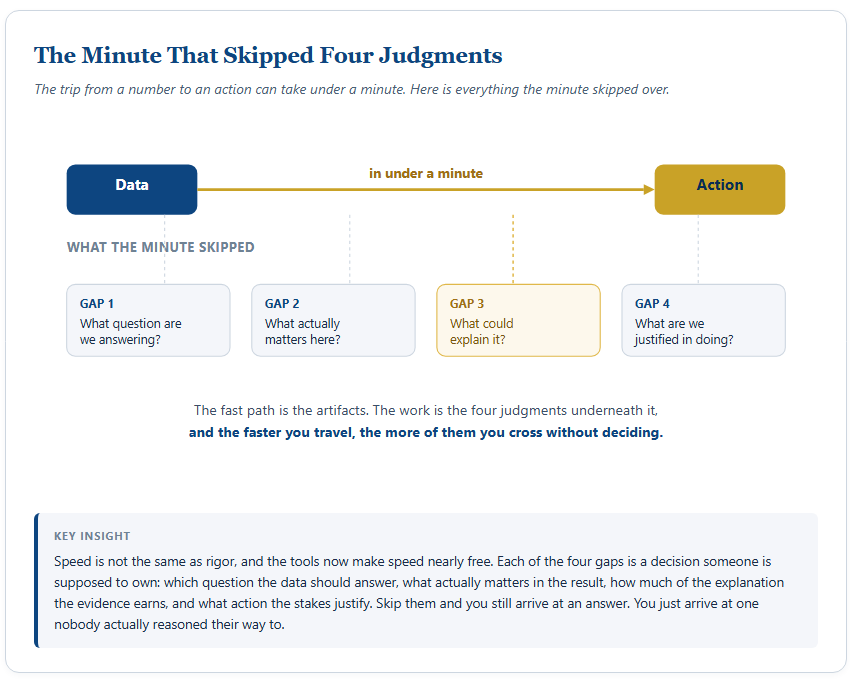
In just a few minutes, you have traveled from a number to an action. You might be right but that is not the problem. The problem is everything that happened along the way that looked obvious enough not to examine.
We pay attention to the outputs. The number, the pattern, the explanation, the recommendation. Each one is something we can see, point to, and put on a slide. But that is not where the hardest work happens. The work happens in the moves between them. Those moves are harder to see, which is exactly why they are so easy to skip.
The Ladder Everyone Knows
One of the oldest models in this field is the DIKW hierarchy: Data, Information, Knowledge, Wisdom. I use a version that adds Understanding as a step between knowledge and wisdom.
Data, then Information, then Knowledge, then Understanding, then Wisdom.
The distinctions are useful. Data is raw observation. Information organizes those observations so you can see what happened. Knowledge adds context and domain expertise so a pattern becomes meaningful. Understanding asks why the pattern might be occurring. Wisdom comes from applying that understanding, watching what happens, and carrying the lesson into the next decision.
Taught this way, it looks like a staircase. You start at the bottom with a pile of raw numbers and climb, step by step, toward something wise. Get the data, and the rest follows.
It does not follow. A dataset does not turn into information on its own. Information does not ripen into knowledge because time passed. A pattern does not become an explanation because it is statistically interesting, and an explanation does not become a justified action because it sounds plausible.
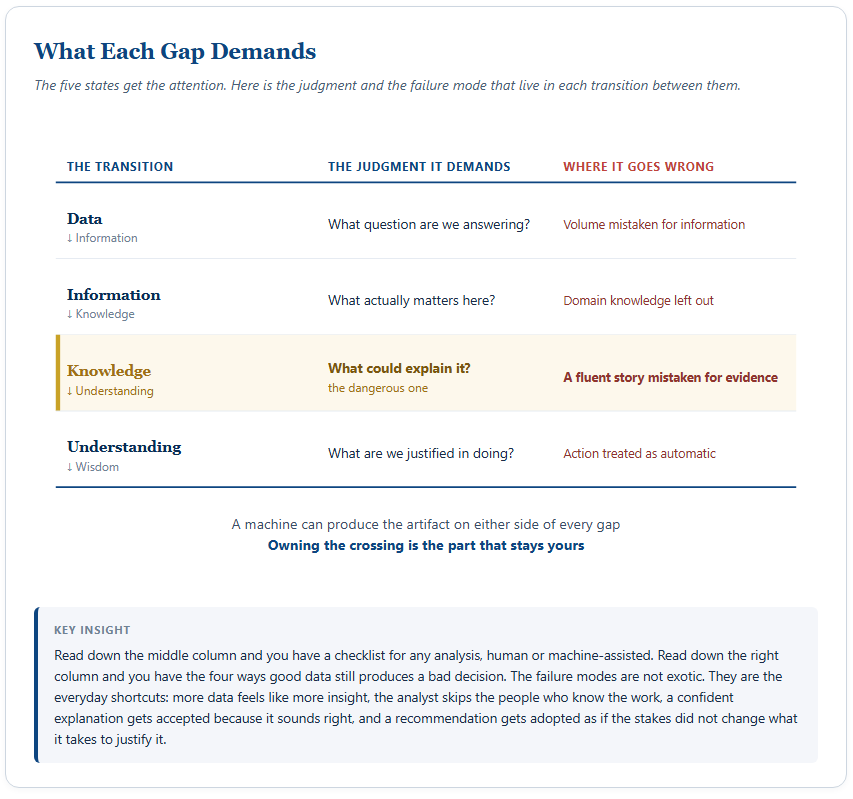
Every step up the ladder is a gap someone has to cross, and crossing it takes a judgment the ladder itself never shows you. The five states get all the attention. The four transitions between them are where the actual work lives, and where it usually goes wrong.
The trap is the ladder itself. It shows you the rungs and hides the climbing.
Every step up the ladder is a gap someone has to cross, and crossing it takes a judgment the ladder itself never shows you. The five states get all the attention. The four transitions between them are where the actual work lives, and where it usually goes wrong.
Gap One, Data to Information: What Question Are We Answering?
Organizations have no shortage of data. That is the easy part now, and getting easier. We collect more, store more, and connect more than ever, and AI lets us interrogate enormous datasets in plain language. But volume is not information. A warehouse full of records is just a larger pile of raw observation until someone points it at a question.
Stay with the turnover problem, because rising turnover never travels alone. Every departure means a backfill, and the backfills expose a neighboring problem: the same HR system shows offers being declined at a rate nobody has examined. So the investigation moves to the recruiting records: applications, interview dates, scheduling logs, offers, acceptances, declines. That is data. Now ask a question of it. Are we hiring in a way that lands the right people before we lose them to someone else? Suddenly the same records have a shape. You calculate offer acceptance rates. You measure the time from final interview to offer. You compare across job families and across quarters. The records became information the moment they were organized around something worth knowing.
Data does not become information because you gathered more of it. It becomes information when you aim it at a question. Technology can do enormous amounts of that organizing work. But someone still has to decide which question deserves an answer, and that decision is not in the data. It is the first thing you bring to it.
Gap Two, Information to Knowledge: What Actually Matters Here?
Say the analysis shows offer declines rose from 21% to 32%, while the average time from final interview to offer stretched from six days to eleven. You know more than you did. The harder question is what matters.
An analyst or an AI system can surface relationships all day. Declines cluster in roles with the longest interview-to-offer gaps. Panel debriefs account for most of the delay. Real patterns, all of them. But they live inside a world the dataset does not fully contain. A recruiter knows that candidates for certain roles routinely carry three competing offers. A hiring manager knows debriefs are nearly impossible to schedule during budget season. Someone close to the work knows that a two-week delay is normal in one job family and fatal in another.
That knowledge is not in the database. Processing the data produces information. Recognizing what matters takes domain knowledge, and domain knowledge is carried by the people who do the work. This is why data literacy cannot belong only to the analysts and the data team. The people who understand the work are not customers waiting for an answer to be handed to them. Their knowledge is part of what makes the information mean anything. The goal was never to turn everyone into a data scientist. It is to make the people who know the work better partners in reading the evidence.
Gap Three, Knowledge to Understanding: What Could Explain It?
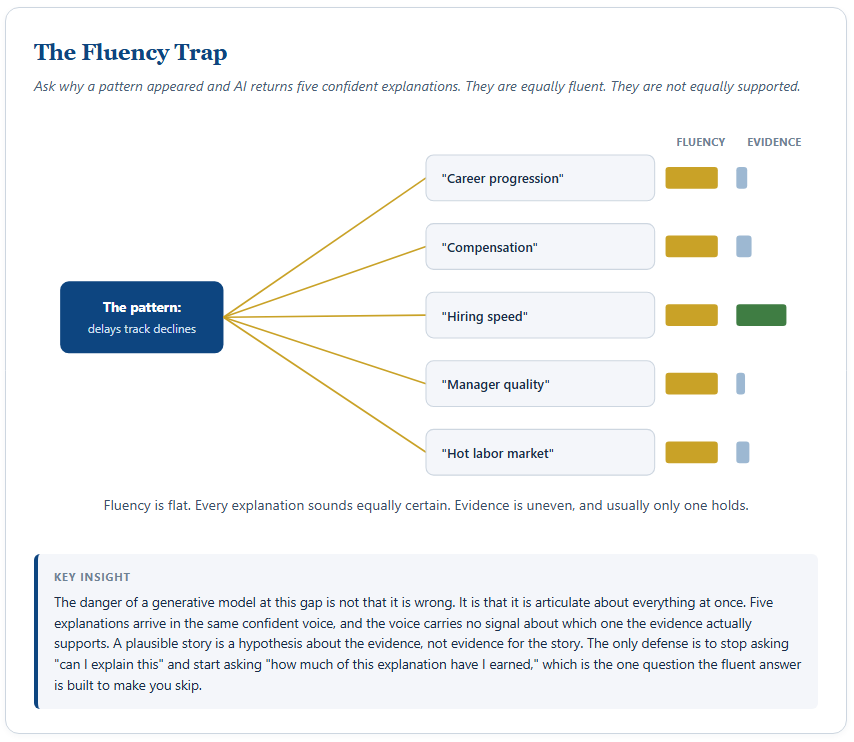
This is the dangerous one. You have found that longer hiring delays travel with higher decline rates. Why? Maybe candidates collect competing offers while they wait. Plausible. It is also a story you just added to the evidence, and the evidence did not come with it.
A pattern tells you what is happening. Understanding reaches for why, and the reach is where people fall. We have always been quick to see two things move together and build a bridge between them. Generative AI makes the bridge almost free. Ask why offer declines rose and a model will hand you five fluent explanations before you finish the question: career progression, compensation, hiring speed, manager quality, a hot labor market. The fluency is the trap. A smooth explanation feels like evidence. It is not. A plausible story is a hypothesis about the evidence, not evidence for the story.
So the question at this gap is not whether you can explain the pattern. You can always explain the pattern. The question is how much of the explanation you have actually earned. That is a different and far more uncomfortable question, and it is the one the fluent answer is designed to make you skip.
Gap Four, Understanding to Wisdom: What Are We Justified in Doing?
Suppose the explanation gets stronger. Candidate surveys mention the delays. Declines run highest where cycles run longest. The hardest-to-fill roles show the tightest relationship. Recruiters report candidates signing elsewhere while panels are still trying to book a debrief. You now hold a well-supported understanding. So what should you do?
It is tempting to think the action falls out of the evidence automatically. It does not. The same evidence justifies different actions under different stakes. A small, reversible pilot might deserve action on moderate confidence. A costly, organization-wide overhaul demands far more, because the cost of being wrong is higher and harder to undo. Reversibility matters. So does cost, and so does who absorbs the risk. A recommendation is not the last output of an analysis. It is another judgment, made under uncertainty, and it should be sized to what you can afford to get wrong.
Even acting does not make you wise. The move from understanding to wisdom is not a single jump. Action is the experiment in between. Say you pilot pre-scheduled debriefs and a five-day decision window. Offer time drops. Acceptance climbs, most in the roles where scheduling had been worst. Now you have learned something. The action did not just produce a result. It produced new evidence about whether your understanding was right. Wisdom is applying what you understood, watching what actually happened, and carrying that forward. Which means wisdom is not the top of the ladder at all. It is the bottom of the next one.
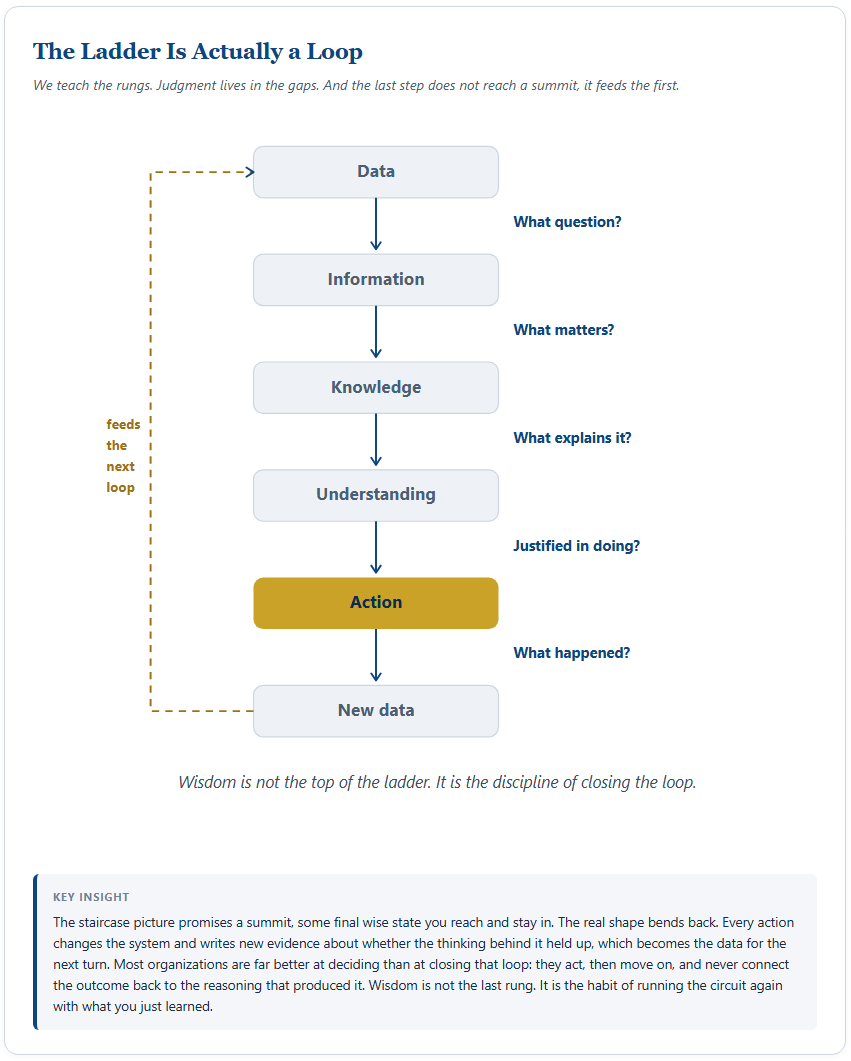
The Ladder Is Actually a Loop
Every action writes new data, which is exactly what the pilot just demonstrated. And it is not a special property of pilots. Organizations decide constantly. They launch programs, rewrite policies, deploy tools, reorganize teams, add controls, remove controls. Every one of those actions changes the system, which means every one of them writes new evidence about whether the thinking behind it held up.
Almost nobody reads it. A program launches and attention moves to the next thing. A policy changes and no one returns six months later to check whether its assumptions were true. A model recommends, someone acts, and the outcome is never connected back to the reasoning that produced it. The loop stays open, and an open loop is where learning goes to die. Every action creates new evidence. The only question that matters is whether anyone goes back to look at it, because that is where wisdom actually starts.
Which is why the staircase was always the wrong picture. Draw the real shape and it bends back on itself:
Data → Information → Knowledge → Understanding → Action → New Data → (Data again)
The last step is not a summit. It feeds the first. What most people were taught as a ladder toward some final wise state is really a loop, and wisdom is not the top of it. Wisdom is the discipline of closing it: connecting what you believed, what you did, what happened, and what you now believe, and running the circuit again.
AI Changed the Rungs, Not the Gaps
For a long time, the division of labor was pretty clear. Technology did the work at the bottom of the ladder. That included things like collecting the data, organizing it, and helping us find patterns. Humans took over from there. We brought the context, worked out what the patterns meant, and decided what to do.
AI has made that distinction much harder to maintain. It can work across the entire ladder now. For example, AI can help frame the question, find the pattern, offer an explanation, recommend an action, and evaluate what happened afterward. The question is no longer where the machine stops and the human starts.
What still matters is who owns the judgment between those steps. AI might find a pattern, but someone has to decide whether that pattern matters in this situation. It might offer a convincing explanation, but someone has to ask how much of that explanation the evidence actually supports. And when it recommends an action, someone still has to decide whether the confidence is high enough, the consequences acceptable enough, and the decision reversible enough to act.
That is the part we cannot lose as AI gets better. The machine can help us make every move along the ladder. But making the move and being justified in making it are not the same thing. The judgment still has to belong somewhere.
The Skill Is Seeing the Move
We have mostly taught data literacy around the things we can see. Things like reading a chart, understanding the metric used, interpreting the analysis, or asking a better question. Those skills definitely still matter, but AI is getting very good at producing the things we have spent years teaching people to work with. What becomes more important is recognizing when the nature of the claim has changed.
A pattern is not an explanation. An explanation still has to be tested. And even a well-supported explanation does not automatically tell you what to do. Something changes at each of those moves, and that change requires judgment. What evidence supports it? What assumptions did we add? What do people close to the work know that the data does not? What would we have to believe before we were willing to act?
Go back to the example that opened this article. Turnover rises. AI helps surface the tenure pattern. Career progression seems like a plausible explanation, and suddenly an investment in internal mobility starts to make sense. Now imagine someone who knows to look for the moves along the way. She asks what question the analysis was actually answering. She brings in someone who understands the hiring process to see whether the pattern means what it appears to mean. She treats career progression as an explanation to test rather than a conclusion to accept. And before recommending a mobility program, she asks what it would cost if that explanation turned out to be wrong.
Nothing about that requires rejecting the AI output or slowing every decision to a crawl. The same tools can still get you from the number to a possible action remarkably fast. The difference is that the judgments along the way are no longer happening unnoticed. Someone is examining them, deciding what the evidence actually supports, and taking responsibility for the move.
That is the skill AI makes more important, not less. A machine can help you reach the next answer faster than ever. You still have to decide whether you have earned the right to believe it.
Kevin is an author, speaker, and thought leader on topics including data literacy, data-informed decisions, business strategy, and essential skills for today. https://www.linkedin.com/in/kevinhanegan/
AI did not end the data literacy crisis. It changed it. As machines move from providing information to interpreting it and recommending what to do, the scarce skill is becoming judgment: knowing what to trust, what to question, and what decisions are still ours to make.
Evidence does not make decisions. People interpret it, weigh it, challenge it, and make judgments. A courtroom reveals what leaders can learn about evidence, expertise, confidence, and data-informed decision-making.
Feeling sure doesn't mean you're right. Learn five simple ways to question what feels true, spot what might be influencing you, and make better decisions about what to believe.
Every organization keeps one scoreboard for mistakes and none for missed opportunities. So people optimize the one they can see, and the largest losses never appear as losses at all. They appear as things no one tried.