Organizations demand evidence before making a change, but rarely apply the same scrutiny to doing nothing. What if our efforts to reduce risk are actually limiting innovation? Explore the hidden costs of inaction and why better decisions require evaluating the status quo, too.
Data quality is a property of the data. Evidence fitness is a relationship between the data, the question, and the cost of being wrong. Stewardship has mastered the first. As AI systems move from displaying data to recommending action, organizations need the second.
AI did not end the data literacy crisis. It changed it. As machines move from providing information to interpreting it and recommending what to do, the scarce skill is becoming judgment: knowing what to trust, what to question, and what decisions are still ours to make.
Organizations demand evidence before making a change, but rarely apply the same scrutiny to doing nothing. What if our efforts to reduce risk are actually limiting innovation? Explore the hidden costs of inaction and why better decisions require evaluating the status quo, too.
The more evidence we demand before changing something, the more willing we become to accept the risks of never changing it.
TL;DRWhy doing nothing escapes the scrutiny every proposal has to face
What you need to know
Most organizations demand evidence before they change anything, then accept the status quo without a single question. The imbalance is built into how people perceive risk and into how organizations approve work. New ideas need a business case. Existing practice rolls forward on last year's budget. Innovation gets hit hardest, because leaders often ask for evidence that only trying the idea could produce. I call the fix decision symmetry: proportionate scrutiny for every meaningful option, including standing still.
Why this matters to you
If you lead, you have probably shelved a promising proposal for lack of evidence without asking what waiting would cost. If you pitch ideas, you have probably watched one die under questions the current approach never had to answer. The costs of inaction arrive slowly and spread out, so they rarely get traced back to the decision that caused them. Over time, an organization that believes it is managing risk carefully quietly filters out its best opportunities.
Who this applies to
Executives and approval committees who decide which proposals move forward. Managers and innovation leads pitching new ideas into a cautious process. Analysts asked to justify a change with data that cannot exist yet. Anyone responsible for a budget, a portfolio, or a strategy where "not now" is the easiest answer to give.
What you'll gain from reading
Four decision symmetry questions that put the status quo on the same footing as change. A way out of the yes-or-no trap, using small, reversible experiments to create the evidence a larger decision needs. A simple rule for matching the evidence you require to the size and reversibility of the action in front of you. And one question to ask the next time a proposal is rejected for lack of evidence. Members can also work through a real proposal with the online Decision Symmetry worksheet.
The Proposal That Had to Prove Everything
A team at a financial institution proposes a new digital service to improve the customer experience. The idea has promise. Early customer feedback is encouraging, competitors are introducing similar capabilities, and the team believes the service could reduce friction while opening new ways to engage.
Leadership is interested. Before approving the investment, they want evidence. How many customers will use it? What will implementation cost? How long until it pays for itself? What happens if adoption falls short? What are the operational and compliance risks?
The team builds projections, estimates costs, evaluates alternatives, and presents its findings. Some assumptions rest on data. Others remain uncertain because the service doesn’t exist yet. Leadership decides there isn’t enough evidence to move forward. The project is shelved.
No one prepares a business case for continuing with the existing service. No one estimates the cost of customers who leave for competitors with better experiences. No one calculates the value of the learning the organization forgoes by not testing the idea.
The proposal had to prove itself, but the decision to do nothing did not.
I've seen variations of this in organizations where the process for approving a new initiative is incredibly rigorous, but the decision to continue investing in an existing approach receives much less scrutiny. Both decisions can have significant consequences, yet only one gets treated as something that needs defending. We demand evidence before changing something while often accepting the existing situation without comparable scrutiny. And that raises an uncomfortable question: What if some of our efforts to improve decision-making are actually making us less innovative?
The Unequal Burden of Proof
Organizations have good reasons to demand evidence. Resources are limited. Investments carry risk. Failed initiatives waste money, disrupt operations, and damage trust. Data-informed decision-making helps organizations evaluate those risks instead of relying on intuition, enthusiasm, or a persuasive slide deck.
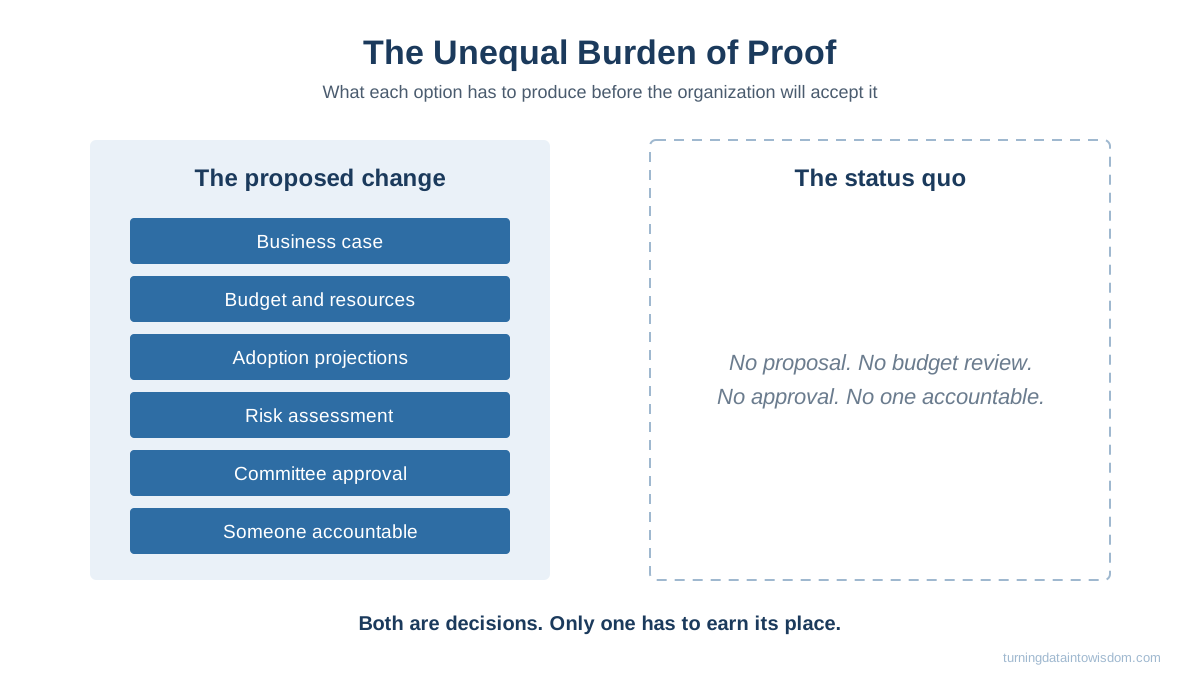
But look at how that rigor gets applied. A proposed change has a visible cost. It needs a budget, resources, an implementation plan, and someone willing to be accountable for the outcome. Its potential consequences are documented and debated.
Maintaining the status quo requires none of that. We rarely ask someone to prepare a formal justification for continuing with an existing approach, much less quantify the benefits of waiting or examine the assumptions behind that choice. Yet maintaining the status quo is still a choice. It commits the organization to a course of action, even if that action is continuing existing practice. And like any other choice, it has consequences.
The existing service may keep satisfying customers. The proposed technology may prove unnecessary. Waiting may preserve resources for a better opportunity. Or customer expectations may shift. Competitors may build capabilities the organization lacks. Employees may keep working around inefficient processes. The organization may lose chances to learn.
I'm not arguing that organizations should always choose change. Sometimes staying with the current approach is the better decision. But we should be willing to evaluate that decision with the same seriousness we apply to a proposed change. When we fail to make that distinction, change must demonstrate why it is worthwhile while inaction is presumed acceptable until someone proves otherwise.
There is a further twist. Leadership in our example asked for evidence of adoption. The team could offer research, comparisons, market trends, and estimates. It could not offer evidence of actual adoption, because the service had never been offered. The organization demanded evidence that could only be generated through the very action it was unwilling to take.
Why the Imbalance Persists
Some of the biggest risks organizations take are the ones they never recognize as decisions.
Part of the explanation lies in how people perceive risk. Decades of behavioral research show that our judgments are not symmetrical. Kahneman and Tversky documented loss aversion, our tendency to weigh potential losses more heavily than comparable gains. Samuelson and Zeckhauser described status quo bias, the pull of existing arrangements simply because they are familiar. Ritov and Baron studied omission bias, the tendency to judge harm caused by action more harshly than comparable harm caused by inaction. None of this means people cannot reason well. It helps explain why some alternatives receive more scrutiny than others.
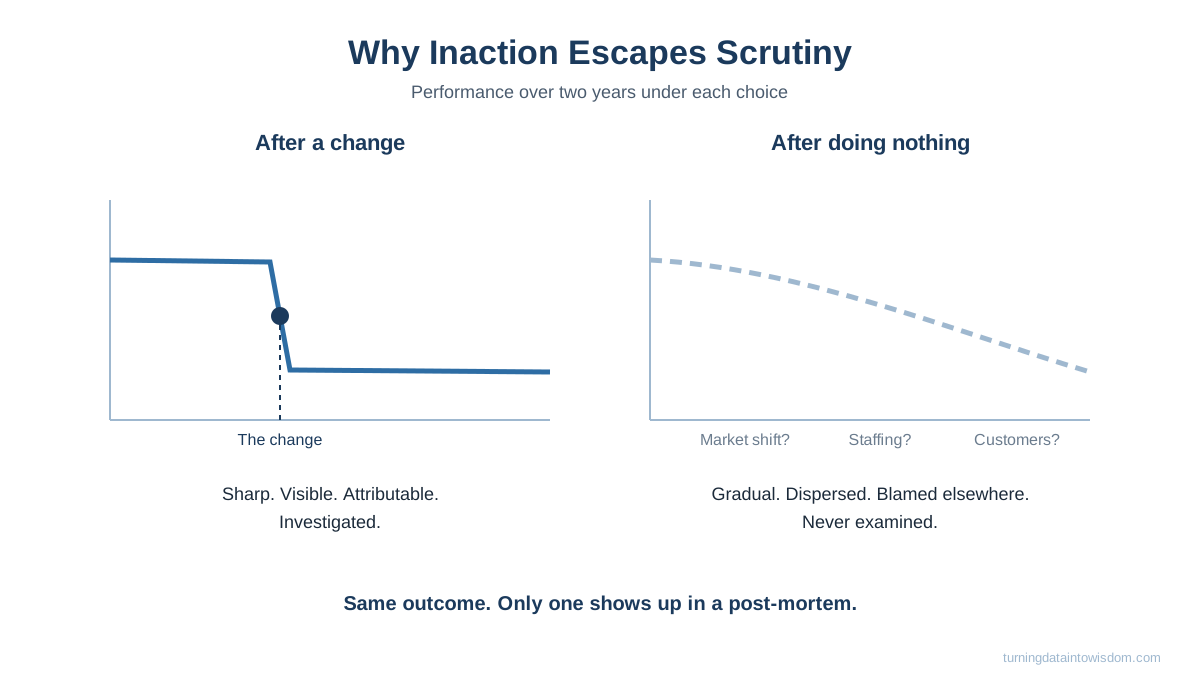
Take a manager deciding whether to introduce a new process. If they implement the change and performance declines, the connection is obvious. They made a change and something went wrong. But suppose they change nothing and performance erodes over the next two years. The decline gets attributed to market conditions, customer expectations, staffing, or some other external factor. The decision not to change is never examined. When a change fails, we can usually identify who approved it and what went wrong. When performance deteriorates because we didn't change something, it's much harder to connect that outcome to a specific decision.
What interests me is how this becomes embedded in the way organizations operate. We can spend considerable effort improving how proposals are evaluated, without ever questioning whether the evaluation process itself favors certain outcomes. The process appears objective because it's consistent, but consistency doesn't necessarily mean we're evaluating all the relevant choices.
Over time, avoiding a visible mistake feels safer than pursuing an uncertain opportunity, even when the opportunity is worth the risk. An organization can have rigorous risk management processes and still overlook the risks associated with decisions it never seriously considered.
When Evidence Becomes a Barrier
Organizations increasingly emphasize evidence-based decision-making, and rightly so. Evidence challenges assumptions, reveals patterns, improves forecasts, and helps us compare alternatives. But evidence becomes a barrier when we misunderstand what it is for.
When organizations improve an existing process, they can draw on substantial history. They know how the process performs and can estimate the effect of incremental change. Genuinely new ideas involve conditions that have never been observed. Historical data offers clues, but it cannot describe a future that has never existed.
If leadership reads data-informed decision-making as requiring strong evidence of success before acting, new ideas never move forward. One of the misconceptions I often challenge when teaching data-informed decision-making is that more evidence always means a better decision. Evidence matters enormously, but we have to be clear about what we're trying to decide. The evidence needed to justify a full investment isn't necessarily the evidence needed to justify an experiment.
Evidence serves different purposes at different moments. Evidence can help us compare established alternatives or identify promising opportunities. But when we're dealing with something genuinely new, we may need to generate evidence rather than expect it to already exist. We can make the mistake of interpreting uncertainty as a reason to reject an opportunity, when what we should be asking is whether there are reasonable ways to reduce or manage that uncertainty.
The Third Option Between Yes and No
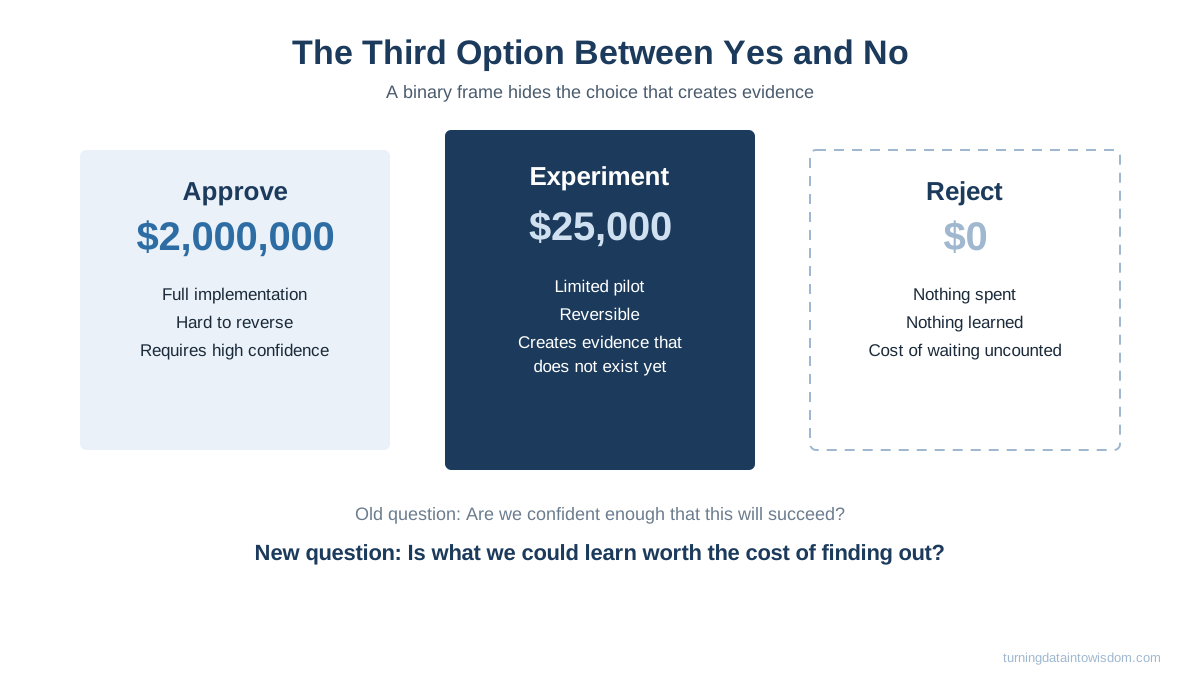
Many organizational decisions get framed as binary. Approve the investment or reject it. Implement the new technology or keep the existing system. Launch the service or abandon the idea. Those are often false constraints. There is usually a third option: experiment.
Suppose the proposed digital service needs $2 million for full implementation and leadership is unsure about adoption and return. Instead of approving or rejecting the whole investment, the organization could run a limited pilot. A $25,000 experiment might test customer interest, surface usability problems, and provide early evidence about adoption.
The pilot would not resolve every uncertainty. It might not predict performance at scale. It could introduce its own biases and operational complications. But it would generate information that currently does not exist.
The organization would be answering a different question. Instead of “Are we confident enough that this service will succeed?” the question becomes “Is what we could learn worth the cost and risk of this experiment?” The first question treats uncertainty as an obstacle and the second treats reducing uncertainty as a worthwhile objective in itself.
Not every idea deserves a pilot. Some experiments are too expensive, too risky, or incapable of producing meaningful evidence. But when an experiment is relatively cheap, reversible, and capable of informing a consequential future decision, it can be justified even when confidence in the ultimate idea remains low. In those situations, it may make more sense to invest in learning than to commit to the full initiative or reject it outright.
This is why I see data-informed decision-making and innovation as complementary rather than competing. A good decision process should do more than check whether a proposal clears an evidence threshold. It should help us find ways to learn, adapt, and create new possibilities.
Evidence should determine the size of our next commitment, not simply whether an idea lives or dies.
Toward Decision Symmetry
Organizations need a more balanced way of evaluating alternatives. I call it decision symmetry: applying appropriate scrutiny to every meaningful alternative, including the status quo.
Decision symmetry means putting the status quo on trial, not just the proposal to change it.
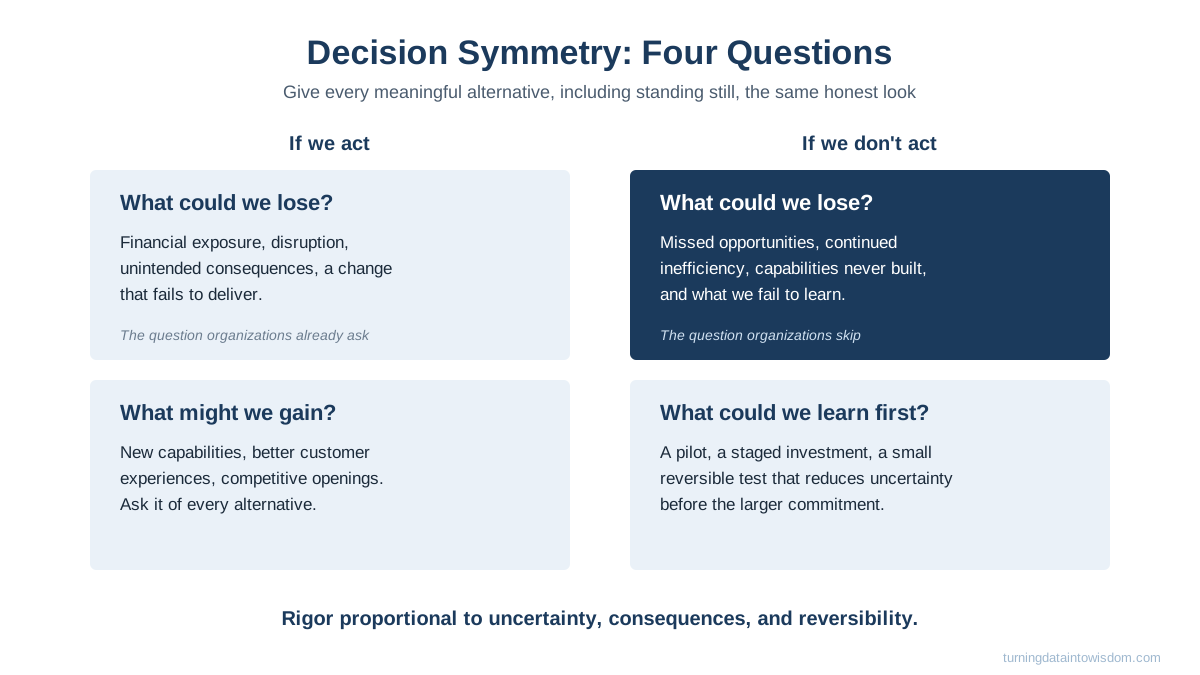
Appropriate does not mean identical. A $2 million investment should not get the same scrutiny as a $25,000 pilot. A reversible operational adjustment should not need the same evidence as an irreversible strategic commitment. Rigor should be proportional to uncertainty, consequences, and reversibility. But every meaningful alternative should be treated as a choice with its own benefits, costs, and risks.
Below are four questions that can help.
What could we lose if we act? This is the question organizations already ask. Financial exposure, operational disruption, unintended consequences, and the possibility that the change fails to deliver.
What could we lose if we don’t act? This examines the cost of the current approach: missed opportunities, continued inefficiency, delayed capability development, and the consequences of external conditions changing while we stand still. And perhaps most importantly, what we fail to learn.
What might we gain from each alternative? This moves the discussion beyond avoiding harm to new capabilities, better experiences, and competitive openings.
What could we learn before making a larger commitment? This introduces experimentation, staged investment, and other ways to reduce uncertainty without committing to the full course of action.
I like these questions because they force us to examine assumptions that often go unchallenged. We're usually quite good at asking what could go wrong if we make a change. We're less disciplined about examining what we're accepting when we choose not to change, or whether a smaller commitment could help us make a better decision.
The second question is the hardest, because it concerns futures that may never be observed. We can measure the cost of a failed pilot. Measuring the value of an opportunity never explored is much harder. Difficulty measuring something does not make it unimportant, it makes human judgment essential. Data can estimate outcomes, experience can inform assumptions, scenario analysis can illuminate possibilities, and uncertainty still remains.
This also changes how we think about confidence. We often say the confidence we require should reflect the consequences of being wrong. That is right but incomplete if we count only the consequences of acting. The consequences of waiting matter too. A large, irreversible investment may require substantial evidence. A small, reversible experiment may be appropriate with far less. The required evidence should reflect the nature of the action, the cost of being wrong, the cost of waiting, and the opportunity to learn. The question is whether we have enough confidence for the particular action in front of us.
Together, these four questions keep the decision process from becoming an exercise in finding reasons not to change. They also guard against the opposite failure: chasing innovation because it is new and exciting. The aim is appropriate consideration of both action and inaction.
What We Never Count
Organizations have become sophisticated at measuring performance. We track revenue, costs, productivity, satisfaction, and countless other indicators. We build dashboards to monitor results and models to predict outcomes. We create governance to ensure decisions rest on reliable evidence.
Yet an entire category of performance stays invisible. We rarely account for opportunities we passed over, experiments we decided against, or capabilities we could have developed. In some cases, we rejected an idea simply because we couldn't demonstrate its value without first trying it.
Not every missed opportunity would have succeeded. Many would have failed, and some were wisely avoided. The problem is that we rarely examine these decisions with the discipline we apply to initiatives that moved forward. A failed project leaves evidence behind: a budget, a timeline, a set of decisions, measurable outcomes. An opportunity never explored leaves almost nothing. Because the consequences are hard to see, the organization never learns what its decision process is systematically excluding.
So the question for leaders is whether our decision processes exist only to protect us from mistakes, or also to help us recognize opportunities worth pursuing. Those goals are compatible. A mature approach to data-informed decision-making should tell us when the evidence is too weak to justify a consequential action, and when the value of learning or acting justifies accepting some uncertainty. It should challenge unjustified optimism without automatically favoring caution. And it should treat the status quo as a choice that deserves examination rather than a neutral position outside the process.
Making a good decision doesn't mean eliminating uncertainty. It means understanding the alternatives, considering the consequences, and deciding what level of uncertainty we're willing to accept. That might mean proceeding, stopping, or waiting until conditions change. In other cases, the right decision is to try something small, learn from it, and use that evidence to determine what comes next.
Put the status quo on trial
Before your team votes on the next proposal, ask all four decision symmetry questions in the room. Write down the answer to “What could we lose if we don’t act?” and keep it with the decision record. If the proposal is rejected, revisit that answer in six months and ask whether the cost of waiting has started to show.
To make that easier, members can use the Decision Symmetry worksheet online. Work through a real proposal step by step, then use the scrutiny check to see what you asked of the change that you never asked of standing still. Save your decisions and come back to them at the revisit date, or copy a one-page readout to attach to the proposal.
If you want help building this into your decision process, or want to pressure-test how your organization treats evidence, contact us.
Kevin is an author, speaker, and thought leader on topics including data literacy, data-informed decisions, business strategy, and essential skills for today. https://www.linkedin.com/in/kevinhanegan/
Evidence does not make decisions. People interpret it, weigh it, challenge it, and make judgments. A courtroom reveals what leaders can learn about evidence, expertise, confidence, and data-informed decision-making.
Feeling sure doesn't mean you're right. Learn five simple ways to question what feels true, spot what might be influencing you, and make better decisions about what to believe.
We teach data literacy as a ladder: data at the bottom, wisdom at the top, climb step by step. But the rungs are not where the work happens. The judgment lives in the gaps between them, and that is exactly where AI now carries us straight past.
Every organization keeps one scoreboard for mistakes and none for missed opportunities. So people optimize the one they can see, and the largest losses never appear as losses at all. They appear as things no one tried.