AI did not end the data literacy crisis. It changed it. As machines move from providing information to interpreting it and recommending what to do, the scarce skill is becoming judgment: knowing what to trust, what to question, and what decisions are still ours to make.
Evidence does not make decisions. People interpret it, weigh it, challenge it, and make judgments. A courtroom reveals what leaders can learn about evidence, expertise, confidence, and data-informed decision-making.
Feeling sure doesn't mean you're right. Learn five simple ways to question what feels true, spot what might be influencing you, and make better decisions about what to believe.
AI made speed cheap. Wisdom is the new scarce resource.
High-Level Summary and Key Takeaways
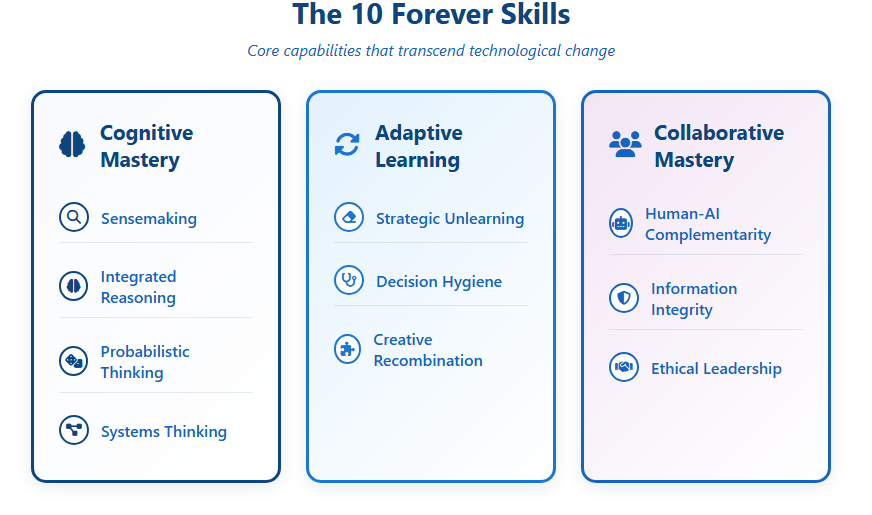
Every tech wave promises human replacement. Each time, the real shift is what human intelligence creates value. AI now makes routine work fast, which raises the premium on judgment, context, and collaboration. The 10 Forever Skills are your durable edge. They help you make sense of messy signals, reason across methods, think in probabilities, see systems, unlearn what no longer fits, practice decision hygiene, remix ideas, partner well with AI, protect information integrity, and lead people ethically toward shared goals. The tools will keep changing. These skills compound.
Key Takeaways
Tools change. Forever Skills endure and grow in value
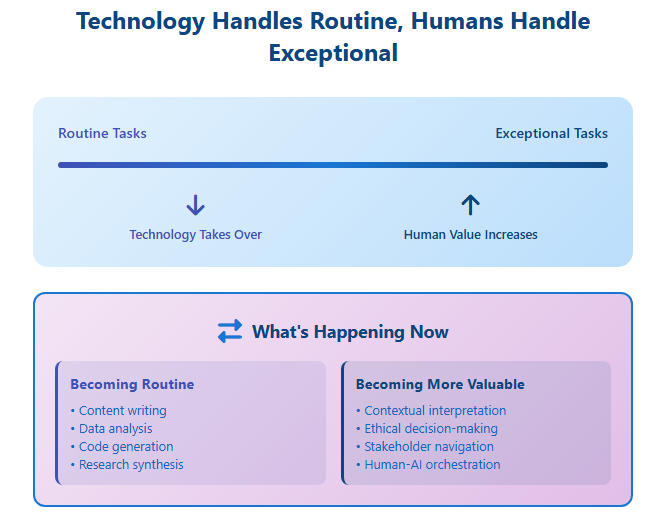
Technology handles routine. Humans handle the exceptional. The line keeps moving
Think in ranges and likelihoods. Update as evidence changes
Unlearn legacy methods that no longer fit. Practice decision hygiene
Combine ideas from other domains to create useful novelty
Collaborate with AI with intent. Validate sources and lead with ethics
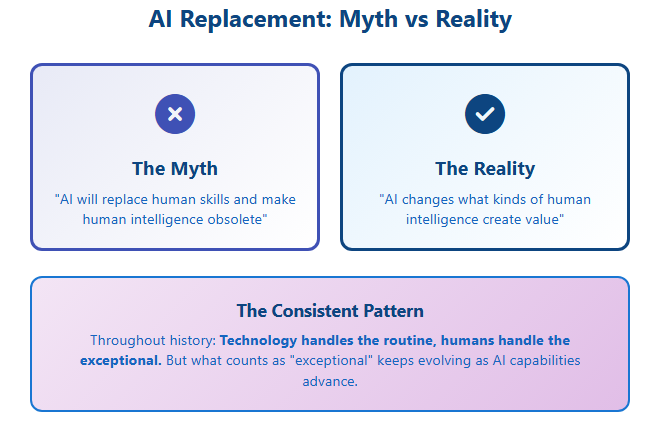
Every generation believes the next technological revolution will make human skills obsolete. They're always wrong but not for the reasons they think.
The printing press didn't eliminate the need for critical thinking; it made discernment more crucial than ever. Steam engines didn't replace human judgment; they amplified the consequences of poor decisions. Computers didn't make analysis unnecessary; they made the ability to ask the right questions exponentially more valuable.
Now, as artificial intelligence masters discrete tasks at superhuman speed, leaders are asking the inevitable question: "What human capabilities will still matter?"
The answer isn't what most expect.
The Myth of Replacement
Here's what the headlines get wrong: AI isn't replacing human intelligence, it's changing what kinds of human intelligence create value.
When chess computers defeated grandmasters, chess didn't die. Instead, the most successful players became those who could collaborate with AI to explore possibilities no human or machine could discover alone. When algorithmic trading transformed finance, the most valuable analysts weren't those who could calculate faster, but those who could interpret what the calculations meant in context.
The pattern is consistent: Technology handles the routine, humans handle the exceptional.
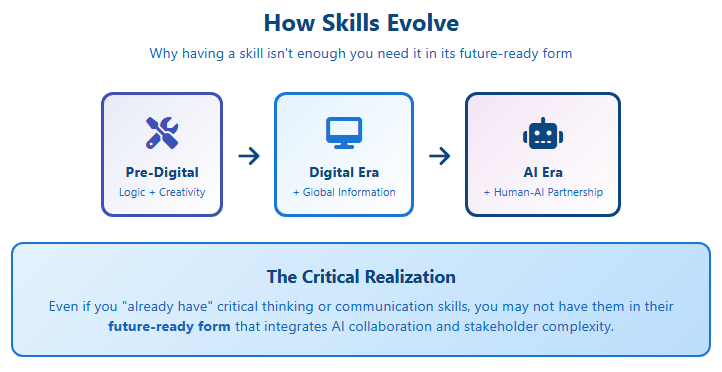
But here's the catch. What counts as "exceptional" keeps evolving. The skills that made you irreplaceable five years ago might make you obsolete today if you haven't adapted them to new realities.
Introducing the Forever Skills
After studying what separates adaptable professionals from those left behind across multiple technological revolutions, we've identified 10 core capabilities that transcend any specific tool or trend. These aren't just "nice to have" additions to your skill set, they're the cognitive and collaborative foundations that determine whether you thrive or merely survive the next 50 years of change.
We call them Forever Skills because they've created advantage in every era of human progress, and they're becoming more valuable, not less, as artificial intelligence handles routine cognitive work.
Category 1: Cognitive Mastery in Complexity
Skills for navigating ambiguity, uncertainty, and information overload
This content is for free members
Create a free account to get full access. No payment required.
AI did not end the data literacy crisis. It changed it. As machines move from providing information to interpreting it and recommending what to do, the scarce skill is becoming judgment: knowing what to trust, what to question, and what decisions are still ours to make.
Evidence does not make decisions. People interpret it, weigh it, challenge it, and make judgments. A courtroom reveals what leaders can learn about evidence, expertise, confidence, and data-informed decision-making.
Feeling sure doesn't mean you're right. Learn five simple ways to question what feels true, spot what might be influencing you, and make better decisions about what to believe.
We teach data literacy as a ladder: data at the bottom, wisdom at the top, climb step by step. But the rungs are not where the work happens. The judgment lives in the gaps between them, and that is exactly where AI now carries us straight past.