AI did not end the data literacy crisis. It changed it. As machines move from providing information to interpreting it and recommending what to do, the scarce skill is becoming judgment: knowing what to trust, what to question, and what decisions are still ours to make.
Evidence does not make decisions. People interpret it, weigh it, challenge it, and make judgments. A courtroom reveals what leaders can learn about evidence, expertise, confidence, and data-informed decision-making.
Feeling sure doesn't mean you're right. Learn five simple ways to question what feels true, spot what might be influencing you, and make better decisions about what to believe.
70% of AI Projects Fail, But Not for the Reason You Think
85% of AI failures are strategic, not technical. Bad data, not bad algorithms, kills AI projects. While companies chase better models, the real problem is fragmented, biased data. Learn why data strategy makes or breaks AI initiatives.
AI doesn't fail in the model. It fails in the data. And most companies are solving the wrong problem.
High-Level Summary
The Problem Most executives are playing the wrong game. They're optimizing algorithms instead of fixing their data foundations.
The Problem: Companies treat AI failure as a technical complexity issue
The Reality: AI doesn't fail in the model. It fails in the data
The Solution: Shift from model-centric to data-centric thinking
What's Actually Happening Stop asking 'How can we build better AI models?' Start asking 'Why is our data destroying every AI initiative?'
Data Quality Crisis: Between 70% and 85% of AI failures stem from poor data foundations, not algorithmic shortcomings
Architecture Mismatch: Legacy data warehouses can't support real-time AI demands
Governance Gaps: Fragmented, ungoverned data creates untrustworthy AI outputs
Bias Amplification: Historical data inequities get perpetuated at AI scale
Key Insights The biggest myth in AI is that sophisticated models can compensate for bad data.
$4 Billion Lesson: IBM Watson failed because it trained on hypothetical scenarios, not real-world patient data
16% Performance Gap: Data-centric improvements outperform algorithmic tweaks in manufacturing
Pattern-Finding Reality: AI models are only as good as the patterns in your training data
What You Should Be Asking Instead Your data strategy isn't supporting your AI strategy, your data strategy IS your AI strategy.
Stop Asking
"What's the best AI model for this problem?"
"Do we have enough data scientists?"
"Which AI platform should we buy?"
Start Asking
"Can our data teams access information in real-time?"
"Does our training data reflect our actual customer base?"
"Are our data sources unified or scattered across departments?"
Your Next Steps
Audit your data architecture—identify fragmentation and access bottlenecks
Establish data governance frameworks that enable (not restrict) AI initiatives
Implement real-time data pipelines to replace static, batch-processing systems
Treat data as a strategic product, not an operational byproduct
Bottom Line Organizations that fix their data strategy first position themselves for AI success. Those that keep chasing better algorithms will join the 70-85% failure statistics. The choice is yours: become data-centric now, or watch your AI investments become expensive lessons in what not to do.
Why Data Strategy, Not Algorithms, Determines AI Success
Artificial intelligence promises to revolutionize business. From predictive insights to automation, AI is projected to generate trillions in economic value over the next decade. Yet behind the hype, a harsher reality exists: most AI initiatives fail.
According to industry research, 70% to 85% of AI and machine learning (ML) projects never deliver meaningful results. Prototypes stall. Models underperform. Business leaders lose confidence. While many assume these failures stem from complex algorithms or a lack of technical expertise, the real culprit is far simpler and far more fundamental.
AI fails because of your data.
In this article, we'll challenge common assumptions about why AI projects underdeliver, reveal the hidden data problem behind most failures, and explain why leading organizations are shifting from model-centric thinking to data-centric strategies.
The Myth: AI Fails Because It's Too Complex
When AI initiatives struggle, executives often blame technical complexity:
Models are too difficult to build.
Data scientists lack specialized skills.
The technology isn't ready.
These explanations are comfortable. They place AI failures in the realm of technical teams and experimental innovation. However, they miss the deeper problem facing most organizations.
The truth: AI doesn't fail in the model. It fails in the data.
AI is like hiring the world's most talented magician for your corporate event, but handing them a box of broken props, mixed-up instruction cards, and stage equipment from five different magic shows. No matter how skilled the magician, the performance will be a disaster,not because magic isn't real, but because you gave them the wrong foundation to work with. This is exactly what's happening with AI in most organizations today.
The Reality: Poor Data Foundations Doom AI
AI models are not magic. They are pattern-finding engines trained on historical data. If that data is incomplete, inconsistent, biased, siloed, or simply missing, the models will fail to generalize and deliver useful outcomes.
Research from Gartner, Deloitte, and McKinsey consistently shows that 70% or more of AI project failures are linked directly to data problems, not algorithmic shortcomings. These include:
Poor data quality and missing governance. Inconsistent formats, missing values, and duplicate entries derail model training and lead to unreliable predictions.
Fragmented or inaccessible data. Information spread across departments without unified architecture impedes access and consistency.
Bias in training data leading to unfair or unreliable outcomes. Historical data often reflects past inequities, which AI systems then perpetuate at scale.
Overreliance on static data warehouses unsuited for AI demands. Legacy architectures built for batch processing cannot support the real-time, diverse data flows that modern AI requires.
So what we are really saying is that sophisticated models cannot compensate for flawed, fragmented, or biased data.
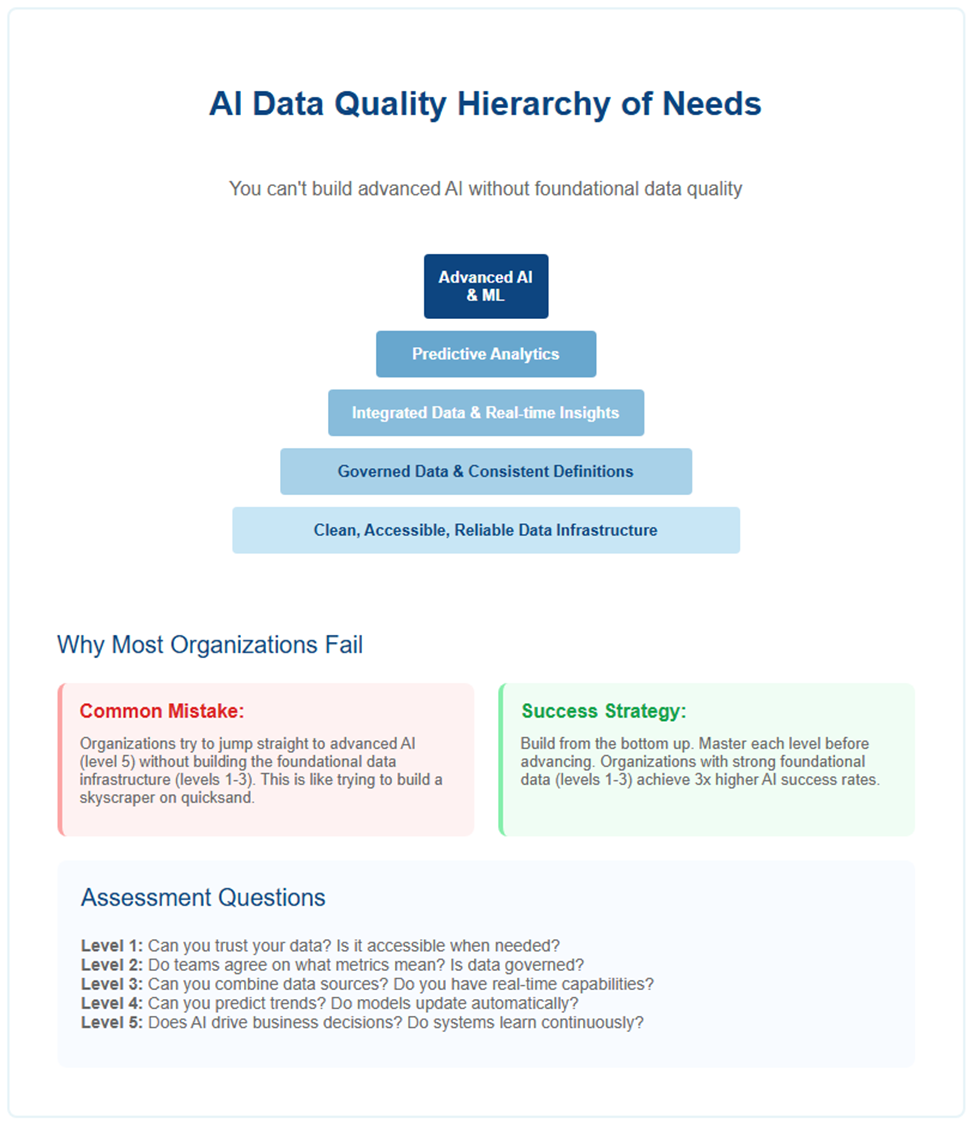
Why AI projects fail. Organizations jump to advanced AI (top) without building the data foundation (bottom).
Case Study: When Bad Data Destroys Billion-Dollar AI
Take IBM Watson for Oncology, a $4 billion investment that failed to deliver safe treatment recommendations. The issue wasn't the AI model's sophistication, but the training data: Watson was built on hypothetical patient scenarios and narrow clinical guidelines, not diverse, real-world patient data.
When deployed globally, it recommended unsafe treatments because its data foundation couldn't generalize across different populations and medical practices. Doctors reported that Watson frequently suggested irrelevant or dangerous therapies. The entire initiative was eventually scaled back, not because the algorithms were flawed, but because the underlying data was insufficient and unrepresentative.
Watson's failure underscores a fundamental truth: AI's success is constrained not by model sophistication, but rather the quality and representativeness of its underlying data.
Sophisticated models cannot compensate for bad data. This is the $4 billion lesson every executive needs to understand.
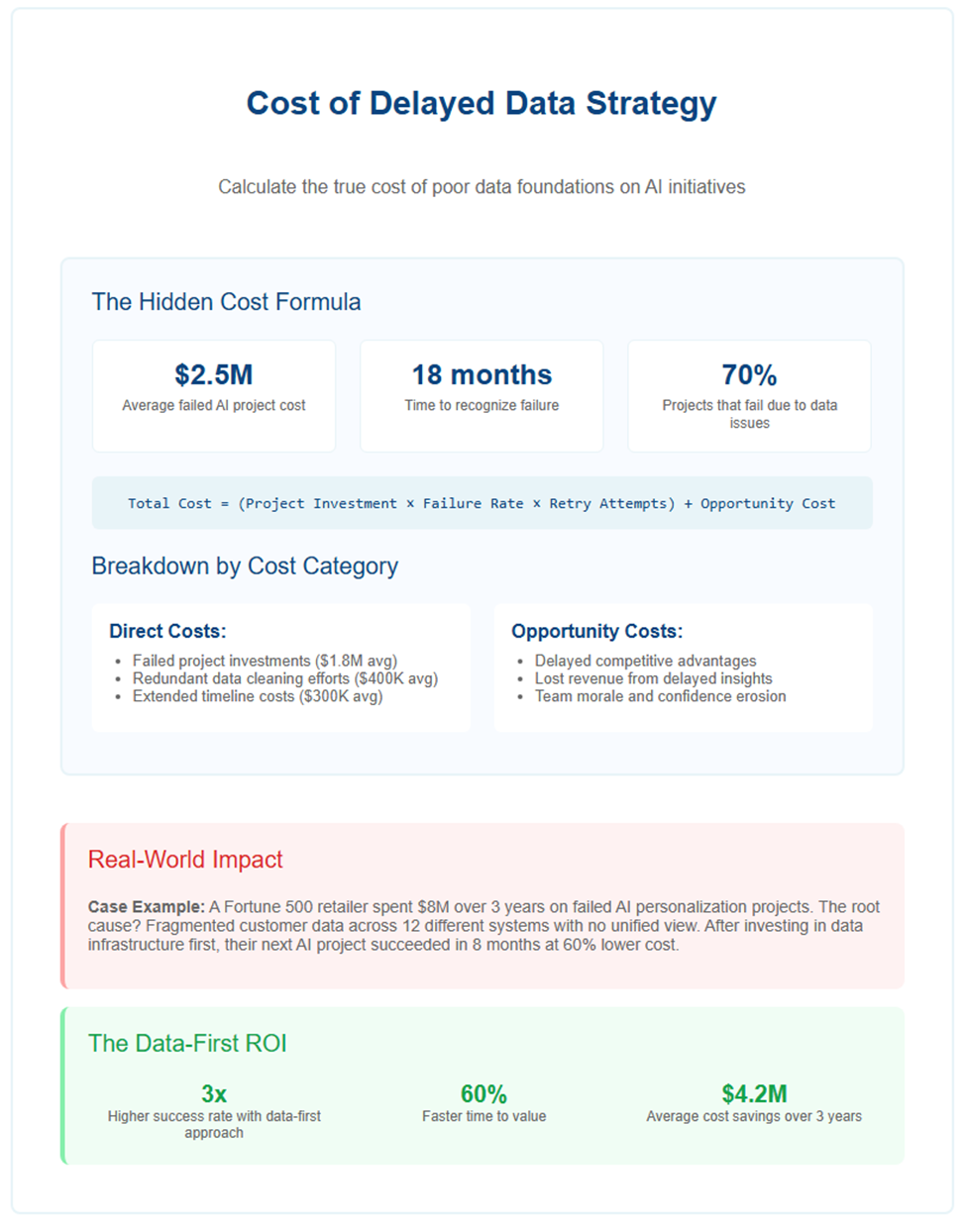
The hidden cost of bad data. $2.5M average per failed AI project, with 70% failing due to data issues, not algorithms
The Shift: From Model-Centric to Data-Centric Thinking
Model-centric thinking is the myopia that's killing AI. Data-centric thinking is the vision that saves it.
Historically, organizations approached AI with a model-centric mindset:
Lock down a dataset.
Build and tune models.
Optimize for performance.
When models underperform, focus on tweaking algorithms.
This approach is backwards. Data-centric AI leaders like Andrew Ng, flips this thinking:
Focus on improving the data, not the model.
Prioritize data quality, diversity, and representativeness.
Treat datasets as evolving products, not static resources.
Data-centric teams recognize that refining data often yields greater performance improvements than changing models. In manufacturing, for instance, improving dataset labeling and addressing data gaps has shown 16% accuracy improvements, far exceeding gains from algorithmic tweaks.
In parallel, successful organizations adopt data-driven architectures, ensuring their AI systems continuously learn from fresh, real-time data rather than stale, one-time snapshots.
This ends the free preview.
The rest of this
content is for free members
Create a free account to get full access. No payment required.
AI did not end the data literacy crisis. It changed it. As machines move from providing information to interpreting it and recommending what to do, the scarce skill is becoming judgment: knowing what to trust, what to question, and what decisions are still ours to make.
We teach data literacy as a ladder: data at the bottom, wisdom at the top, climb step by step. But the rungs are not where the work happens. The judgment lives in the gaps between them, and that is exactly where AI now carries us straight past.
Every organization keeps one scoreboard for mistakes and none for missed opportunities. So people optimize the one they can see, and the largest losses never appear as losses at all. They appear as things no one tried.
What a historic Red Sox winning streak reveals about the Two Clocks of decision-making. Every important decision is made between the deadline to act and the time required for evidence to mature. That's where judgment matters most.