AI did not end the data literacy crisis. It changed it. As machines move from providing information to interpreting it and recommending what to do, the scarce skill is becoming judgment: knowing what to trust, what to question, and what decisions are still ours to make.
Evidence does not make decisions. People interpret it, weigh it, challenge it, and make judgments. A courtroom reveals what leaders can learn about evidence, expertise, confidence, and data-informed decision-making.
Feeling sure doesn't mean you're right. Learn five simple ways to question what feels true, spot what might be influencing you, and make better decisions about what to believe.
The data literacy movement built something real, but the category has reached its limit. AI did not create the mismatch, it exposed it. The question is no longer how to make people more literate. It is how to design organizations that think better. A Cognitive Operating System is what comes next.
This is not an argument that data literacy failed. It is an argument that the work was always something larger than the category we built around it.
What You Need To Know About
The data literacy category has reached its limit. The goal it served was correct, but the framing was always wrong: a workforce skill problem treated as a knowledge gap, when the real challenge has always been judgment under uncertainty. AI did not create this mismatch. It exposed it. The question is no longer how to make people more literate, it is how to design organizations that think better.
Why this matters to you If your organization is investing in data literacy as a training program, you are measuring the wrong thing. Completion rates, certification counts, and confidence scores tell you nothing about whether decisions are improving. The gap between “people were trained” and “decisions got better” is widening, and AI is accelerating both sides of it. The leaders who recognize this shift early stop optimizing for a category that has already plateaued and start designing for the capability that actually moves outcomes.
Who this applies to This piece is written for the leaders who are accountable for decision quality but inherited a literacy program built for a different era: heads of data, learning, and transformation, plus the executives who fund capability work and increasingly question what it returns. It is also for practitioners who have spent years building inside the category and are starting to feel the framing strain. The common thread is not a job title. It is the experience of watching trained people still hesitate to commit to a decision the data should have made easier.
What you will gain from reading A clearer language for what your workforce actually needs, distinct from what the literacy category has been selling. A diagnostic for testing whether your current program is producing decision quality or just activity. The shape of the successor frame, a Cognitive Operating System, with the four shifts that distinguish it from a curriculum. And a position to take in your next strategy conversation that does not require defending the old category to advocate for the underlying work.
The dashboard is up on the screen. The numbers are clean. The slides are well designed. Three minutes in, somebody asks the quiet question.
“Do we trust this?”
Nobody answers right away. The room shifts. A few people look at their notes. Someone offers a careful caveat. Someone else asks where the data came from. The meeting moves on, but the decision stalls. Everyone leaves without committing to anything. The data was there. The decision was not.
I have sat in that meeting more times than I can count. So has every leader reading this.
That moment is the quiet failure of data literacy. Not in the data. Not in the dashboard. In the gap between what the workforce was trained to do and what the moment actually required.
I have spent more than a decade of my career building data literacy. I have written about it, taught it, measured it, certified it, and stood on conference stages defending it. So what I am about to say is not easy.
The data literacy movement, as a category, has already lost.
Not because the goal was wrong. The goal was right. People do need to read, interpret, and reason with data. Organizations do need a workforce that can think clearly with evidence. None of that has changed.
What has changed is everything around it.
“The goal was right. The category we built
around it is exhausted.”
The quiet failure nobody wants to name
Walk into almost any large organization and ask a simple question. Has your data literacy program made decisions better?
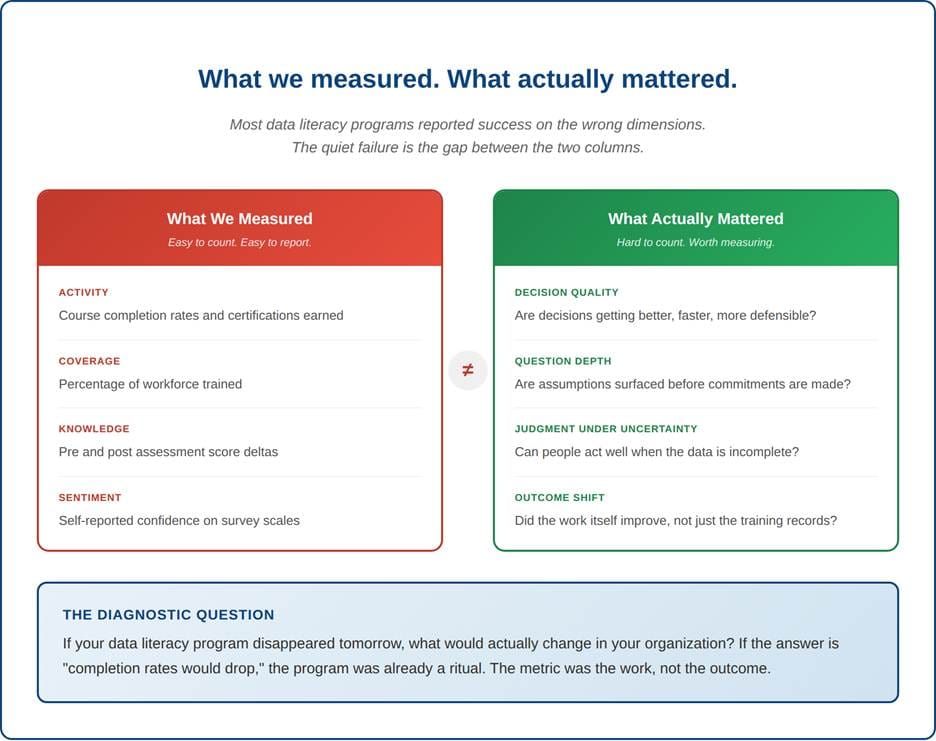
You will get a long pause. You will get program metrics. You will get completion rates, certification counts, and survey scores. What you will rarely get is a confident yes.
That is the failure. We measured the wrong things, scaled the wrong models, and called it progress.
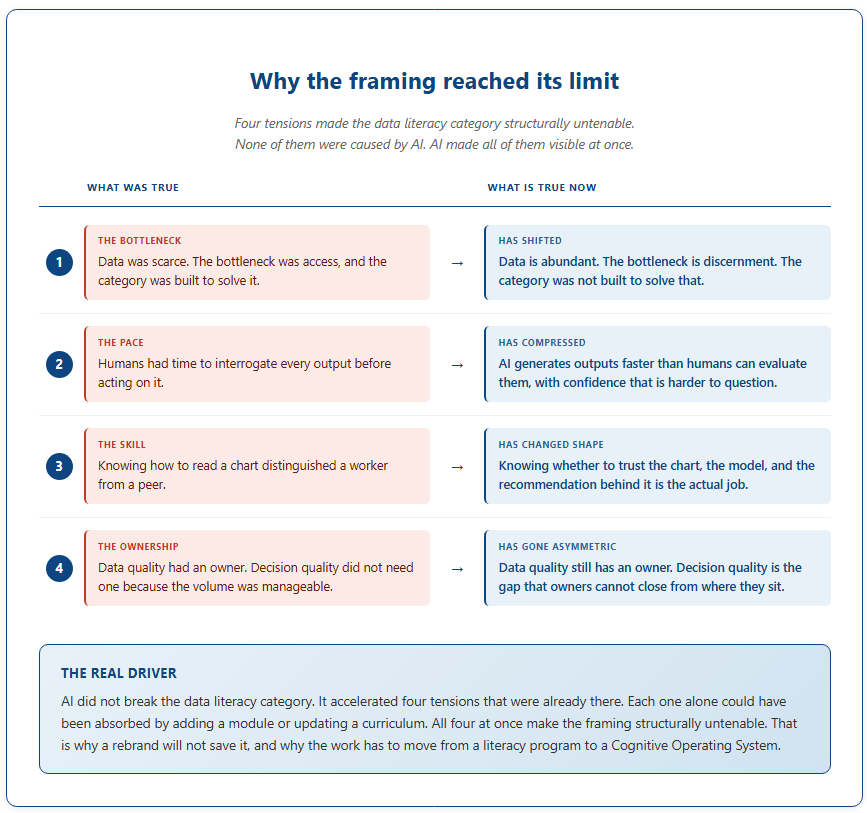
Most data literacy programs were designed for a world that no longer exists. A world where data was scarce, dashboards were the answer, and the bottleneck was access. We built curricula around tools, charts, and statistical basics. We treated literacy as a knowledge problem. We rolled it out like compliance training.
And then the world moved. Data became abundant. AI made output cheap. The bottleneck stopped being access. It became discernment, judgment, and the ability to ask better questions of systems that now generate answers faster than humans can evaluate them.
The category did not adapt. It kept selling the old promise to a problem that no longer exists.
Why the brand is beyond repair
There is a temptation, when something we love starts to fail, to rebrand it. Add a word. Update the curriculum. Call it “data literacy 2.0” and keep going.
I have done this. So have most of my colleagues in the field. It does not work.
The term “data literacy” has been stretched to mean too many things to too many people. For some, it is statistical fluency. For others, it is dashboard reading. For vendors, it is whatever their product happens to do. For HR, it is a training line item. For executives, it is a slide in the strategy deck. The label has become so diluted that it no longer communicates anything specific.
When a category cannot define itself, it cannot defend itself. And when it cannot defend itself, budgets quietly migrate elsewhere.
“When a category cannot define itself, it
cannot defend itself.”
The deeper problem is that the term frames the work as a deficit. Literacy implies illiteracy. It positions adults as remedial students. It assumes the gap is in the person rather than in the system around the person. That framing was always uncomfortable. In an AI-saturated workplace, it is also wrong. The gap is no longer “can this person read a chart.” The gap is “can this person reason well when the chart, the model, and the recommendation all arrive at the same time.”
A Pattern Worth Noticing Schools used to teach typing as a discrete subject. Companies used to run computer literacy programs. Both categories disappeared, not because the work failed, but because it succeeded so completely that the framing became unnecessary. Computer literacy is the closer parallel. Universities offered courses. Companies ran certification programs. Professional associations held conferences. The skill was real, the work was urgent, the funding was substantial. The category does not exist anymore. Data literacy is on the same trajectory. The work is real. The category that organized it for the last two decades is doing the same disappearing act, for the same reason.
That is not a literacy problem. That is something else entirely.
What the work actually was
Strip away the branding and look at what good data literacy practitioners were really doing. We were teaching people to think.
We were teaching them to question sources. To weigh evidence against context. To resist the false confidence of a clean visualization. To distinguish correlation from cause, signal from noise, and confidence from certainty. We were teaching judgment under uncertainty. We just kept calling it data literacy because that was the door budget came through.
“The skill was always cognitive. The label
was always commercial.”
That mismatch is now catching up with us, and AI is the reason it is impossible to ignore. AI changes three things at once. It increases the speed at which information arrives, which leaves less time to think. It increases the confidence with which answers are presented, which makes them harder to question. And it increases the volume of decisions a single person is expected to weigh in on, which means more judgment is required from people, not less.
Reading a chart is table stakes. Knowing whether to trust the chart, the model that produced it, and the recommendation built on top of it is the actual job.
That work needs a name. “Data literacy” is no longer it.
What comes next
I think the successor is closer to what I have been calling a Cognitive Operating System. Not a curriculum. Not a course. A system.
An operating system has layers that work together. It has inputs, processes, feedback, and governance. It runs in the background while people do their work. It gets updated as the environment changes. That is closer to how human reasoning actually scales inside an organization than any training program I have ever seen.
“A curriculum teaches a skill once. An
operating system upgrades how an organization thinks.”
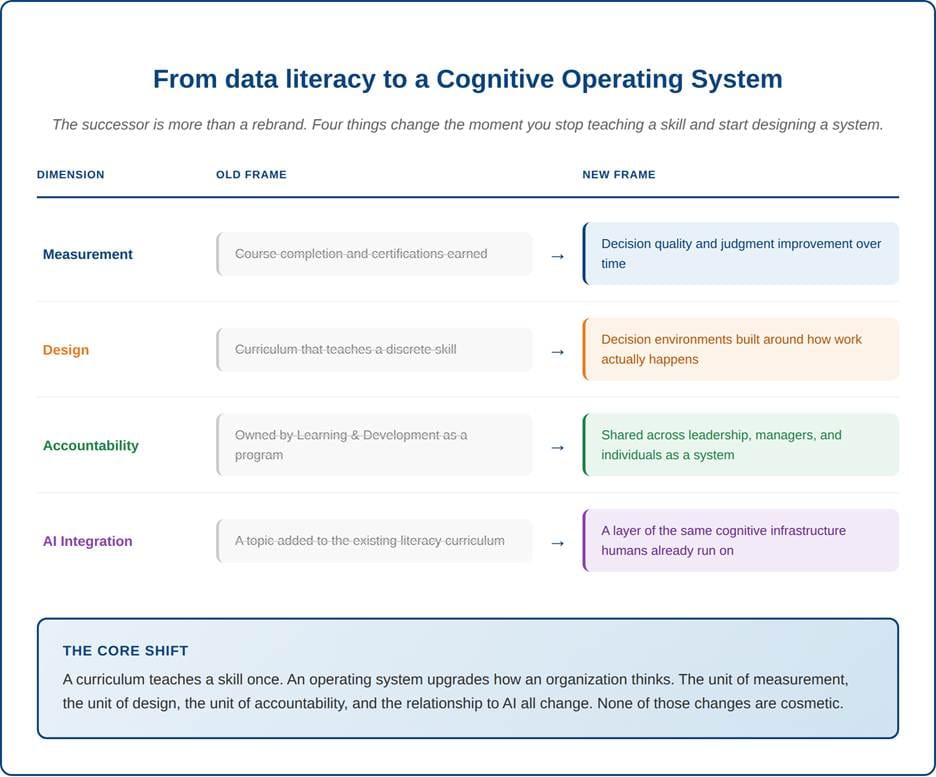
The shift from literacy to operating system is more than a rebrand. It changes four things.
It changes the unit of measurement. Instead of asking how many people completed training, you ask whether decision quality has improved. Instead of counting certifications, you track how often assumptions get surfaced before commitments get made. The metric stops being knowledge and starts being judgment.
It changes the unit of design. Instead of designing a course, you design a decision environment. The questions become structural. Where do decisions get made? Who has the context? What information arrives in time, and what arrives too late? Training becomes one component, not the whole program.
It changes the unit of accountability. Literacy programs sit inside L&D. Operating systems sit across the organization. Leadership owns the conditions for thinking. Managers own the daily reinforcement. Individuals own the practice. No single function gets to call it done.
It changes the relationship to AI. A literacy program treats AI as a topic to add. An operating system treats AI as a layer of the same cognitive infrastructure humans are already running on. The integration becomes architectural, not additive.
So what does this actually look like inside an organization? A few things you would expect to see.
You would see decision checkpoints built into the work itself, not bolted on as approval gates. You would see assumption logging, where the reasoning behind a decision is captured at the time it is made, not reconstructed later. You would see feedback loops on decisions, where outcomes are reviewed against the thinking that produced them, and the lessons feed back into how the next decision gets framed. You would see clear ownership of decision quality, with someone accountable for it the way someone is accountable for data quality or system uptime today.
None of that fits inside a course catalog. All of it fits inside a system.
That is the work ahead.
The honest reframe
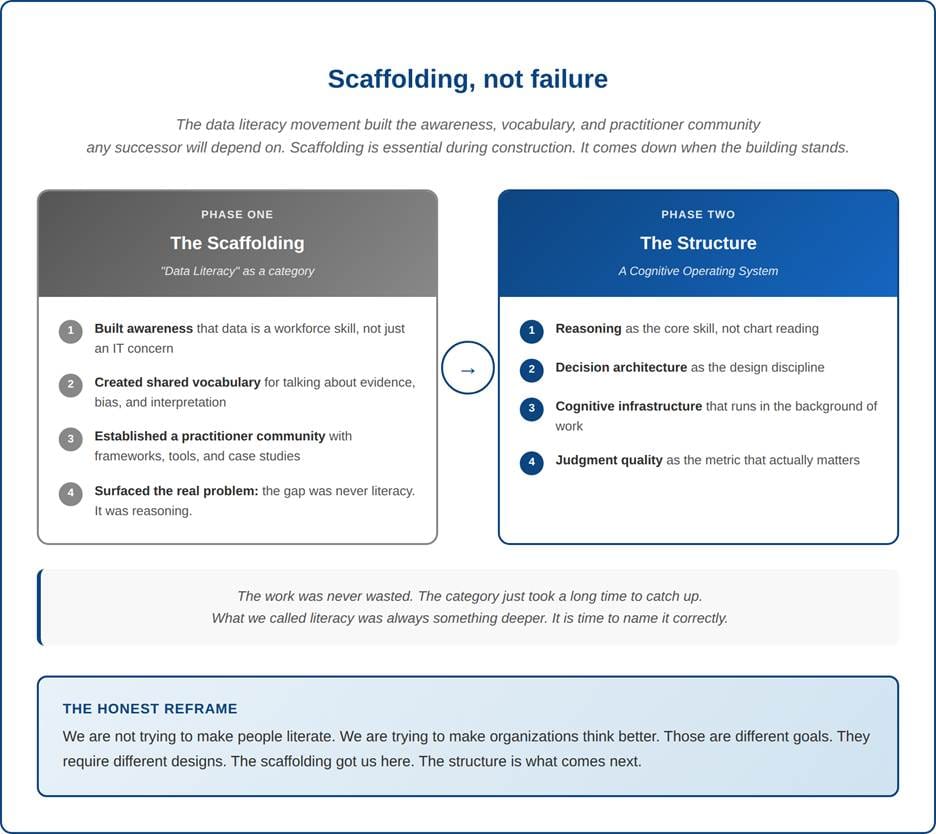
I am not saying the work was wasted. The opposite. The data literacy movement built the awareness, the vocabulary, and the practitioner community that any successor will depend on. None of what comes next is possible without what came before.
But the category is exhausted. The brand is diluted. The framing is misaligned with the problem.
The most useful thing those of us who built this field can do now is admit that and start naming what the work actually is. Reasoning. Judgment. Decision architecture. Cognitive infrastructure. Whatever language survives, the unifying truth is the same. We are not trying to make people literate. We are trying to make organizations think better.
“We are not trying to make people literate.
We are trying to make organizations think better.”
Those are different goals. They require different designs.
A question for practitioners
If your data literacy program disappeared tomorrow, what would actually change in your organization?
If the answer is “completion rates would drop,” the program was already a ritual. If the answer is “decisions would get worse, faster, and we would not catch them in time,” then what you have is not a literacy program. It is something more important, hiding under the wrong name.
The work was always more than literacy. The category just took a long time to catch up. It is time to let it go. The next pieces in this series take up what comes after, including how a Cognitive Operating System gets designed, measured, and built.
Tools for taking this further
If the question at the end of this article is sitting with you, two companion pieces are available.
The diagnostic.A ten-question self-assessment that translates this article's argument into ten questions you can ask about your own program. Five minutes, no email required. Use it to test whether your program is functioning as a ritual, scaffolding, or an operating system.
The facilitator guide. A printable conversation guide for running a thirty-minute discussion with your leadership team. Five questions, with what to listen for in the answers and how to push the conversation when it stalls. Use it when you want to test the article's claims with the people who fund or own your current program.
Both are available with our free membership, both are practitioner tools, both work better if you do not skip the diagnostic before running the team conversation.
Kevin is an author, speaker, and thought leader on topics including data literacy, data-informed decisions, business strategy, and essential skills for today. https://www.linkedin.com/in/kevinhanegan/
AI did not end the data literacy crisis. It changed it. As machines move from providing information to interpreting it and recommending what to do, the scarce skill is becoming judgment: knowing what to trust, what to question, and what decisions are still ours to make.
Evidence does not make decisions. People interpret it, weigh it, challenge it, and make judgments. A courtroom reveals what leaders can learn about evidence, expertise, confidence, and data-informed decision-making.
Feeling sure doesn't mean you're right. Learn five simple ways to question what feels true, spot what might be influencing you, and make better decisions about what to believe.
We teach data literacy as a ladder: data at the bottom, wisdom at the top, climb step by step. But the rungs are not where the work happens. The judgment lives in the gaps between them, and that is exactly where AI now carries us straight past.