AI did not end the data literacy crisis. It changed it. As machines move from providing information to interpreting it and recommending what to do, the scarce skill is becoming judgment: knowing what to trust, what to question, and what decisions are still ours to make.
Evidence does not make decisions. People interpret it, weigh it, challenge it, and make judgments. A courtroom reveals what leaders can learn about evidence, expertise, confidence, and data-informed decision-making.
Feeling sure doesn't mean you're right. Learn five simple ways to question what feels true, spot what might be influencing you, and make better decisions about what to believe.
The training works. People finish more capable, and then the capability quietly goes unused. That gap is not a failure of data literacy. It is a sign the field has matured into something larger, and the practitioner role is changing to meet it. Here is what it is becoming.
The hardest part of data literacy was never teaching people to read the data. It was creating environments where acting on it could survive.
What You Need to Know
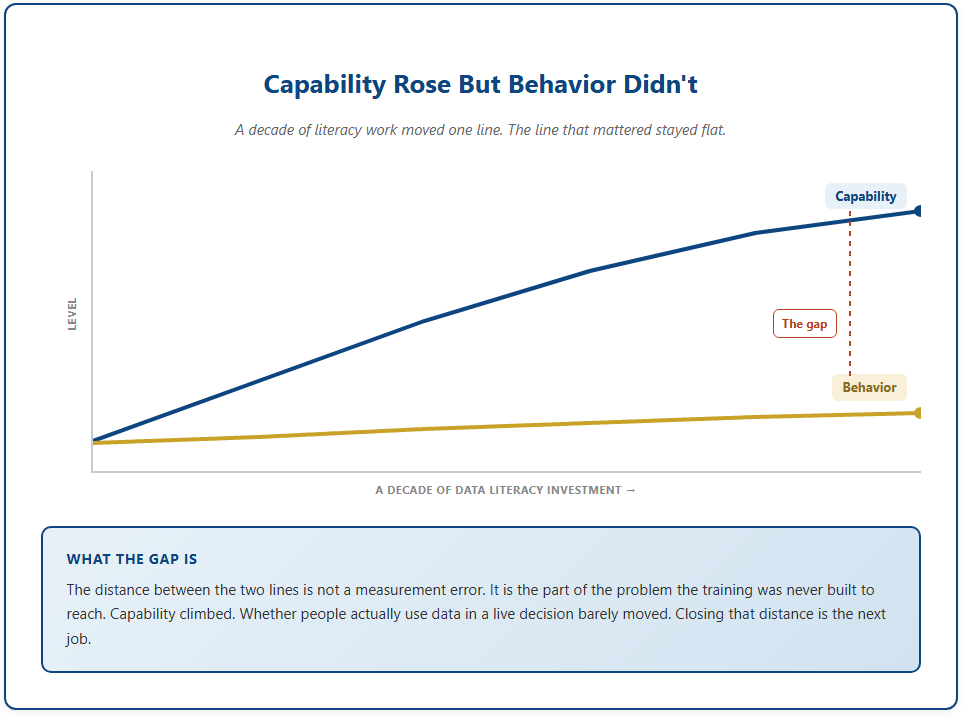
For a decade, data literacy work has aimed at a single target: build capability. Teach people to read, question, and use data. That target was correct, and the field largely hit it. But capability turned out to be the easier half of the problem. Capable people still return to their work and leave the data unused, not because they lack skill, but because the environment around them never made using it the rational choice. The role that built the capability is now being asked to address what the capability alone could not fix.
Why This Matters to You If you lead data literacy or enablement work, you have likely felt the plateau. The training lands well, the energy is real, and weeks later the behavior has snapped back. The reflex is to question the program, refine the content, run it again. That reflex keeps you working on the layer that was never broken. The shift this article describes moves you from explaining why adoption stalled to diagnosing it, from delivering capability to shaping the conditions that let capability hold. The difference is the difference between effort that plateaus and effort that compounds.
Who This Applies To This is written for the people who sit between what an organization teaches and what it actually does: data literacy leaders, enablement and analytics translators, learning and capability owners. The common thread is not a job title. It is a vantage point. These are the people positioned to see exactly where confidence breaks, where adoption quietly reverts, and where what the organization says it wants pulls apart from what it rewards.
What You'll Gain from Reading You will leave with a clearer read on why capable people underuse data, and why more training rarely fixes it. You will have a sharper way to frame your own role, one that treats stalled adoption as a signal to investigate rather than a failure to fix. And you will have language for something most practitioners sense but struggle to name: that the work has grown beyond teaching skills into shaping the conditions where judgment and data actually meet.
Talk to enough data literacy leaders and the same observation surfaces. Not as a complaint but more like a quiet puzzle.
The training works and people finish the program more capable than they started with. They can read a chart, question a number, frame a sharper question, push back on a weak analysis. The capability is real and measurable. Then those same people go back to their desks, and the new capability quietly goes unused.
The dashboard gets built and gets used less than anyone expected. The analyst's caveats get cut somewhere between the deck and the executive summary. The data gets pulled up after the decision instead of before it. None of that happens because the training failed. It happens because something the training never touched is still running underneath.
The practitioners noticing this are not falling short in their jobs. They are succeeding at the capability layer and discovering, first-hand, that capability was never the whole job.
You can teach someone to read a chart. You cannot teach them to act on one they were never rewarded for using. Capability was the easy half of the problem. We are only now meeting the hard half.
This is Not Data Literacy Failing
It would be easy to read all of this as bad news for data literacy. It is not. The capability gap was real. A decade ago, plenty of people genuinely could not work with data, and literacy programs set out to close that gap. The field made meaningful progress against it. The fact that we are now talking about a different problem is the proof that the first one moved.
And the original work has not gone anywhere. Organizations still need strong literacy programs, onboarding, role-based enablement, and analytical capability building. That work did not stop mattering. The expectations around it grew.
What practitioners are running into is not the failure of data literacy. It is the maturity of it. Every field reaches a point where the founding problem is mostly handled and a deeper one comes into view. Data literacy has reached that point. The founding problem was capability. The deeper one is behavior. The role is growing to meet it.
Here is what that growth looks like, told through what practitioners are already discovering.
Moving From Teaching Data Skills to Diagnosing Why Skilled People Still Do Not Use Data
The first shift is the hardest to accept, because it means the obvious explanation is usually wrong.
When a capable person does not use data, the reflex is to assume a skills gap. More training. A refresher. A better course. But the practitioners closest to this work keep finding the same thing. The person can do the analysis. They choose not to, or the moment passes, or the workflow never makes room for it.
This ends the free preview.
The rest of this
content is for free members
Create a free account to get full access. No payment required.
AI did not end the data literacy crisis. It changed it. As machines move from providing information to interpreting it and recommending what to do, the scarce skill is becoming judgment: knowing what to trust, what to question, and what decisions are still ours to make.
Evidence does not make decisions. People interpret it, weigh it, challenge it, and make judgments. A courtroom reveals what leaders can learn about evidence, expertise, confidence, and data-informed decision-making.
Feeling sure doesn't mean you're right. Learn five simple ways to question what feels true, spot what might be influencing you, and make better decisions about what to believe.
We teach data literacy as a ladder: data at the bottom, wisdom at the top, climb step by step. But the rungs are not where the work happens. The judgment lives in the gaps between them, and that is exactly where AI now carries us straight past.