AI did not end the data literacy crisis. It changed it. As machines move from providing information to interpreting it and recommending what to do, the scarce skill is becoming judgment: knowing what to trust, what to question, and what decisions are still ours to make.
Evidence does not make decisions. People interpret it, weigh it, challenge it, and make judgments. A courtroom reveals what leaders can learn about evidence, expertise, confidence, and data-informed decision-making.
Feeling sure doesn't mean you're right. Learn five simple ways to question what feels true, spot what might be influencing you, and make better decisions about what to believe.
Data Without Thinking Is Useless. Here’s How AI Can Fix That
We're testing data literacy all wrong. Multiple-choice quizzes measure memorization while real decisions require navigating ambiguity and uncertainty. Discover how AI coaching transforms assessment from scoring answers to developing critical thinking at scale.
Generative AI isn’t here to replace human reasoning, it’s here to train it.
High-Level Summary
Most organizations are playing the wrong game. They're measuring data memorization instead of data reasoning. Traditional assessments test "right answers" while real decisions require navigating ambiguity. Multiple-choice quizzes create false confidence that crumbles under real-world complexity.
The AI Solution The biggest myth in data education. Good assessment requires human graders. Plot twist. AI coaches better than humans ever could.
Generative AI can review open-ended explanations, analyze argument quality, and provide personalized feedback at scale. It's not replacing human thinking, it's training it.
What Changes Now Stop asking "Did they get the right answer?" and start asking "Can they question assumptions and reason through uncertainty?"
Your Next Steps
Audit current assessments - If they're multiple choice, you're measuring the wrong thing
Design scenario-based challenges - Use real business problems, not textbook exercises
Implement AI coaching - Focus on reasoning quality, not factual accuracy
The Bottom Line Data literacy isn't about memorizing statistics, it's about developing confidence to make decisions with incomplete information. AI coaching finally makes scalable, personalized feedback possible.
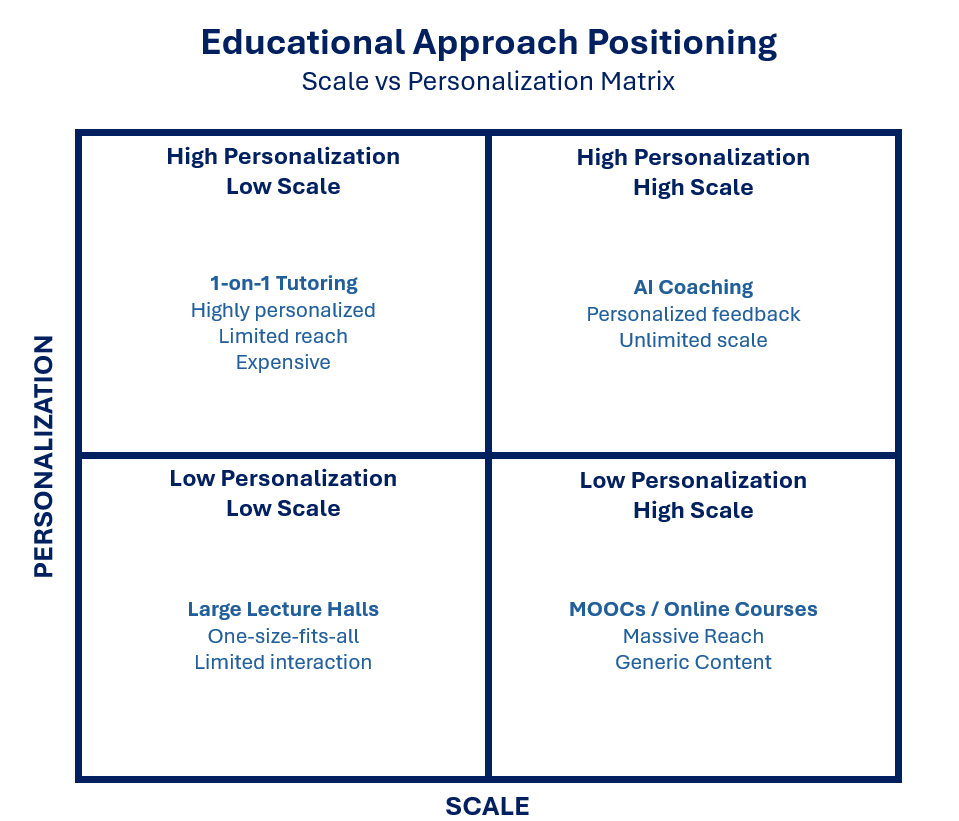
For centuries, education faced an impossible choice: reach many people or serve them well. AI coaching breaks this constraint.
Most of us drown in data but can’t think with it. That’s the real crisis. Data literacy and data-informed decision-making skills are essential, yet many programs still cling to outdated ways of measuring them. Multiple-choice quizzes and rote memorization exercises might be easy to grade, but they fail to capture how someone actually reasons through uncertainty, bias, or ambiguity.
If the goal is to build true data confidence (the ability to apply data in messy, imperfect, real-world situations), then we need to rethink assessment altogether. Generative AI finally gives us a way to do that, enabling scalable, high-quality coaching on reasoning skills that previously could only happen one-on-one.
The Problem with "Right Answers"
Most traditional assessments measure whether learners know the "correct" answer. That's helpful for certain foundational skills, but data-informed decision-making is rarely so black and white. In the real world, there are trade-offs to weigh, multiple perspectives to consider, and incomplete or even conflicting data sets to interpret.
Critical thinking, analytical reasoning, and even creative problem-solving cannot be fully measured by a simple multiple-choice test. Instead, these skills require learners to explain their process, justify their decisions, and reflect on the assumptions driving their analysis. Historically, assessing that depth of reasoning was too expensive and time-consuming to scale.
This creates a fundamental mismatch: we need people who can navigate uncertainty and complexity, but we're testing them on memorized facts and clear-cut answers. The result? Organizations invest heavily in data literacy training, only to discover their people still struggle when faced with real-world data challenges.
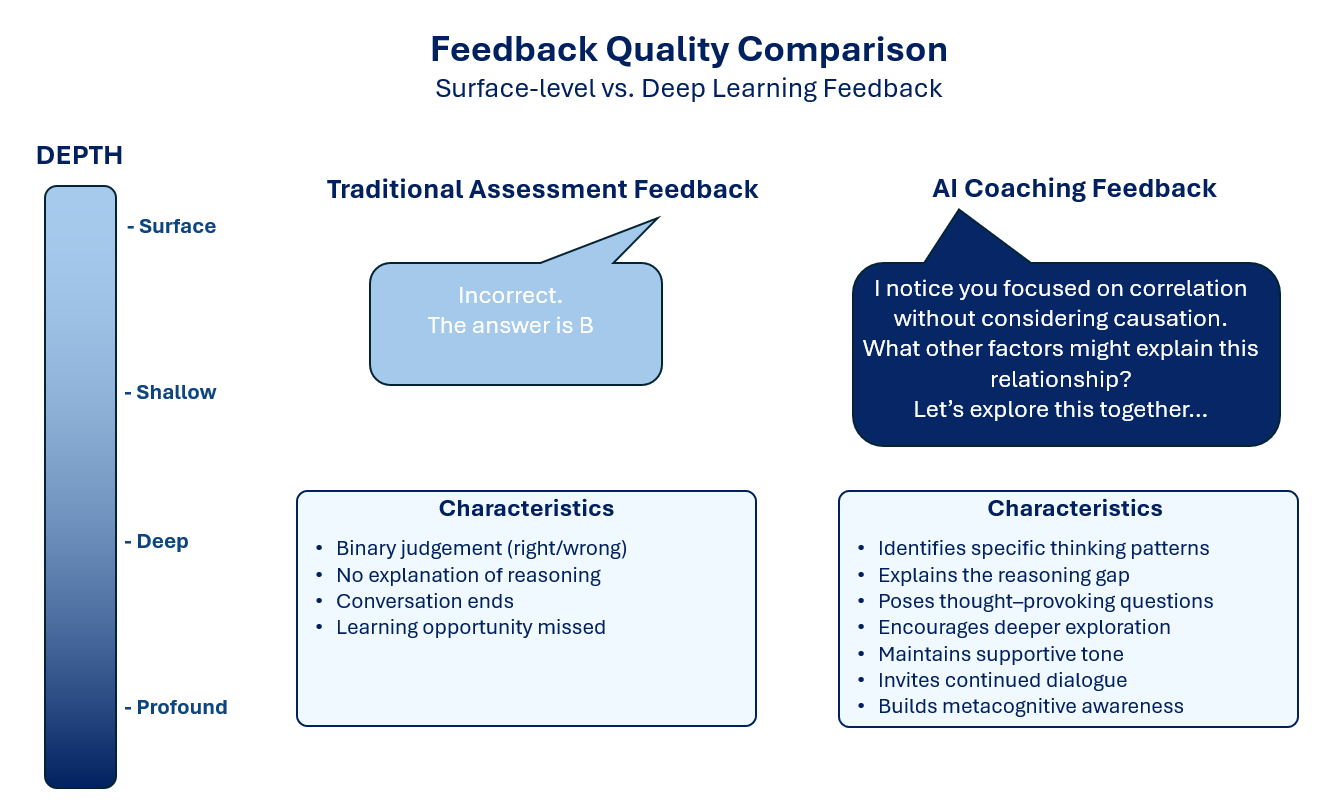
Traditional assessment stops at "wrong answer", AI coaching starts there. One builds recall, the other builds reasoning capability.
Enter Generative AI - A Scalable Data Coach
Generative AI changes the equation entirely. Rather than just marking right or wrong, a generative AI can review open-ended explanations, analyze argument quality, check for logical consistency, and even highlight potential biases or missed considerations. In effect, it becomes a coach. One that listens to each learner's reasoning, responds with tailored feedback, and suggests ways to improve their thinking.
For centuries, education faced an impossible choice: reach many people or serve them well. AI coaching breaks this constraint, delivering personalized learning at unlimited scale.
What This Looks Like in Practice
Consider a business simulation where learners must choose between two market expansion strategies based on customer data. Instead of selecting A or B, learners explain their reasoning:
This ends the free preview.
The rest of this
content is for paid subscribers
Become a paid subscriber to get full access and unlock all paid content.
AI did not end the data literacy crisis. It changed it. As machines move from providing information to interpreting it and recommending what to do, the scarce skill is becoming judgment: knowing what to trust, what to question, and what decisions are still ours to make.
Evidence does not make decisions. People interpret it, weigh it, challenge it, and make judgments. A courtroom reveals what leaders can learn about evidence, expertise, confidence, and data-informed decision-making.
Feeling sure doesn't mean you're right. Learn five simple ways to question what feels true, spot what might be influencing you, and make better decisions about what to believe.
We teach data literacy as a ladder: data at the bottom, wisdom at the top, climb step by step. But the rungs are not where the work happens. The judgment lives in the gaps between them, and that is exactly where AI now carries us straight past.