AI did not end the data literacy crisis. It changed it. As machines move from providing information to interpreting it and recommending what to do, the scarce skill is becoming judgment: knowing what to trust, what to question, and what decisions are still ours to make.
Evidence does not make decisions. People interpret it, weigh it, challenge it, and make judgments. A courtroom reveals what leaders can learn about evidence, expertise, confidence, and data-informed decision-making.
Feeling sure doesn't mean you're right. Learn five simple ways to question what feels true, spot what might be influencing you, and make better decisions about what to believe.
Good Intentions Are Not an Organizational Change Strategy
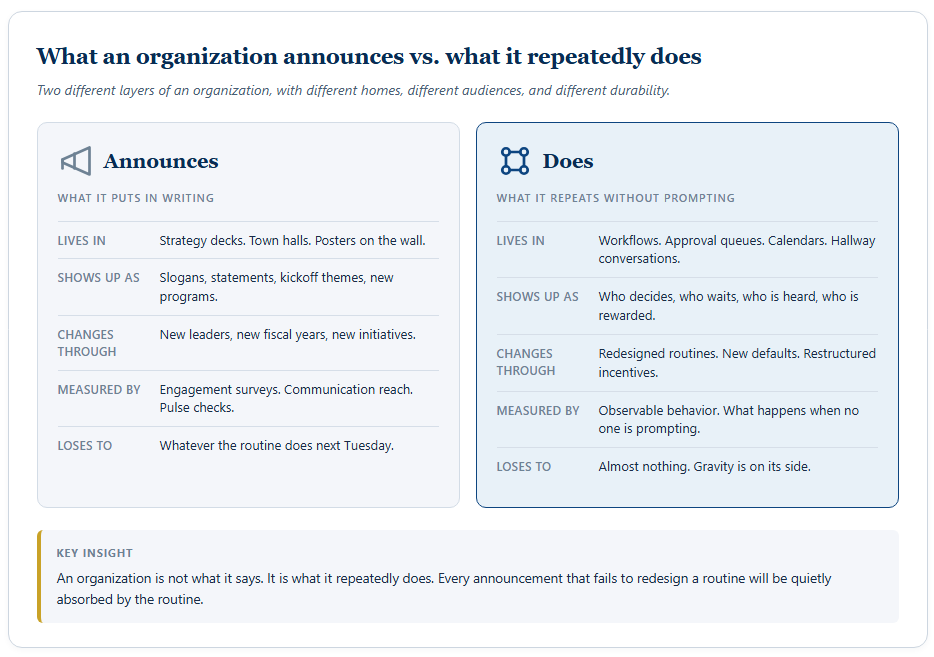
An organization is not what it says. It is what it repeatedly does. Most transformations stall because they change the people while leaving the routines untouched. Good intentions can start a transformation. Only a new channel can sustain one.
The day-to-day behavior of an organization is its real value system. Everything else is paperwork.
What You Need To Know
An organization is not what it says. It is what it repeatedly does, and what it repeatedly does is rarely chosen on purpose. Most leaders assume change comes from clearer strategy or different people. The deeper truth is that organizations behave according to their routines, and those routines outlast every leader and every initiative announced to disrupt them. Until the routine changes, the behavior will not.
Why This Matters to You If you have ever launched a change effort that produced early progress and then drifted back to where it started, you have already experienced the cost of misdiagnosing the problem. Most transformation budgets are spent on the people layer, on training and communication campaigns, while the routines that quietly produce behavior remain untouched. The result is initiatives that look successful for two quarters and then quietly disappear. Reading this changes where you direct the next dollar of effort, and stops the cycle of relaunching the same transformation under a new name.
Who This Applies To This applies to anyone responsible for shifting how a team or an organization behaves. It will land hardest for those who have inherited a pattern of stalled transformations, or change efforts that quietly reverse themselves once the launch energy wears off. It is especially useful for leaders who can see the problem clearly but cannot understand why naming it does not solve it. The frame fits regardless of whether you carry the title of executive, transformation lead, function head, or operator on the ground.
What You'll Gain from Reading You leave with a lens that makes organizational routines visible, and a frame for separating the layer that announces from the layer that actually produces behavior. You gain a sharper diagnostic question to bring into the next stalled transformation conversation, one that points at the system rather than the people inside it. You also gain a clear picture of where most change budgets are wasted, and where the durable leverage actually sits. The result is fewer transformations that drift back, and more interventions designed to hold.
The routines that outlast every strategy
In a recent article, I argued that people do not make decisions according to their skills. Rather, they make them according to their habits. Skills are what people can do when asked, but habits are what they do without being asked. Reflecting on most decisions, they happen without being asked.
This argument is also true of organizations. An organization is not what it says, it is what it repeatedly does. And just like habits are what individuals do without being asked, what an organization repeatedly does is rarely chosen on purpose. This fact is the part that most organizational transformations miss.
The Illusion of Intent
If you ask a leadership team if they want more innovation, they will say yes. If you ask them if they also want faster learning, they will also say yes. The same is true if you ask them if they want better collaboration, more experimentation, more agility, and sharper use of data. All of the replies will be yes. And for the most part, leaders are being honest and sincere when they answer that way.
The trouble is that it is just the leader's intentions about what they and the organization want. That actually tells you very little about what it actually does. Behaviors are set by forces that rarely show up in an organizational strategy deck. How decisions get made. How resources get moved. What gets rewarded on Friday. What gets quietly punished. Which tradeoffs feel safe and which feel risky.
Those forces produce patterns, then the patterns repeat, and after enough repetitions, they become the default. What begins as a sensible response to a local problem slowly becomes the way things are done. The original reason may disappear. The routine remains. Once a behavior becomes the default, the organization does not need to choose it. It just shows up.
That is what an organizational habit looks like.
The most powerful force in an organization is the routine no one wrote down.
The river finds its channel
Picture a river running through a valley.
This ends the free preview.
The rest of this
content is for paid subscribers
Become a paid subscriber to get full access and unlock all paid content.
AI did not end the data literacy crisis. It changed it. As machines move from providing information to interpreting it and recommending what to do, the scarce skill is becoming judgment: knowing what to trust, what to question, and what decisions are still ours to make.
Evidence does not make decisions. People interpret it, weigh it, challenge it, and make judgments. A courtroom reveals what leaders can learn about evidence, expertise, confidence, and data-informed decision-making.
Feeling sure doesn't mean you're right. Learn five simple ways to question what feels true, spot what might be influencing you, and make better decisions about what to believe.
We teach data literacy as a ladder: data at the bottom, wisdom at the top, climb step by step. But the rungs are not where the work happens. The judgment lives in the gaps between them, and that is exactly where AI now carries us straight past.