AI did not end the data literacy crisis. It changed it. As machines move from providing information to interpreting it and recommending what to do, the scarce skill is becoming judgment: knowing what to trust, what to question, and what decisions are still ours to make.
Evidence does not make decisions. People interpret it, weigh it, challenge it, and make judgments. A courtroom reveals what leaders can learn about evidence, expertise, confidence, and data-informed decision-making.
Feeling sure doesn't mean you're right. Learn five simple ways to question what feels true, spot what might be influencing you, and make better decisions about what to believe.
How to Navigate Complex Business Decisions in the AI Era. A Practical Framework
Traditional reasoning stops at the 'best' explanation. Integrated Reasoning starts there. When AI gives you probabilities and data is incomplete, you need a systematic way to think about thinking. Here's the 5-step framework that changes everything.
Most people know how to think. Few people know how to think systematically about thinking. That's the difference between having opinions and having a competitive advantage.
Your practical guide to navigating complexity, AI, and ambiguity with confidence
Most professionals can explain the difference between inductive and deductive reasoning. Many know abductive reasoning (finding the best explanation for what they observe). But when you're facing real-world decisions with incomplete data, AI-generated outputs, and time pressure, those traditional forms of logic only take you so far.
In our previous articles, we introduced a new framework: Integrated Reasoning, a thinking model built for today's information-rich, fast-moving world. This article is your next step: how to use it.
Why Thinking Needs a Process (Not Just a Definition)
Integrated Reasoning blends multiple thinking skills, from logic-based reasoning to probabilistic judgment, contextual awareness, and signal triage. But for many, especially those just starting, that can feel a bit abstract.
What people need most is a way to begin like a scaffold to practice until it becomes second nature. That's where the Integrated Reasoning Loop comes in.
We're not just teaching you a new way to think. We're giving you a systematic way to think about thinking, and that changes everything
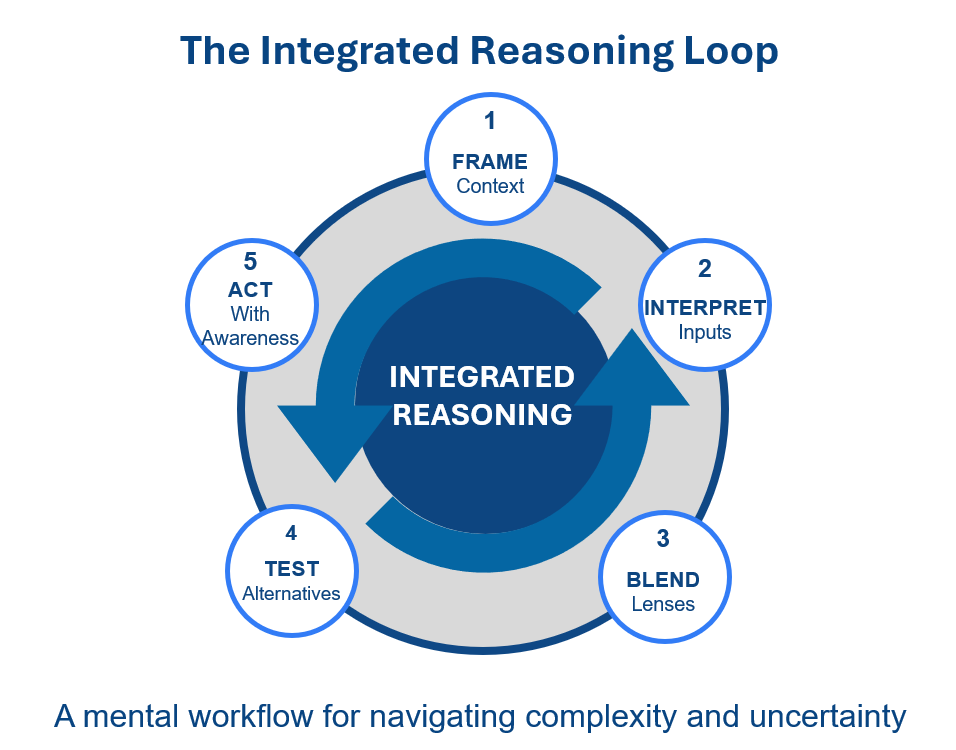
The Integrated Reasoning Loop
This five-step mental workflow gives you a way to pause, process, and respond, even when the data is incomplete, the AI is confident, and the situation is unclear.
A systematic approach to pause, process, and respond, even when data is incomplete, AI sounds confident, and situations are unclear.
This ends the free preview.
The rest of this
content is for paid subscribers
Become a paid subscriber to get full access and unlock all paid content.
AI did not end the data literacy crisis. It changed it. As machines move from providing information to interpreting it and recommending what to do, the scarce skill is becoming judgment: knowing what to trust, what to question, and what decisions are still ours to make.
Evidence does not make decisions. People interpret it, weigh it, challenge it, and make judgments. A courtroom reveals what leaders can learn about evidence, expertise, confidence, and data-informed decision-making.
Feeling sure doesn't mean you're right. Learn five simple ways to question what feels true, spot what might be influencing you, and make better decisions about what to believe.
We teach data literacy as a ladder: data at the bottom, wisdom at the top, climb step by step. But the rungs are not where the work happens. The judgment lives in the gaps between them, and that is exactly where AI now carries us straight past.