AI did not end the data literacy crisis. It changed it. As machines move from providing information to interpreting it and recommending what to do, the scarce skill is becoming judgment: knowing what to trust, what to question, and what decisions are still ours to make.
Evidence does not make decisions. People interpret it, weigh it, challenge it, and make judgments. A courtroom reveals what leaders can learn about evidence, expertise, confidence, and data-informed decision-making.
Feeling sure doesn't mean you're right. Learn five simple ways to question what feels true, spot what might be influencing you, and make better decisions about what to believe.
Seeing the Whole Picture. Media Bias, Data Interpretation, and Decision-Making Blind Spots
Facts don’t always tell the full story. Data can be factually accurate yet still present a biased narrative. In business and life, even technically correct data can lead us astray when taken out of context or selectively framed. Learn how to spot the blind spots and see the whole picture.
Being technically correct is the most sophisticated form of being wrong. Every successful misleading statement starts with a true fact.
High-Level Summary and Key Takeaways
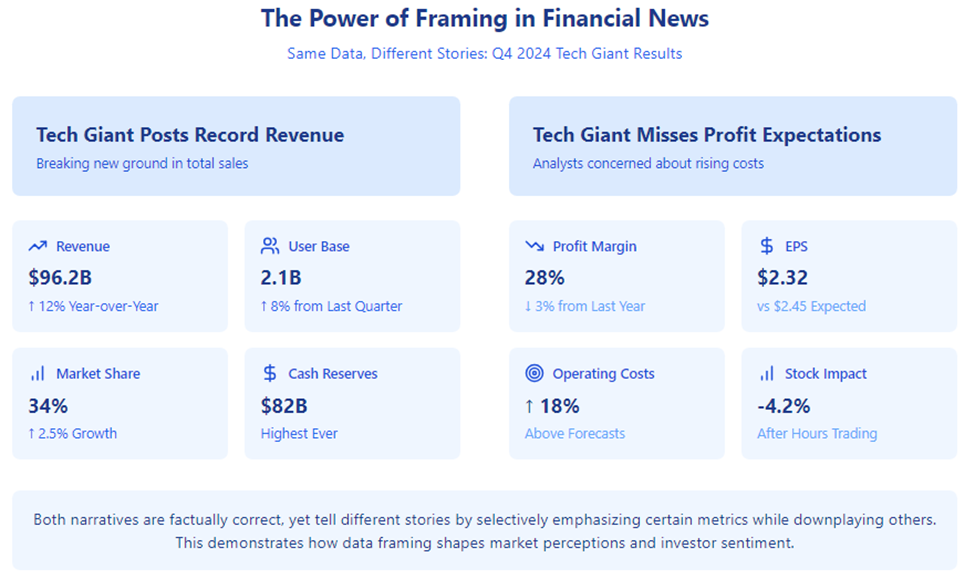
The abundance of information in modern life presents a fascinating paradox: having more data doesn't guarantee better decisions. Media consumption and business analytics share striking parallels in how the selective presentation of facts can shape interpretations while remaining technically accurate. A news outlet might highlight record revenues while another emphasizes missed profit targets - both true statements painting different pictures of reality.
This selective interpretation manifests similarly in business decisions, where teams might celebrate surface-level metrics while missing crucial underlying trends. The consequences often emerge through missed market opportunities, misguided investments, or flawed strategic choices. Understanding these parallel challenges illuminates effective strategies for more comprehensive analysis.
Multiple perspective-taking serves as a crucial tool for better decision-making, complemented with systematic frameworks that examine context and challenge assumptions. Organizations that implement structured approaches to information analysis - from regular contrary reviews to diverse feedback channels - develop stronger capabilities for nuanced interpretation.
The path to better decisions lies not in eliminating bias entirely, but in creating systems that acknowledge and account for natural human tendencies toward selective interpretation. True insight emerges from embracing complexity and maintaining healthy skepticism toward simple narratives, whether they originate from media headlines or data dashboards.
Key Takeaways
Technical Accuracy Doesn't Guarantee Complete Truth Information can be entirely factual while still leading to flawed conclusions. The selective presentation of accurate data, whether in media headlines or business metrics, shapes narratives by emphasizing certain aspects while obscuring others. Understanding this paradox helps decision-makers look beyond surface-level accuracy to seek comprehensive context.
Echo Chambers Exist in Both Media and Data Analysis People naturally gravitate toward information that confirms their existing beliefs, creating dangerous feedback loops. This pattern appears identically in how individuals consume news and how organizations interpret business data. Breaking free requires deliberately seeking contrary viewpoints and implementing structured processes to challenge dominant narratives.
Effective Decision-Making Demands Multiple Perspectives Sound choices emerge from triangulating multiple data sources and viewpoints. Just as understanding current events requires consulting various news sources, meaningful business insights come from examining multiple metrics across different timeframes and contexts. This comprehensive approach helps surface hidden trends and potential blind spots before they become costly mistakes.
Systematic Frameworks Overcome Natural Biases The human tendency toward selective interpretation can be countered through structured analysis tools and regular contrary reviews. Decision journals, devil's advocate sessions, and explicit assumption documentation create accountability and help organizations build more robust analytical capabilities over time.
Listen to AI Narration
0:00
/848.4
In an age of information abundance, we face a peculiar paradox. Having access to more data doesn’t automatically lead to better decision-making. Whether we’re consuming news media or analyzing business metrics, the way information is framed can dramatically influence our conclusions—even when every fact presented is technically accurate.
Just as media narratives can be biased while remaining factually true, data interpretations in business and life can lead us to flawed conclusions when we see only part of the picture. Exploring these parallels can uncover valuable strategies for making more informed, balanced decisions.
The Parallel Paths of Media and Data Bias
Consider this scenario. Two news outlets report on a company’s quarterly earnings. One headline reads, “Tech Giant Posts Record Revenue,” while another declares, “Tech Giant Misses Profit Expectations.” Both statements are factually correct but paint vastly different pictures of the company’s performance.
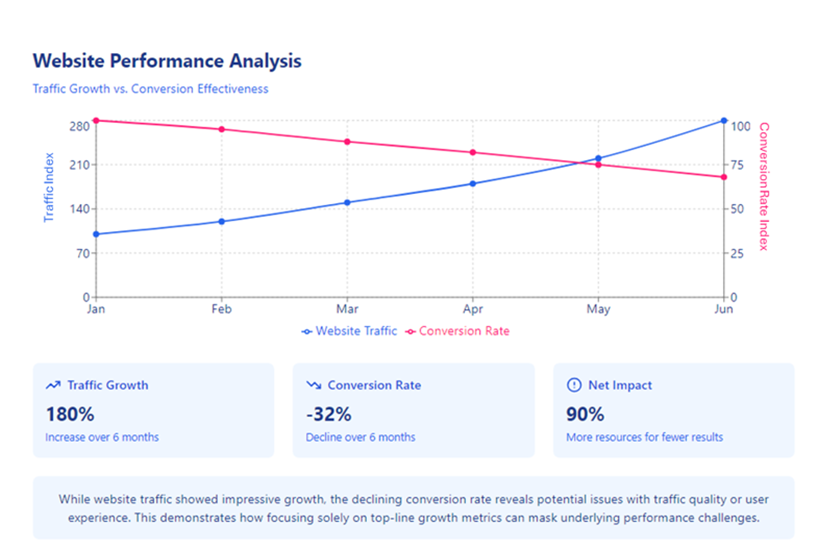
This mirrors a common challenge in business analytics: a marketing team may celebrate record-high website traffic while overlooking a simultaneous decline in conversion rates. In both cases, the facts tell part of the story, but the framing creates different narratives.
So, what’s the key lesson? Whether we’re reading news or analyzing data, partial perspectives can lead to misguided decisions. True understanding comes from seeing the full picture.
The Hidden Costs of Partial Perspectives
The consequences of relying on partial information can be significant, as we can see through two revealing examples. Consider how news coverage of short-term market volatility, when presented without contextualizing longer-term trends, can trigger panic selling among investors, leading to unnecessary financial losses. This same pattern of incomplete perspective manifested in a retail chain that focused exclusively on same-store sales growth while ignoring changing customer demographics. Their data showed impressive year-over-year growth, which led to aggressive expansion plans. However, they missed critical signals about shifting consumer preferences and emerging competition. The result? Millions invested in new locations that ultimately underperformed. In both scenarios, the data wasn't wrong—it was incomplete.
Framing and Selection Bias. The Stories We Tell Ourselves
Framing bias occurs when certain details are highlighted while others are omitted. Media outlets and analysts often make choices about what information to include based on their audience’s interests or the story they want to tell.
Truth isn't just about getting the facts right. It's about getting the right facts. Big difference, massive consequences.
In the same way, businesses can unconsciously focus on data points that support their goals while ignoring inconvenient facts.
When we examine examples of framing bias, we can see how this plays out across different contexts. In media coverage, a report might discuss job growth but omit crucial information about wage changes or the distribution between part-time and full-time positions, ultimately skewing the audience's understanding of economic conditions. Similarly, in the business world, a company might enthusiastically highlight increased app downloads following a marketing campaign while overlooking a concurrent spike in customer service complaints.
This ends the free preview.
The rest of this
content is for free members
Create a free account to get full access. No payment required.
Evidence does not make decisions. People interpret it, weigh it, challenge it, and make judgments. A courtroom reveals what leaders can learn about evidence, expertise, confidence, and data-informed decision-making.
Feeling sure doesn't mean you're right. Learn five simple ways to question what feels true, spot what might be influencing you, and make better decisions about what to believe.
We teach data literacy as a ladder: data at the bottom, wisdom at the top, climb step by step. But the rungs are not where the work happens. The judgment lives in the gaps between them, and that is exactly where AI now carries us straight past.
Every organization keeps one scoreboard for mistakes and none for missed opportunities. So people optimize the one they can see, and the largest losses never appear as losses at all. They appear as things no one tried.