AI did not end the data literacy crisis. It changed it. As machines move from providing information to interpreting it and recommending what to do, the scarce skill is becoming judgment: knowing what to trust, what to question, and what decisions are still ours to make.
Evidence does not make decisions. People interpret it, weigh it, challenge it, and make judgments. A courtroom reveals what leaders can learn about evidence, expertise, confidence, and data-informed decision-making.
Feeling sure doesn't mean you're right. Learn five simple ways to question what feels true, spot what might be influencing you, and make better decisions about what to believe.
The AI Paradox: Why Automation Increases Human Value
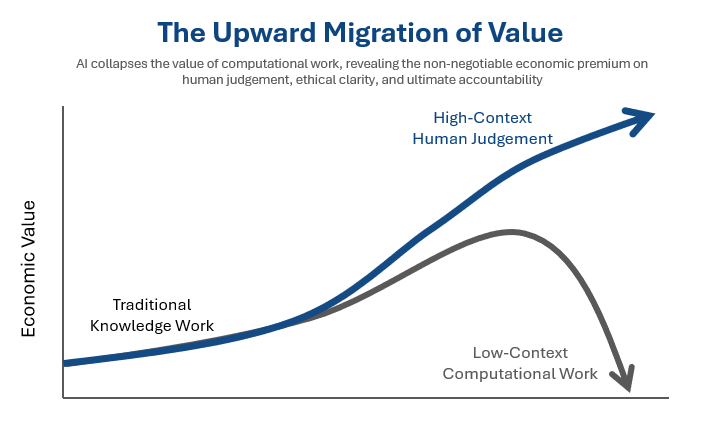
What if the economic value of knowledge workers isn't falling, it's concentrating? As AI automates computation, human judgment becomes more valuable, not less. This isn't optimism. It's pattern recognition. Organizations that understand this shift will build competitive moats.
AI collapses the value of computational work, revealing the non-negotiable economic premium on human judgement, ethical clarity, and ultimate accountability
We are not entering an AI economy. We are entering a judgment economy where the strategic premium shifts from those who can process information to those who can interpret it under conditions of ambiguity, contradiction, and consequence.
90 Second Audio Recap
0:00
/84.149116
What You Need to Know
The prevailing narrative assumes AI will collapse human economic value by automating knowledge work. That prediction only holds if knowledge work is defined as information processing. It's not. Knowledge work has always bundled two distinct activities: computation and judgment, into roles that appeared uniform because technology didn't allow their separation. AI is the unbundling. It automates the computational layer, revealing that judgment, sense-making, and accountability were always the valuable components. As AI commoditizes analysis, the economic premium on human interpretation doesn't decline, it concentrates.
Why This Matters to You If your organization still measures performance through throughput metrics, task completion rates, and handling time, you're rewarding exactly the capabilities AI will commoditize. The bottleneck in high-stakes decisions is no longer generating analysis, it's interpreting what conflicting data means, framing which problems are worth solving, and owning accountability when outcomes diverge from predictions. Organizations that continue optimizing for computational speed while failing to cultivate judgment capabilities are building toward irrelevance. The risk isn't that AI replaces your workforce, it's that your performance systems inadvertently train people for the collapsing curve while competitors architect around the concentrating one.
Who This Applies To This framework is critical for executives redesigning organizational capability, CHROs rethinking performance management, and strategy leaders positioning for competitive advantage in AI-augmented markets. It's equally relevant for knowledge workers navigating career decisions in a landscape where some skills are racing toward commodity pricing while others command unprecedented premiums. If you're responsible for workforce strategy, talent development, or organizational design, or if you're making personal investment decisions about which capabilities to build, you're operating in the divergence this article maps.
What You'll Gain from Reading You'll acquire a structural framework for distinguishing computational cognition (which AI will dominate) from contextual cognition (which remains uniquely human). You'll understand why the value curve is bending upward rather than collapsing, supported by labor economics research and market salary data. You'll gain the conceptual clarity to identify which organizational capabilities are appreciating assets versus depreciating ones, and the strategic vocabulary to articulate why judgment, ethical reasoning, and accountability represent defensible competitive advantages rather than soft skills. After reading, you'll be able to evaluate whether your organization is architected for the economy that's emerging or the one that's disappearing.
You are being told two things at once. First, that AI will replace 40% of your workforce within five years. Second, that you need to invest heavily in upskilling everyone who remains.
Both narratives rest on the same assumption: that knowledge work is primarily information processing. That assumption is about to cost you a strategic advantage.
Pause the AI hype for a moment and ask a simpler question. What is the actual job of a knowledge worker? If your answer is information processing, the future looks bleak. If your answer is sense-making, judgment, and responsibility, the future looks entirely different. The first definition collapses under automation. The second becomes more valuable than ever.
The Prevailing Narrative Gets the Curve Wrong
Many futurists predict that as AI becomes more capable, the economic value of the knowledge worker will approach zero. Some even suggest humans may eventually carry negative value if they slow down or interfere with automated systems.
That prediction only works if we define knowledge work incorrectly. Once we recognize that knowledge work is fundamentally the act of interpreting information in context, the entire curve starts to bend upward.
What follows is a structured case for why human value will rise, supported by research and grounded in twenty five years of work helping organizations build data-informed decision-making capabilities. This is not optimism. This is pattern recognition across industries, disciplines, and automation waves.
The organizations that understand this shift will build competitive moats. Those who miss it will commoditize themselves.
As AI automates more of the computational work, we are not watching the end of the knowledge economy. We are watching the rise of the judgment economy, where competitive advantage flows to organizations that can interpret, decide, and take responsibility under uncertainty.
1. The Premise Assumes Substitution, Not Recombination
Many arguments assume that AI will simply replace human tasks one-for-one. That view flattens history and misunderstands how technology actually transforms work.
This ends the free preview.
The rest of this
content is for free members
Create a free account to get full access. No payment required.
AI did not end the data literacy crisis. It changed it. As machines move from providing information to interpreting it and recommending what to do, the scarce skill is becoming judgment: knowing what to trust, what to question, and what decisions are still ours to make.
We teach data literacy as a ladder: data at the bottom, wisdom at the top, climb step by step. But the rungs are not where the work happens. The judgment lives in the gaps between them, and that is exactly where AI now carries us straight past.
Every organization keeps one scoreboard for mistakes and none for missed opportunities. So people optimize the one they can see, and the largest losses never appear as losses at all. They appear as things no one tried.
What a historic Red Sox winning streak reveals about the Two Clocks of decision-making. Every important decision is made between the deadline to act and the time required for evidence to mature. That's where judgment matters most.