AI did not end the data literacy crisis. It changed it. As machines move from providing information to interpreting it and recommending what to do, the scarce skill is becoming judgment: knowing what to trust, what to question, and what decisions are still ours to make.
Evidence does not make decisions. People interpret it, weigh it, challenge it, and make judgments. A courtroom reveals what leaders can learn about evidence, expertise, confidence, and data-informed decision-making.
Feeling sure doesn't mean you're right. Learn five simple ways to question what feels true, spot what might be influencing you, and make better decisions about what to believe.
The Alibi Effect: How Analytics Replace the Judgment They Were Meant to Support
When a decision fails, leaders point to the model. The analysis had already removed the judgment that would have caught the mistake, long before the call was made. This is how analytics stops being a tool you use and becomes one you hide behind.
The model didn't fail you. It replaced the judgment that would have caught the mistake.
TL;DRWhy the alibi was built years before the bad decision
What you need to know
The familiar critique of analytics is that models sometimes give wrong answers and leaders should treat them carefully. The deeper problem runs underneath. Analytics also quietly removes the slow work that builds the judgment to recognize a wrong answer in the first place, then absorbs the blame when judgment fails. The visible alibi after a bad call is only possible because a less visible substitution happened years earlier.
Why this matters to you
Most consequential calls today come with analytical cover. The pain is not that the cover is wrong now and then. It is that leaders can defend a decision in the room and still not own it, and they have stopped doing the work that would let them know when the model is missing something. The current state is fluent agreement with the dashboard. The better state is using the analysis to sharpen your thinking, carrying it into the moment as one voice, and owning the call when it goes sideways.
Who this applies to
Anyone whose decisions ride on analytical inputs in high-stakes moments. Operators making calls under time pressure. Executives presenting bets to a board. Analysts and decision scientists watching their work get used as cover. Boards and change leaders responsible for the systems that decide where accountability lands when a call fails.
What you'll gain from reading
A working distinction between the kind of decision an analytical tool was built for and the kind it cannot carry. A way to recognize the substitution while it is happening, not years later. Language for the asymmetry where credit routes up to the person and blame routes sideways to the tool. And a clearer sense of what the slow developmental work actually produces, so you can tell when efficiency is removing waste and when it is removing the formation that makes ownership possible.
The executive stood in front of the board explaining why the initiative had failed. A forecast that once looked solid no longer matched reality. The market had moved, assumptions had broken down, and the expected outcome never arrived.
Then came the sentence that ended the real conversation. "The model recommended it." The room stopped examining the decision and started examining the model. But that was not where the story began. By the time decision-makers point to a model after a bad decision, they have often spent years relying on it to answer questions they used to have to answer themselves.
Most people notice the move that happens after the decision. The model becomes part of the explanation, and responsibility starts to drift. The scary part is that few people notice what made that move possible.
It's called the Alibi Effect: when analysis becomes a substitute for judgment on the way in and a shield from accountability on the way out.
Understanding how that happens requires distinguishing between two very different kinds of decisions.
Prep-grade tools, in-game decisions
Most data tools are built for one kind of decision and asked to do another.
The first kind of decision is prep-grade. Conditions are stable, the question is well-defined, and you have time. In sports, that is a general manager building a draft board who has weeks to prepare. In business, that is a CFO modeling next year's pricing over the span of months. In both those situations, the work rewards patience and rigor.
The second kind of decision is in-game. Conditions shift while you are deciding and the question keeps changing shape. In sports, that is a coach calling a timeout with forty seconds left who does not have time to consult a chart. In business, that is a CEO responding to a competitor's surprise announcement. They cannot wait for the model to refresh.
Analytics in both business and sports were built mostly for the first kind of decision. The trouble starts when leaders pull prep-grade tools into in-game moments, and then point at those tools when the call goes wrong.
The tools themselves are not the problem. Market sizing models, AI-assisted competitive analysis, and algorithmic screening do real work. In sports, expected goals (xG) has genuinely changed football. Fourth down models have shown NFL coaches were systematically too conservative for decades. These tools frame decisions, narrow options, and pressure-test assumptions. What they cannot do is carry the weight of the specific moment.
The model knows what tended to work across thousands of situations. It does not know what matters in this one.
What the Sports Models Actually Measure
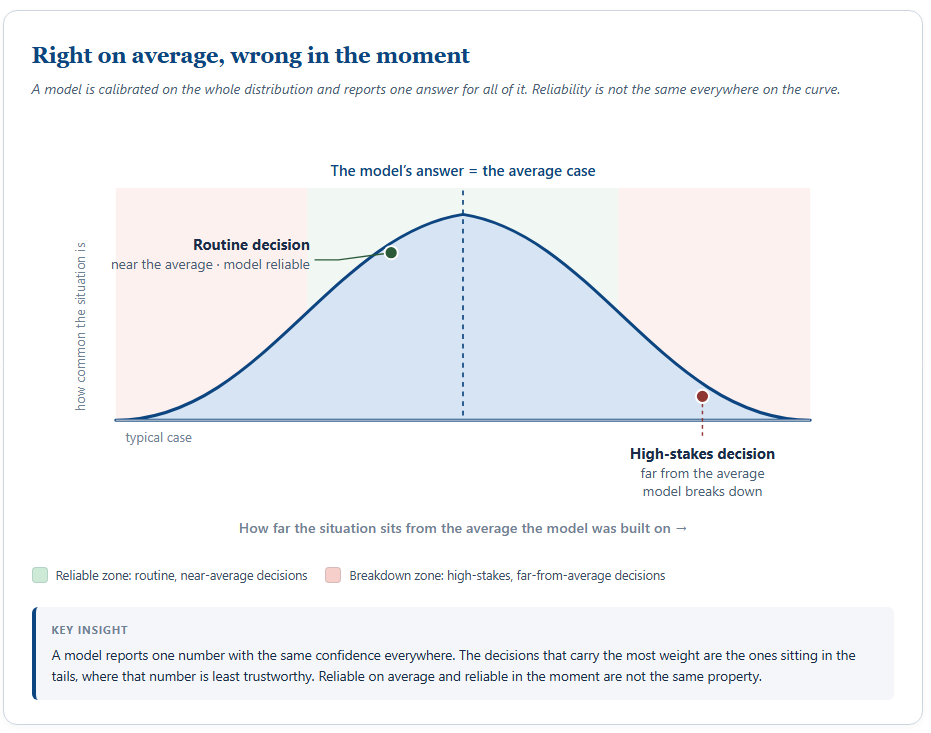
Fourth down win-probability charts are built on thousands of plays across many seasons. They tell you, on average, what tends to maximize expected points from a given field position. They do not tell you what to do in this game, with this offensive line, against this defense, with this quarterback playing through a shoulder injury. A regular season decision sits closer to the average. A playoff decision against an elite opponent sits further from it. The model is right on average and can be wrong in the specific case.
Expected goals works the same way. It aggregates shot quality across a season to reveal patterns invisible inside a single match. The model is powerful at that scale. Inside ninety minutes, the sample is too small for xG to render a verdict. A team can dominate xG and lose because the model does not weight chance sequencing, defensive transitions, or the psychological effect of conceding first.
Both tools are calibrated for the long run. Most consequential decisions are short-run decisions where the specifics carry the weight. The instrument is excellent. The application is wrong.
A model reports the same confidence whether it knows the answer or not.
Inform, don't replace
None of this means analytics belongs only in the planning room. The decision-makers who get this right do not switch the analysis off when the pressure rises, they carry it into the moment and let the moment push back. The model still helps. It just stops being the one making the call.
A pricing model might suggest a particular discount level based on thousands of prior deals. The sales leader still knows that the customer just changed CEOs, that a competitor has entered the account, and that this renewal carries strategic importance beyond the contract value. The model informs the decision. It does not make it.
The model was built to summarize the long run. It can inform a short-run decision but it can't make one.
The alibi has two operations
When a decision goes wrong, decision-makers sometimes point to the artifact behind it, like the model recommended it, or the forecast supported it, or the AI ranked it first. The analysis becomes part of the explanation. Sometimes that explanation is fair as models can be wrong. The problem occurs when the artifact does more than explain the decision. It starts carrying responsibility for it.
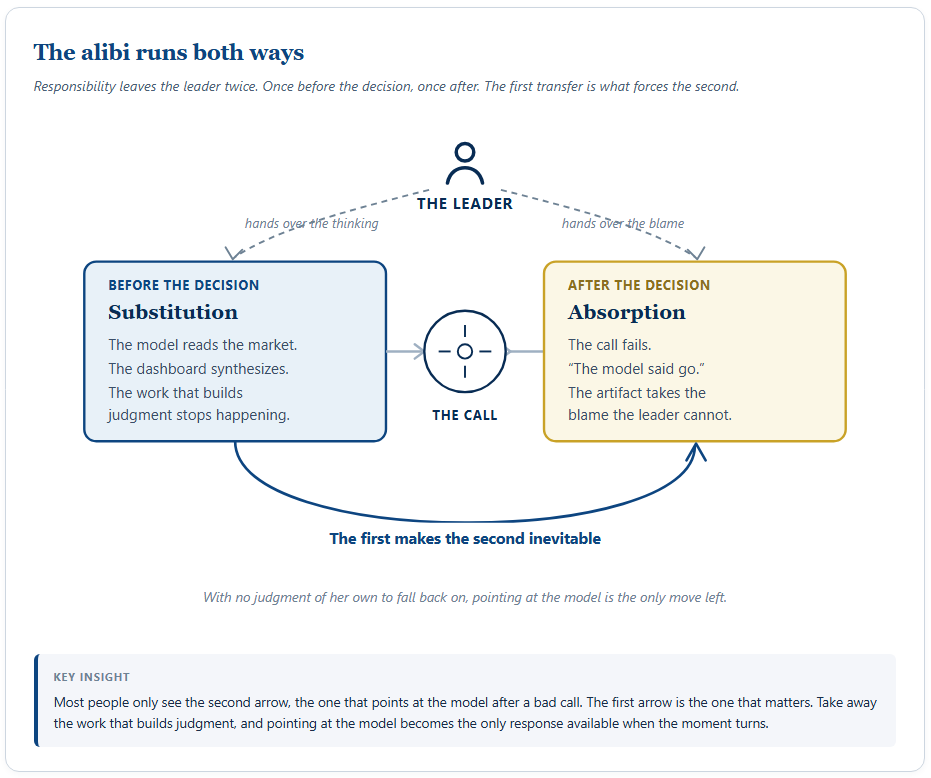
That is the alibi, and it runs in two directions.
One operation runs before the decision. The artifact substitutes for the work that builds judgment. The model reads the market for you, the dashboard synthesizes for you, or the AI summarizes the field for you. Each shortcut removes something. What is important is that many people think what was removed is waste. Some of it is, but not all of it. Some of what was removed was forming the decision-maker.
The other operation runs after the decision. The artifact absorbs the blame when judgment fails. The model said go. The AI flagged the candidate. The analysis showed the market was ready. The leader points at the chart in a different room than the one where the call was made.
Both move responsibility from the person to the artifact. The first removes the work that builds judgment. The second leaves the decision-maker with nothing to fall back on when judgment is exactly what the moment demands. And the first makes the second inevitable.
Before the decision
This is the half no one points to or talks about, because it never produces a moment to point to.
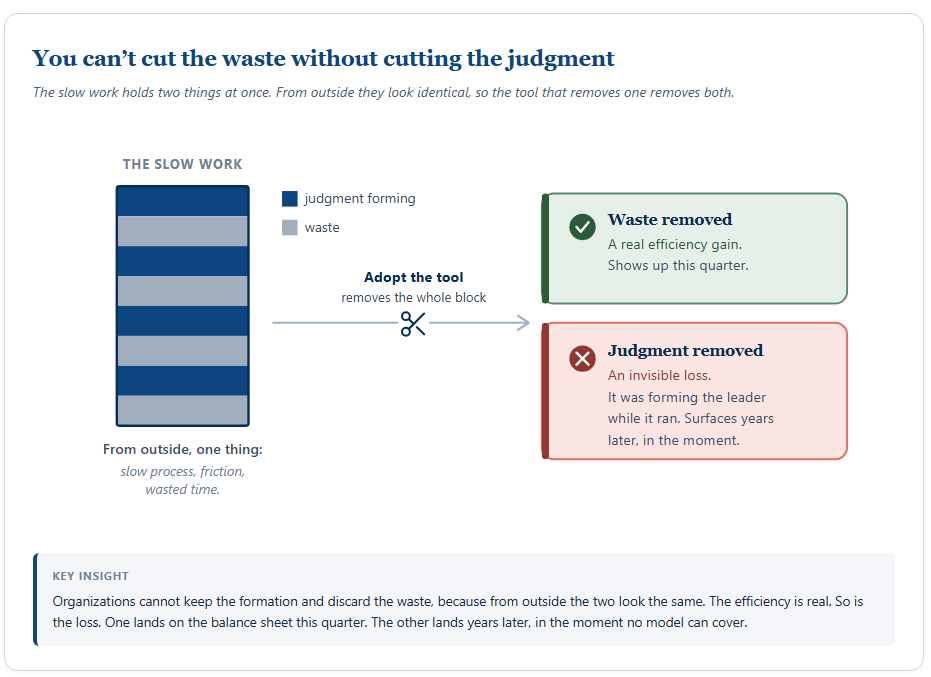
The slow read of the market that taught a generation of executives to feel a competitor's move coming. Or the argument over the draft pick that taught the GM how to weigh upside against fit. Or the grind through the data that built calibrated intuition. The hours in the field that produced the judgment the model cannot summarize, because the judgment was forming in the process itself.
AI summarizes, models score, and dashboards rank. Each shortcut removes something, and organizations can't easily tell waste from formation. They look the same from outside. Both look like time, friction, slow process. The leader who insists on the slow process looks defensive or nostalgic. The leader who adopts the tool looks decisive. Years pass. The tool delivers real efficiency. The forming work quietly stops.
The danger is not that AI gets an answer wrong now and then, it's that it removes the activities through which people learn to recognize a wrong answer when they see one.
Then the in-game moment arrives. The decision-maker is done prepping and needs to stand behind their decision. But, the model is wrong about something specific, and the decision-maker has no way to know what. That kind of knowing was supposed to come from the work the model has been doing for years. When the call fails, the only move left is to point at the model. The substitution made the absorption necessary.
The dashboard did your thinking for years. Then came the moment that needed you.
After the decision
This is the second half of the alibi and the half everyone will recognize.
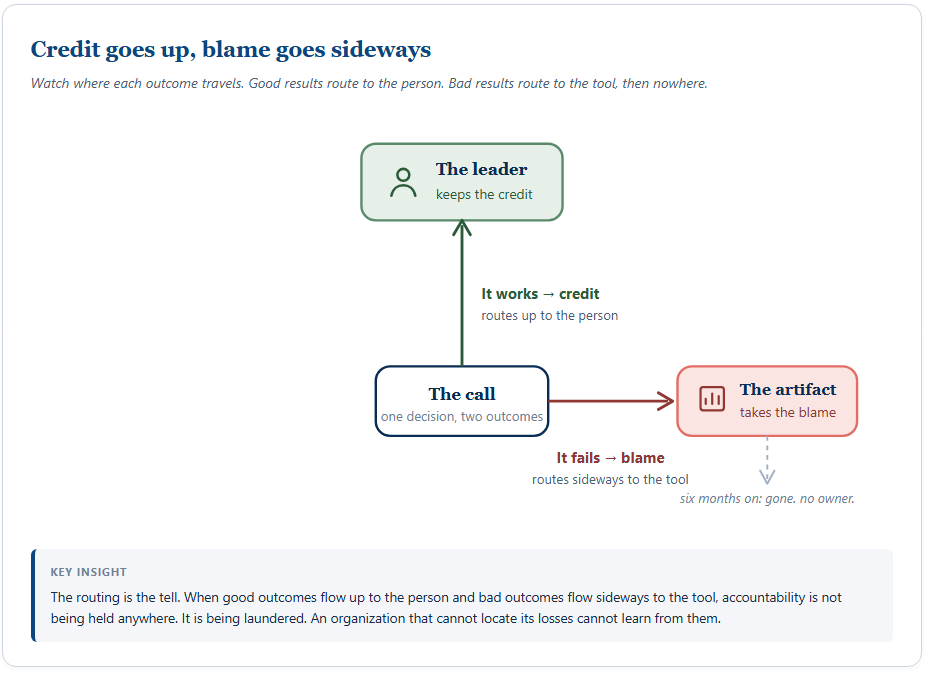
When the decision works, the decision-maker takes the credit. Good instincts, sharp execution, decisive action under pressure. When the decision fails, the model takes the blame. The good outcomes belong to the person and the bad ones belong to the tool.
It is important to note that accountability does not disappear here, it diffues. It seeps out of the decision-maker and into the artifact, where no one can hold it, because an artifact is not the kind of thing you hold responsible.
The failed acquisition, or the botched hire, or the strategic bet that did not land. Six months later the model is gone, the consultant is gone, the executive has moved on, and nobody owns the loss. And worst of all, the organization learns nothing from it.
This half is the easier one to fix. The harder half is what created the conditions for it.
The same move in four business tools
The pattern is identical to the sports case. Each one is built for the aggregate. The decision lives in the specific.
AI-assisted hiring
Built for surfacing candidates a tired recruiter would scroll past.
Blind to whether the person ranked fourth is the only one who will actually thrive on your team.
Market sizing and forecasting
Built for showing whether you are playing in a real market or a vanity one.
Blind to whether to greenlight this product, this quarter, given what you heard in last week’s customer interviews.
Algorithmic pricing
Built for optimizing across thousands of transactions where the elasticity curve holds.
Blind to the strategic account where the relationship and the competitor matter more than the curve.
AI-generated strategy
Built for producing an output that reads well and sounds authoritative.
Blind to what you learned in yesterday’s hallway conversation, or which board member is wobbling.
The tool is built for the aggregate. The decision lives in the specific.
When the call works, you take the credit. When it fails, the model does.
Organizations often reward both side of the Alibi Effect
The Alibi Effect is not just an individual habit. Organizations often reward both sides of it. Before the decision, they celebrate speed, efficiency, and automation. Market research becomes a dashboard or competitive analysis becomes an AI summary. Activities that once helped leaders develop their own understanding gradually disappear because the artifact can produce an answer faster.
After the decision, many of those same organizations make it easy to point back to the artifact. The forecast supported it, or the framework recommended it, or the model ranked it first. Responsibility becomes harder to locate because it has been spread across processes, tools, committees, and reports.
The result of this is a system that weakens judgment on the way in and diffuses accountability on the way out. The alibi works because the system around it was built to let it work, coming and going.
What good looks like
The decision-makers who get this right do something both simple and hard. They use the analysis to sharpen their thinking before the moment, and then they carry it into the moment as one voice among several. And when the decision goes wrong, they own it.
When the decision fails, they say so plainly. The analysis pointed one way, I weighed it against other things, I made the call, and it did not work. They do not hand ownership to the artifact. The analysis stays evidence and the decision stays theirs.
This is harder than it sounds, and harder than the current culture admits. Owning the call in the boardroom requires having done the slow work in private. A decision-maker who has not read the market, argued the pick, ground through the data cannot own the call, because they cannot evaluate it. They can only repeat what the model said.
The courage to refuse the visible alibi depends on having refused the invisible one years earlier. The slow work is what builds the judgment that makes owning the call possible.
Back to the boardroom
Picture the meeting going differently.
The executive stands in front of the board, the initiative still failed, and says something closer to this. The forecast was wrong. The assumptions did not hold. The model was one input, I made the call, and I own the result.
You can imagine how that lands. Some board members would find it refreshing. Others would call it career-limiting. Either way it sounds like a leader, not a defendant.
The meeting is only the visible part though. Behind their ability to say those words is a longer story. They have been reading the market themselves, not just receiving the dashboard. They can tell when the model has missed something. They own the call because they have done the work that builds the capacity to own it.
The boardroom is the easy version. The pattern shows up everywhere analytical artifacts give decision-makers cover: AI-generated strategy memos, governance committees citing the framework, consulting decks invoked months after the consultants left, and the postgame press conference with the xG chart on the screen. The artifact changes and the move stays the same.
Data-informed decision-making was never meant to move responsibility. It was meant to raise the quality of the responsibility you already hold.
If the analysis is doing the owning in your organization, it is doing work it was never built for. Someone, somewhere, is getting away with a decision they should be answering for. The boardroom is the easy part. The harder question is what the analysis has been quietly owning for years, in the moments no one was watching.
If the analysis is doing the owning, someone is getting away with the loss.
Where to go from here
The point of this article is not to stop using data, analytics, or AI. It is to make sure they remain inputs to judgment rather than substitutes for it. If you're curious whether the Alibi Effect is showing up in your own decisions, start with the Alibi Audit. It helps you examine a decision you've already made and identify where analysis was informing the call, where it was replacing judgment, and where responsibility may have quietly shifted from person to artifact.
If you're facing an important decision right now, use the Own-the-Call Card instead. It is designed to be completed before the decision is made. The goal is simple: clarify what the analysis is telling you, what it cannot know, and what you are choosing to own regardless of the outcome.
The test is not whether the model was right, it is whether you can still explain the decision without hiding behind it.
Kevin is an author, speaker, and thought leader on topics including data literacy, data-informed decisions, business strategy, and essential skills for today. https://www.linkedin.com/in/kevinhanegan/
AI did not end the data literacy crisis. It changed it. As machines move from providing information to interpreting it and recommending what to do, the scarce skill is becoming judgment: knowing what to trust, what to question, and what decisions are still ours to make.
Evidence does not make decisions. People interpret it, weigh it, challenge it, and make judgments. A courtroom reveals what leaders can learn about evidence, expertise, confidence, and data-informed decision-making.
Feeling sure doesn't mean you're right. Learn five simple ways to question what feels true, spot what might be influencing you, and make better decisions about what to believe.
We teach data literacy as a ladder: data at the bottom, wisdom at the top, climb step by step. But the rungs are not where the work happens. The judgment lives in the gaps between them, and that is exactly where AI now carries us straight past.