AI did not end the data literacy crisis. It changed it. As machines move from providing information to interpreting it and recommending what to do, the scarce skill is becoming judgment: knowing what to trust, what to question, and what decisions are still ours to make.
Evidence does not make decisions. People interpret it, weigh it, challenge it, and make judgments. A courtroom reveals what leaders can learn about evidence, expertise, confidence, and data-informed decision-making.
Feeling sure doesn't mean you're right. Learn five simple ways to question what feels true, spot what might be influencing you, and make better decisions about what to believe.
The Biggest Things We Have to Unlearn after 2025 (And Why That's a Good Thing)
2025 revealed a quiet mismatch between what people knew and what work required. AI made the gap visible, not by replacing humans, but by raising the bar for judgment, context, and adaptation. This article explores the unlearning that followed.
2025 was the year the gap between 'working harder' and 'working differently' became undeniable. 2026 is when we find out who's willing to redesign instead of just reoptimize.
90 Second Audio Recap
0:00
/86.81941
What You Need To Know
2025 forced a reckoning: many beliefs that built careers and organizations are now creating fragility instead of value. This isn't about adopting new tools or working harder, it's about unlearning core assumptions around performance, control, expertise, and what makes people and systems resilient. The organizations and individuals struggling most aren't those who failed to adapt quickly enough. They're the ones still optimizing for a world that no longer exists.
Why This Matters to You If you feel exhausted despite high output, if your team moves fast but produces brittle decisions, if new technology keeps disappointing despite its promise, you're likely operating on outdated mental models. The cost shows up as silent disengagement, avoidable failures that nobody owns, and strategies that look good in reports but collapse under execution. What worked in stable conditions becomes the constraint in uncertain ones. The question isn't whether to unlearn, it's whether you'll do it deliberately or let reality force it on you.
What You'll Gain from Reading This article provides diagnostic frameworks to identify which beliefs are costing you energy and creating organizational fragility. You'll understand why control-based systems fail under uncertainty, why psychological safety is a strategic capability rather than a culture initiative, and why skill fitness matters more than skill possession when expertise has an expiration date. You'll leave with clarity on what to stop defending and what to start building, not because it's trendy, but because the world changed and your operating model needs to catch up.
Every year teaches us something. 2025 demanded something harder. It demanded unlearning.
Not the fluffy kind. The real kind. The kind where you realize a belief you built your identity around is no longer helping you, your team, or your organization. The kind where you stop asking, "How do we optimize this?" and start asking, "Should this even exist in this form anymore?"
If 2024 was the year of acceleration, 2025 was the year of friction.
Not because people got worse. Because the world got more complex, more automated, more polarized, and more emotionally expensive. A lot of what "worked" before still looked good in reports but collapsed under execution.
You can't optimize your way out of a problem that requires redesign. And you can't redesign what you're still trying to defend.
Here are the biggest things we had to unlearn in 2025, and what replaced them.
1) Output Is Not Worth
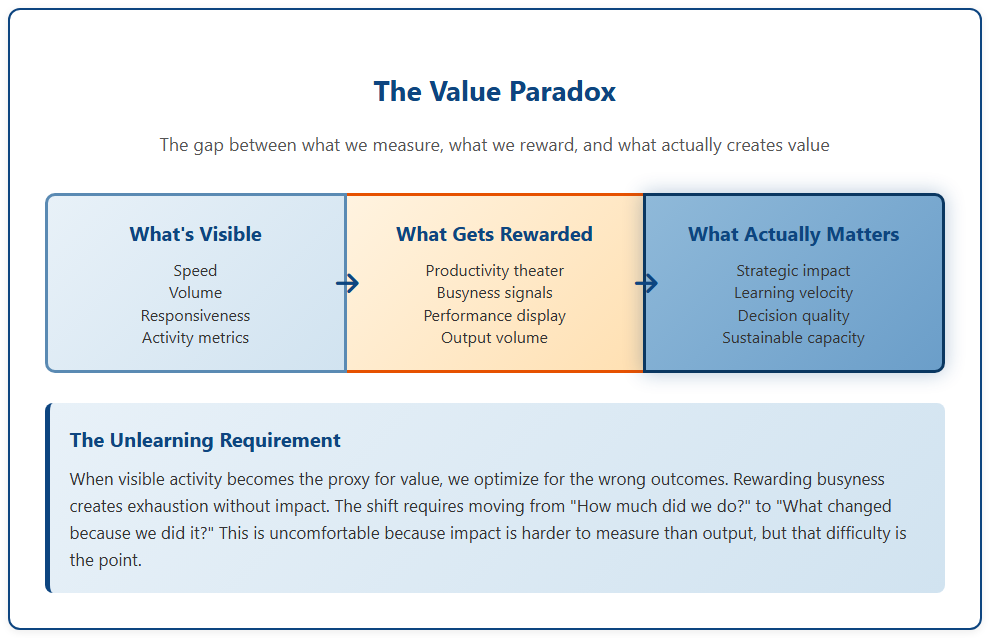
Busyness became the performance signal we could measure easily, so we stopped measuring what actually mattered. The unlearning isn't about working less. It's about admitting that visible activity was always a proxy, and proxies break when the world gets complex.
This is the one that quietly broke a lot of people.
We spent years rewarding visible output: speed, volume, responsiveness, productivity theater. Then 2025 made that model impossible to sustain. The cost showed up everywhere: burnout, silent disengagement, short-termism, and leaders who felt like they had to perform competence instead of practice it.
Unlearning required a brutal reframe:
Performance is not the same thing as value
Busyness is not a proxy for contribution
Capacity is a business constraint, not a personal weakness
What replaced it is a more adult definition of value: impact over activity, learning over perfection, and sustainability over heroics.
The gap between what we measure and what actually creates value explains why so many high-performing individuals feel exhausted without impact. Closing this gap requires redefining performance itself.
2) Control-Based Leadership Creates Fragility
Control-based systems don't fail loudly, they fail quietly, one deferred decision at a time, until the accumulated weight of unresolved complexity collapses all at once.
Control looks efficient until it meets uncertainty.
2025 punished command and control in subtle ways. It slowed decisions. It created compliance instead of commitment. It trained people to hide problems instead of surface them early. It produced organizations that looked aligned until reality changed.
The old model assumed leaders must have answers, control prevents risk, and certainty builds confidence.
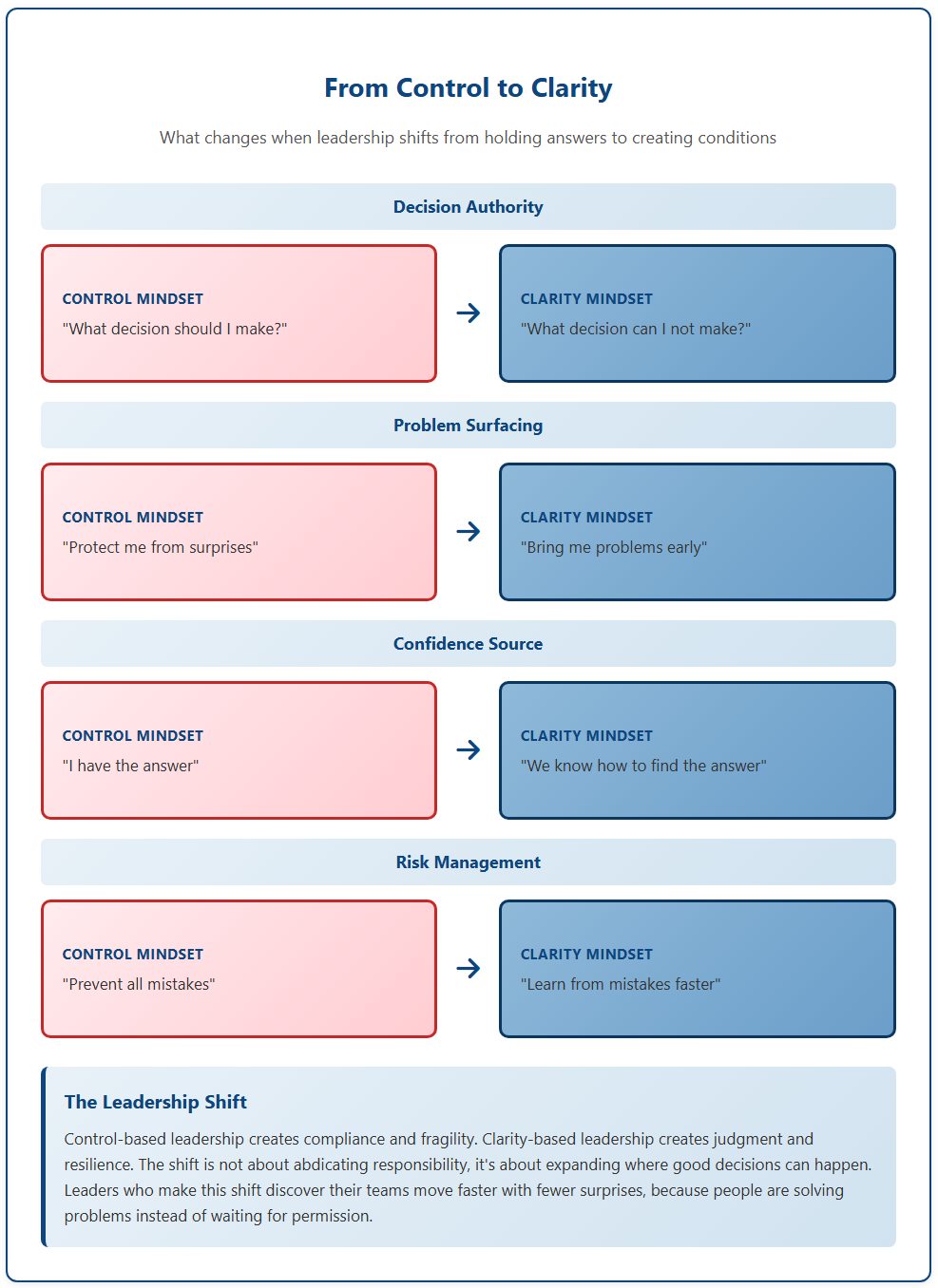
The shift from control to clarity isn't about abandoning responsibility, it's about multiplying where good judgment can happen. Leaders who make this transition find their teams move faster with better outcomes.
The new reality taught the opposite.
Leaders who stopped asking "What decision should I make?" and started asking "What decision can I not make?" found their teams moved faster with fewer surprises. They set direction, then created conditions for good judgment to compound. They designed decision rights instead of holding decision authority.
Resilience came from learning speed, not rigid control. Confidence came from clarity and candor, not certainty. If your culture depends on people pretending everything is fine, it will collapse the moment something actually matters.
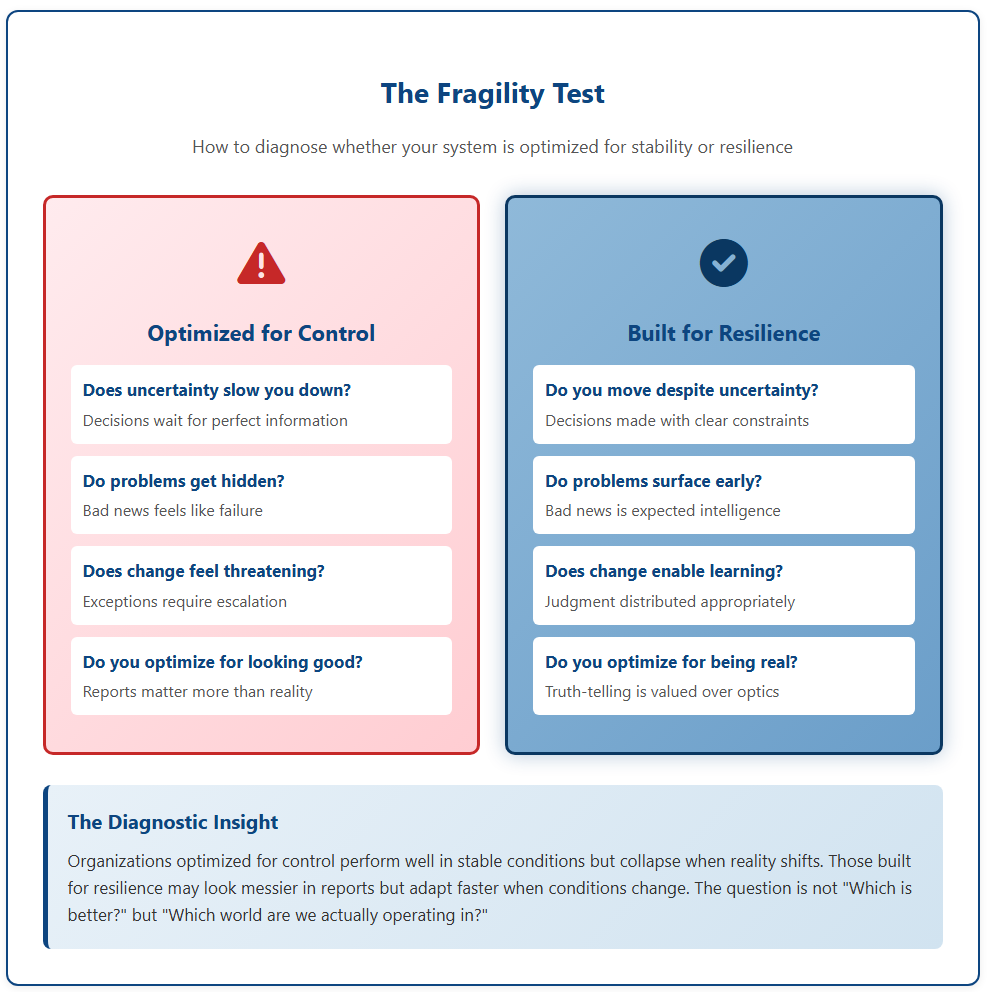
Organizations optimized for control look efficient in stable conditions but collapse under uncertainty. Use this diagnostic to assess whether your systems are built for appearances or for resilience.
3) Psychological Safety Is Not "Soft"
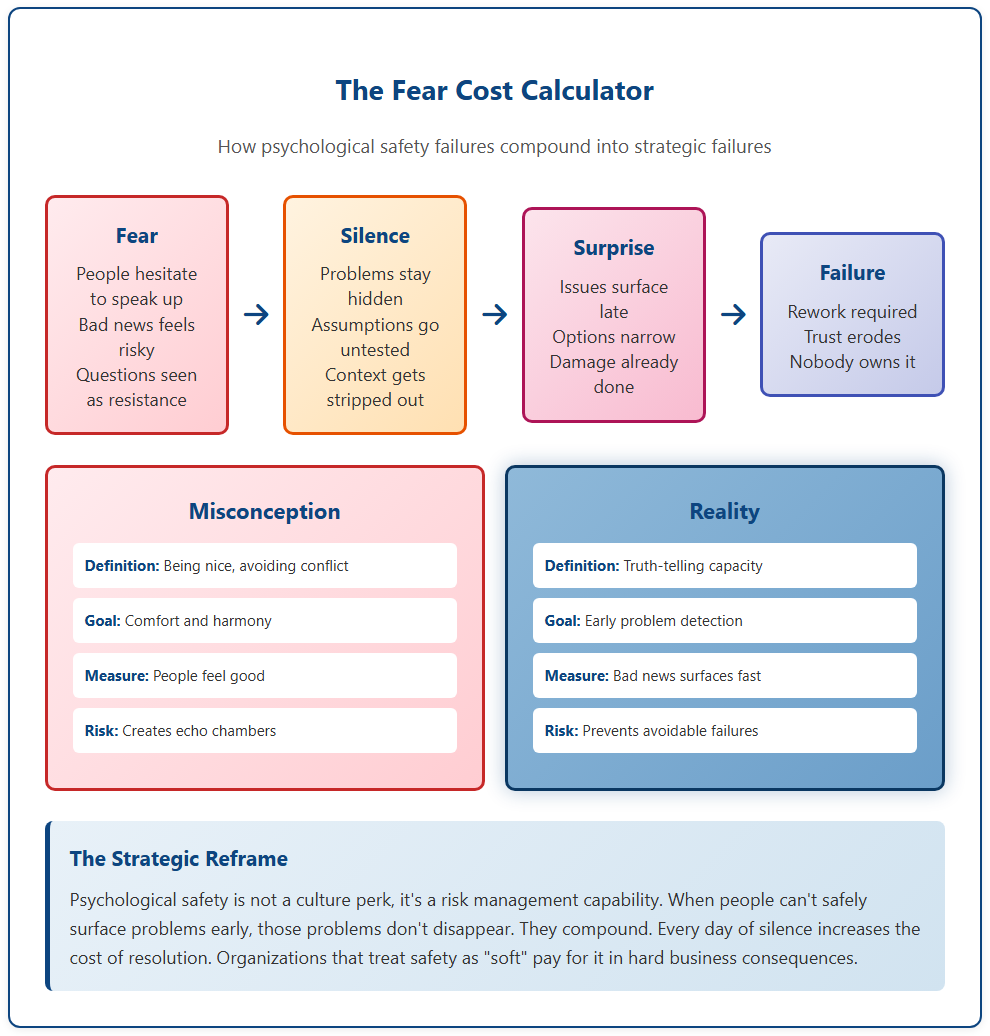
Fear is the most expensive thing you're not measuring. It shows up as late surprises, rework, reputational damage, and strategic blindspots, but we call it 'unexpected turbulence' instead of what it actually is: the cost of silence.
This year made one thing unmistakable: fear is expensive.
Fear creates silence. Silence creates surprises. Surprises create rework, reputational damage, and avoidable failures that nobody wants to own.
A lot of organizations had to unlearn the idea that psychological safety is a "nice-to-have" culture initiative. In 2025, it showed up as a strategic capability. It became a prerequisite for innovation, risk management, and responsible use of AI.
The unlearning looked like this:
Stop treating safety as comfort
Start treating safety as truth-telling capacity
Stop punishing mistakes
Start punishing concealment
Psychological safety is not about being nice. It's about making it possible for people to say what is real.
Fear doesn't just create discomfort, it creates strategic blindspots. When bad news can't surface safely, problems compound silently until they become crises. This is why psychological safety is a risk management capability, not a culture perk.
4) Careers Are Not Stable, Skills Are Not Permanent
Skill fitness is the new competitive advantage. It's not what you know today, it's how fast you can rebuild capability when the ground shifts tomorrow.
2025 accelerated something uncomfortable: the half-life of skills kept shrinking faster than career planning could accommodate.
Degree. Job. Identity. Repeat.
That narrative worked in slower eras. It breaks when roles keep morphing and what made you valuable two years ago may not be what makes you valuable next year. Many professionals felt the discomfort of realizing their expertise had an expiration date they hadn't planned for.
What happened in 2025 that made this unavoidable? AI crossed a threshold. Not in capability alone, but in accessibility. Suddenly, skills that felt durable became table stakes or disappeared into automation. The gap between "I know how to do this" and "this still matters" widened faster than most people anticipated.
The unlearning is simple to say and hard to live:
You are not your job title
You are not your tool stack
You are not done learning
What replaces it is a different kind of confidence: the ability to adapt, reframe, and rebuild capability without spiraling.
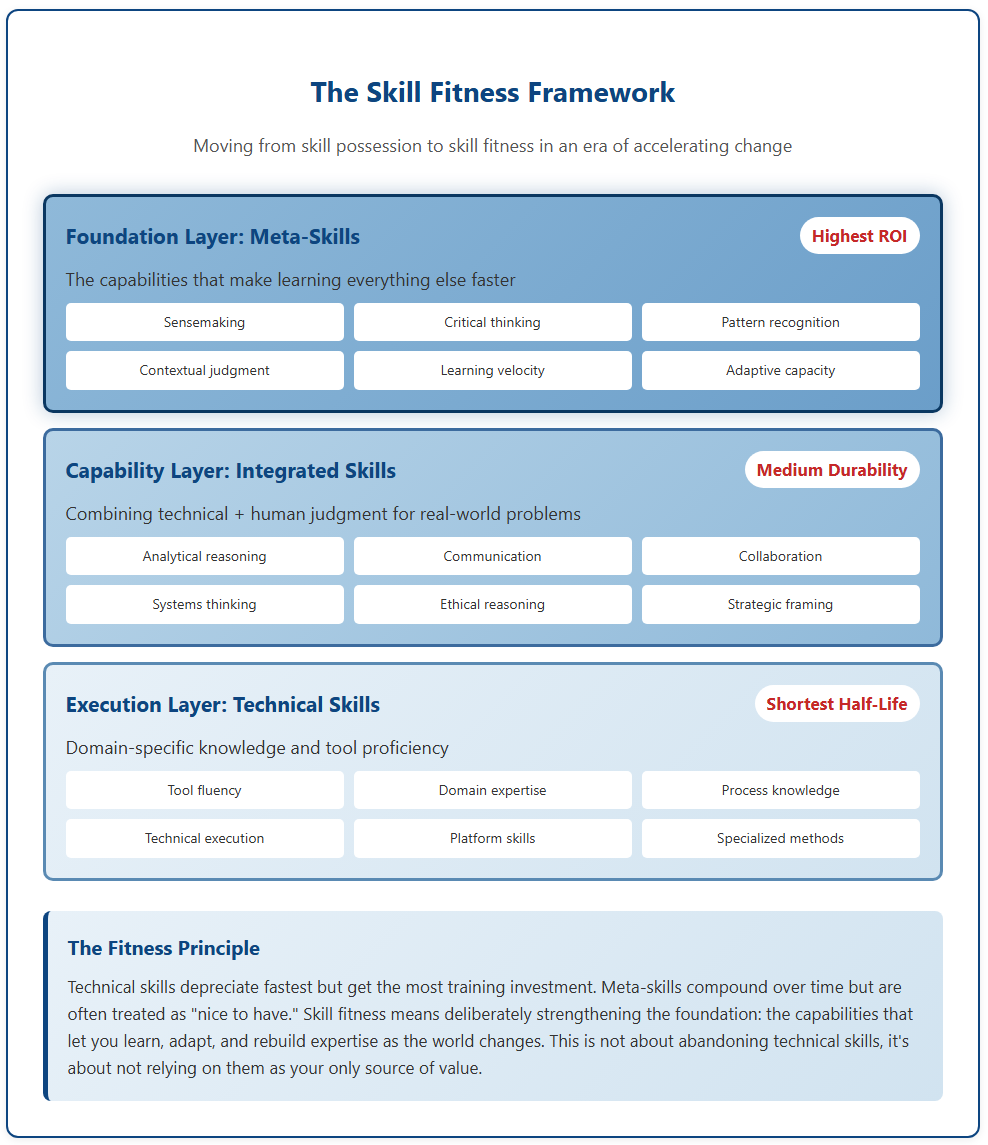
In other words, skill fitness becomes more important than skill possession.
When technical skills depreciate faster than we can retrain, the competitive advantage shifts to meta-skills, the capabilities that make learning everything else faster. This framework shows where to invest your development energy.
This ends the free preview.
The rest of this
content is for free members
Create a free account to get full access. No payment required.
Evidence does not make decisions. People interpret it, weigh it, challenge it, and make judgments. A courtroom reveals what leaders can learn about evidence, expertise, confidence, and data-informed decision-making.
Feeling sure doesn't mean you're right. Learn five simple ways to question what feels true, spot what might be influencing you, and make better decisions about what to believe.
We teach data literacy as a ladder: data at the bottom, wisdom at the top, climb step by step. But the rungs are not where the work happens. The judgment lives in the gaps between them, and that is exactly where AI now carries us straight past.
Every organization keeps one scoreboard for mistakes and none for missed opportunities. So people optimize the one they can see, and the largest losses never appear as losses at all. They appear as things no one tried.