AI did not end the data literacy crisis. It changed it. As machines move from providing information to interpreting it and recommending what to do, the scarce skill is becoming judgment: knowing what to trust, what to question, and what decisions are still ours to make.
Evidence does not make decisions. People interpret it, weigh it, challenge it, and make judgments. A courtroom reveals what leaders can learn about evidence, expertise, confidence, and data-informed decision-making.
Feeling sure doesn't mean you're right. Learn five simple ways to question what feels true, spot what might be influencing you, and make better decisions about what to believe.
The Decision-Making Model You Learned Is Designed for a World That No Longer Exists
Decisions don’t fail because they’re poorly made. They fail because assumptions go unchecked. In a fast-changing world, organizations need systems that continuously test, learn, and adjust while decisions are still in motion, not after outcomes are already locked in.
Most organizations treat decisions as conclusions. The best organizations treat them as experiments.
90 Second Wisdom Audio Brief
0:00
/95.178594
What You Need To Know
Most decision frameworks treat the decision as the finish line. That assumption no longer holds. Decisions now outlive the conditions they were based on, which means the real risk is not making the wrong call upfront, but failing to detect when the logic behind it breaks. The shift is from decision-making to decision-learning.
Why This Matters to You You are likely operating in an environment where more data, more analysis, and more alignment are not producing better outcomes. The issue is not effort. It is that decisions are left unexamined while they are still active. Without a structured way to test assumptions and adjust in motion, teams continue down paths that no longer make sense, often realizing it too late to act efficiently.
Who This Applies To This applies to anyone responsible for making or influencing decisions under uncertainty. People who are asked to justify choices with incomplete information, navigate competing interpretations of data, or carry accountability for outcomes that unfold over time. If your work involves translating insight into action, this is your problem space.
What You’ll Gain from Reading A way to think about decisions as evolving hypotheses rather than fixed commitments. A structured approach for identifying and testing assumptions, monitoring early signals, and responding while there is still time to adjust. Clarity on how to move from one-time decision quality to continuous decision capability.
The best decision your organization made last year might be wrong by now. The problem is, nobody has checked.
Think about the last major decision your organization made. A budget allocation. A program launch. A technology investment. A strategic pivot. Think about how much effort went into making that decision. The business case. The stakeholder alignment. The data gathering. The approvals.
Now think about what happened after. How much structured effort went into finding out whether the assumptions underneath that decision were still correct six months later?
For most organizations, the answer is close to zero. Research shows that only about 20% of projects receive any form of post-decision review. The other 80% run on their original logic until the annual review, at which point the only question is whether the KPI hit the target. Nobody examines why.
Organizational learning research has documented this gap for decades. Studies of after-action reviews and post-implementation learning consistently show that organizations spend far more time planning decisions than examining whether those decisions actually worked. Outside of fields like aviation and the military, structured review processes remain surprisingly rare, even though they are one of the most effective ways to improve decision quality over time.
The Decision Gap. Most organizations invest 85% of their structured effort before the decision and less than 5% after. Yet the highest-value learning, whether assumptions held, whether the environment changed, whether the decision is still sound, happens after implementation. McKinsey research confirms the cost: 61% of executive decision-making time is spent ineffectively, and roughly 80% of projects never receive a structured post-decision review. The framework described in this article is designed to close this gap.
This is not a failure of effort. It is a failure of design. The decision-making frameworks most professionals learned, whether in MBA programs, leadership training, or management books, were built for a different world. They follow a familiar path: define the problem, gather data, analyze, decide, implement. Some add a "monitor" step at the end. Most treat the decision as the finish line.
That model worked when the world moved slowly enough that your assumptions could survive six months without checking. It does not work anymore.
Three Changes That Broke Traditional Decision Models
Decisions now outlive their assumptions
A strategic decision made in January may be operating on assumptions that are contradicted by April. Markets shift. Competitors move. Customer behavior changes. Regulations evolve. Technology reshapes entire industries between planning cycles.
“In a stable world, good decisions survive unchanged. In a changing world, good decisions evolve.”
The traditional model assumes that the conditions present at decision time will hold long enough for the outcome to arrive. That assumption itself is now the most dangerous one in your portfolio. A six-month planning cycle that worked in 2005 is too slow for the pace at which the ground is shifting today.
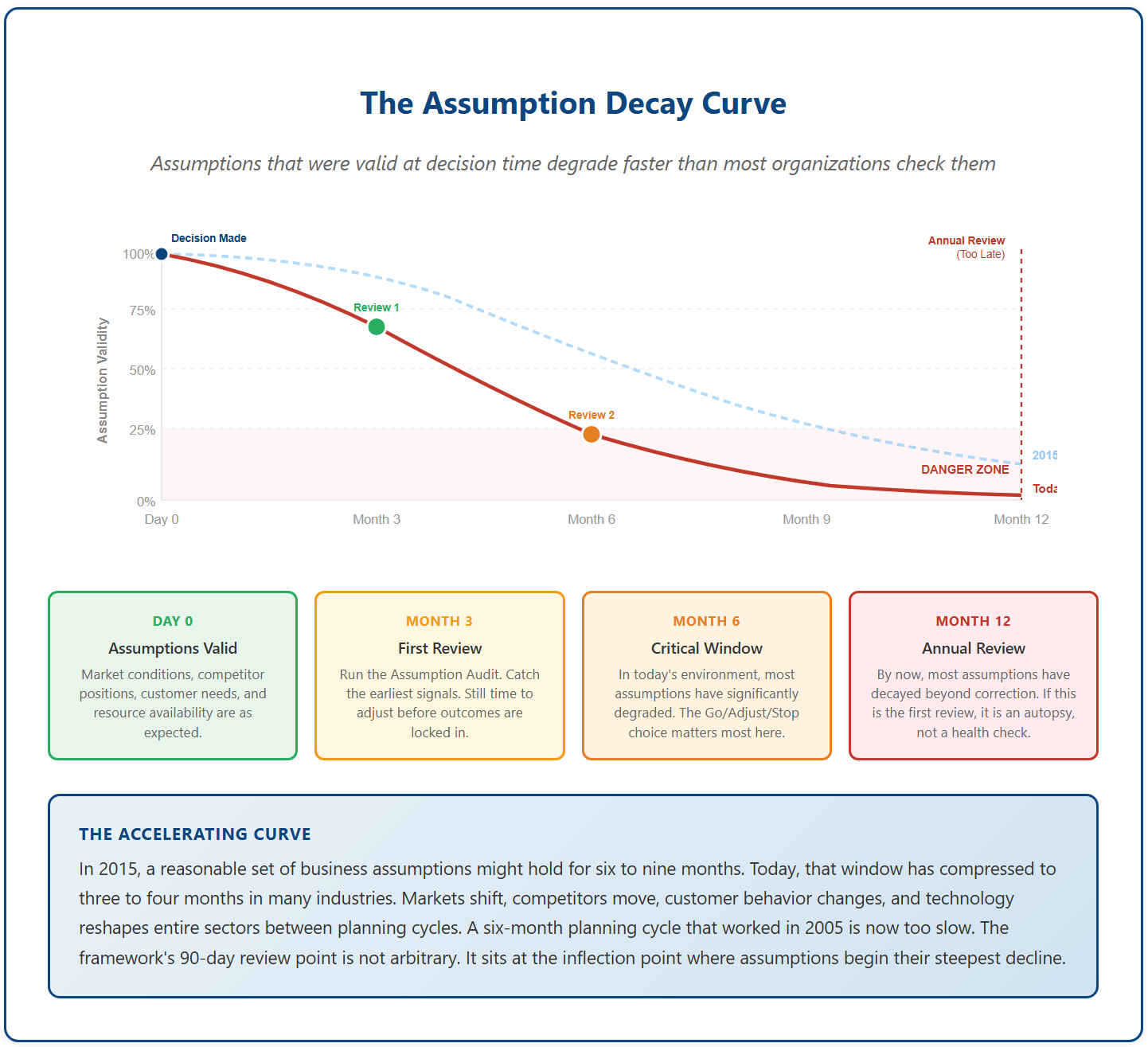
The Assumption Decay Curve. Assumptions that were valid at decision time degrade faster than most organizations check them. In 2015, a reasonable set of business assumptions might hold for six to nine months. Today, that window has compressed to three to four months in many industries. The framework's 90-day review point sits at the inflection point where assumptions begin their steepest decline. An annual review, by contrast, arrives long after the window for course correction has closed
What you need is not better prediction at the front end. You need a system that checks whether your assumptions are still holding while the decision is still active. Not after the project ends. Not at the annual review. While there is still time to adjust.
This ends the free preview.
The rest of this
content is for free members
Create a free account to get full access. No payment required.
AI did not end the data literacy crisis. It changed it. As machines move from providing information to interpreting it and recommending what to do, the scarce skill is becoming judgment: knowing what to trust, what to question, and what decisions are still ours to make.
Evidence does not make decisions. People interpret it, weigh it, challenge it, and make judgments. A courtroom reveals what leaders can learn about evidence, expertise, confidence, and data-informed decision-making.
Feeling sure doesn't mean you're right. Learn five simple ways to question what feels true, spot what might be influencing you, and make better decisions about what to believe.
We teach data literacy as a ladder: data at the bottom, wisdom at the top, climb step by step. But the rungs are not where the work happens. The judgment lives in the gaps between them, and that is exactly where AI now carries us straight past.