AI did not end the data literacy crisis. It changed it. As machines move from providing information to interpreting it and recommending what to do, the scarce skill is becoming judgment: knowing what to trust, what to question, and what decisions are still ours to make.
Evidence does not make decisions. People interpret it, weigh it, challenge it, and make judgments. A courtroom reveals what leaders can learn about evidence, expertise, confidence, and data-informed decision-making.
Feeling sure doesn't mean you're right. Learn five simple ways to question what feels true, spot what might be influencing you, and make better decisions about what to believe.
The Five Behaviors That Separate Data-Informed Leaders from Everyone Else
Frameworks do not change organizations. Behaviors do. After years working with executive teams globally, the difference comes down to five disciplines so automatic they do not require willpower to activate.
Frameworks do not change organizations. Behaviors do.
90 Second Wisdom Audio Brief
0:00
/78.576327
What You Need To Know
Most organizations treat better decision-making as a knowledge problem. It is not. The professionals who consistently make stronger decisions are not the ones who know the most frameworks. They are the ones who have built a small number of disciplines into how they actually work, so automatic that they do not require a checklist to activate. The gap between knowing what good looks like and doing it under pressure is not closed by more training. It is closed by aligning three layers: the behaviors you practice, the mindsets that sustain them, and the beliefs underneath that determine whether any of it survives the first moment of organizational resistance.
Why This Matters to You You have almost certainly been in a room where a team made a confident decision on untested assumptions, continued investing in something the evidence no longer supported, or skipped the one conversation that could have changed the outcome. These are not failures of intelligence. They are failures of discipline, and they are predictable. The cost is not abstract: resources committed to the wrong initiative are resources unavailable for the right one, and every month of delayed discovery compounds the damage. The difference between organizations that catch problems early and those that discover them at the annual review is not better tools. It is five specific behaviors practiced until they become reflexive.
Who This Applies To This applies to anyone who makes decisions under uncertainty, defends recommendations with incomplete data, or has ever watched a team continue down a path that the evidence suggested they should leave. That includes executives setting strategy, managers allocating resources, analysts building the case, and individual contributors deciding where to invest their attention. The challenge is not role-specific. It is cognitive: the same biases that prevent a senior leader from calling stop prevent an analyst from naming a disconfirming hypothesis.
What You Will Gain from Reading You will walk away with five behaviors you can start practicing immediately, beginning with one that takes less than two minutes and changes how you relate to every decision you make. You will understand why most professional development fails to change how people actually decide, and what has to be true at the belief level for any behavior to stick under pressure. You will have a clear mental model for the difference between acting on conviction and acting on a hypothesis, and you will know which one leads to faster learning, earlier correction, and fewer expensive surprises.
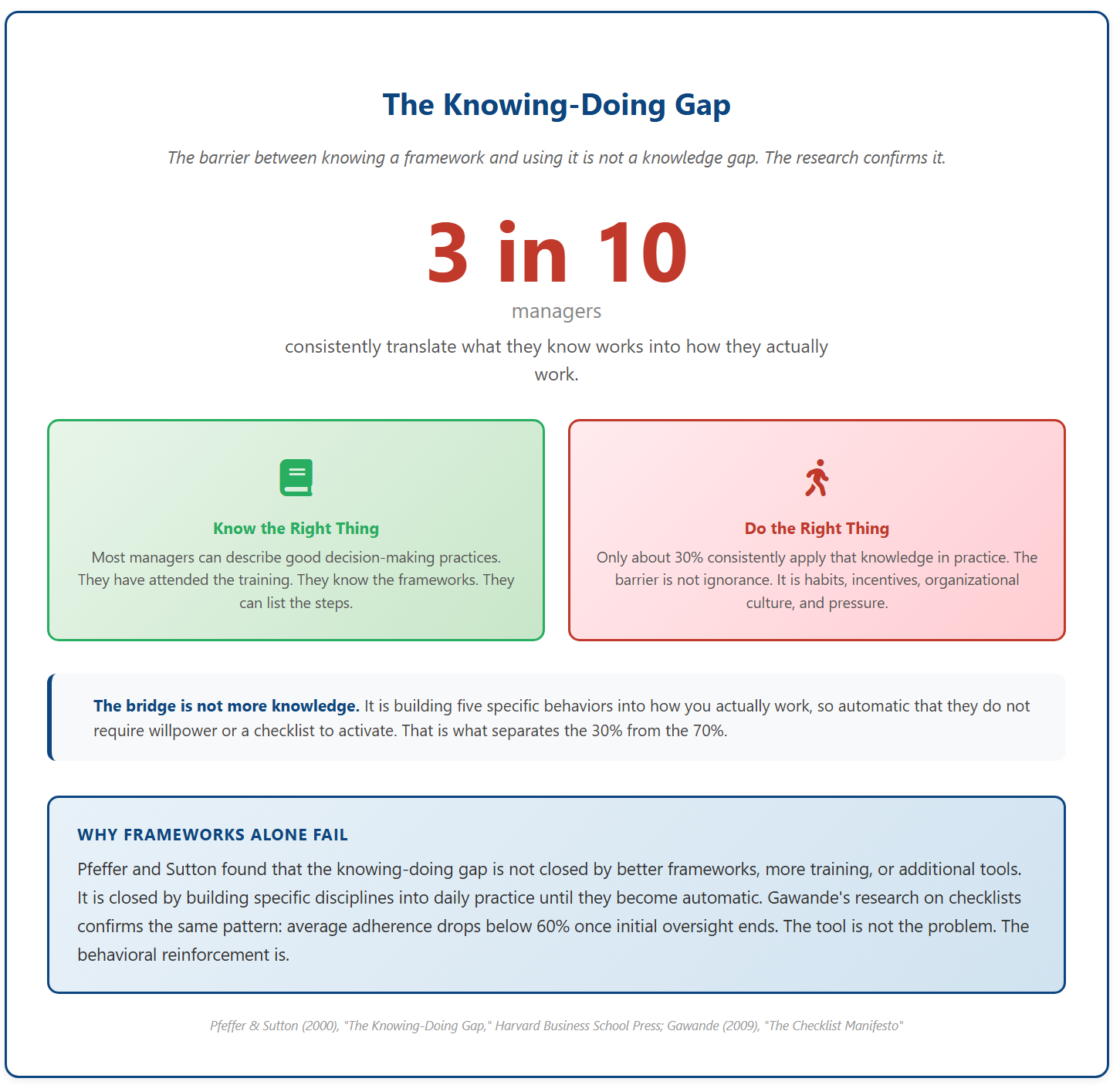
You can teach someone a 10-step decision-making process. You can give them templates, tools, and a wall poster with the steps listed in order. None of it matters if they walk into the next meeting and make the same decision the same way they always have.
The gap between knowing a framework and using it is not a knowledge gap. It is a behaviour gap. The professionals who consistently make better decisions are not the ones who know the most frameworks. They are the ones who have built a small number of disciplines into how they actually work, disciplines so automatic that they do not require willpower or a checklist to activate.
After years of working with organizations on data-informed decision-making, from executive teams at the United Nations to data leaders at the National Library Board of Singapore, I have found that the difference comes down to five behaviours, five mindsets, and a set of beliefs that most professionals have never been asked to examine.
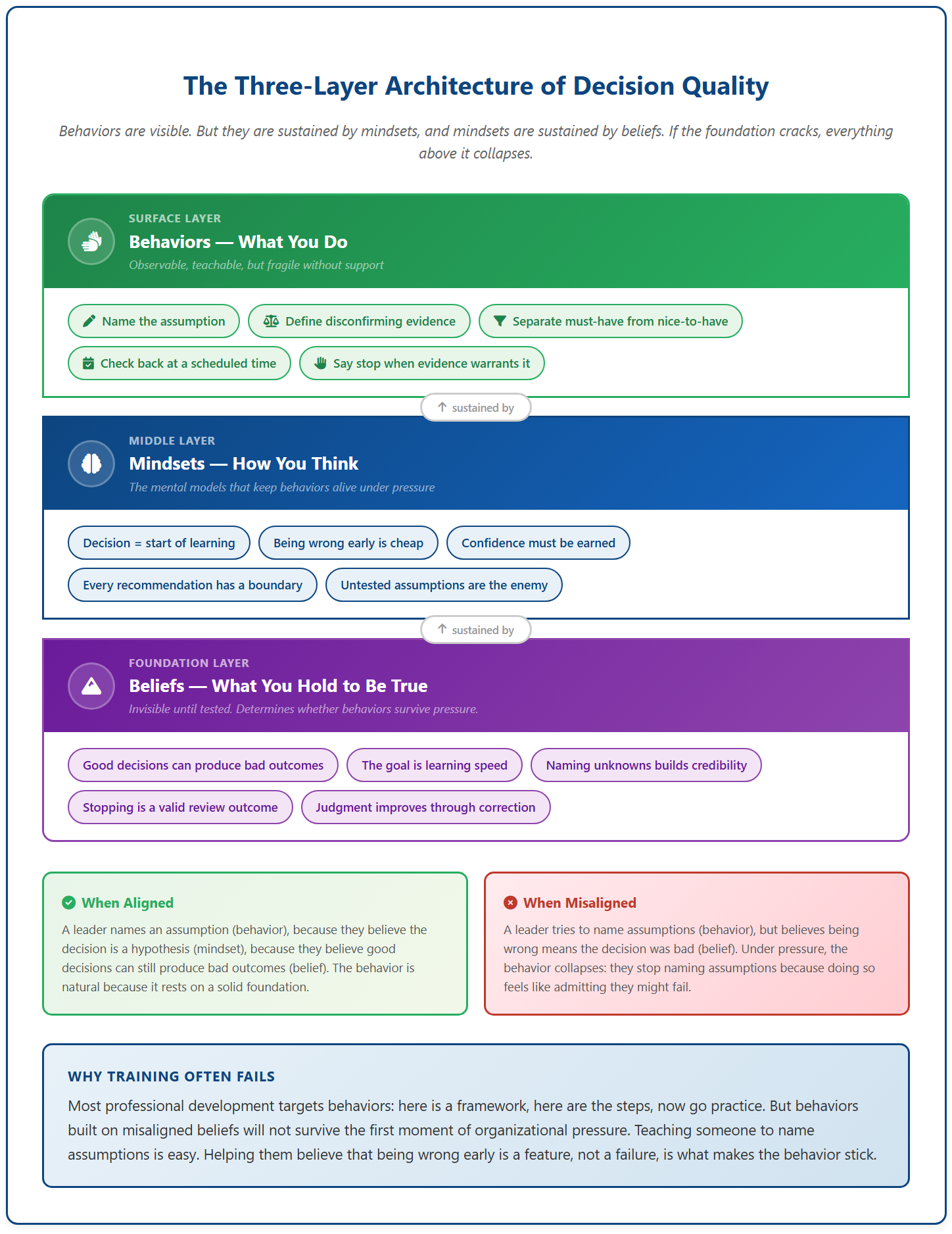
The behaviours are what you do. The mindsets are how you think. The beliefs are what you hold to be true about decisions, data, and your own judgement. All three layers have to align. A good behaviour built on the wrong belief will not survive pressure.
The Five Behaviors
1. Name the assumption before you act on it
This is the single most important behaviour in data-informed decision-making. It is also the one most professionals skip.
Every decision rests on assumptions. When a team decides to expand into a new market, they are assuming the demand exists, that their product translates, that they can hire locally, and that the regulatory environment is navigable. When a manager decides to restructure a team, they are assuming the current structure is the bottleneck, that the new structure will be accepted, and that productivity will recover within a reasonable timeframe.
Most of the time, nobody names these assumptions. They operate invisibly, treated as facts rather than hypotheses. The team moves forward with full confidence, and the confidence comes not from evidence but from the simple fact that nobody paused to ask "what are we assuming here?"
The behaviour is deceptively simple: before committing to a course of action, write down the three assumptions the decision depends on. Not the risks. Not the open questions. The assumptions. The things you are treating as true without evidence.
An assumption you have named is a hypothesis you can test. An assumption you have not named is a blind spot operating without your knowledge. The act of naming it does not require you to have the answer. It requires you to acknowledge the question exists.
2. Define what would change your mind before you look at the evidence
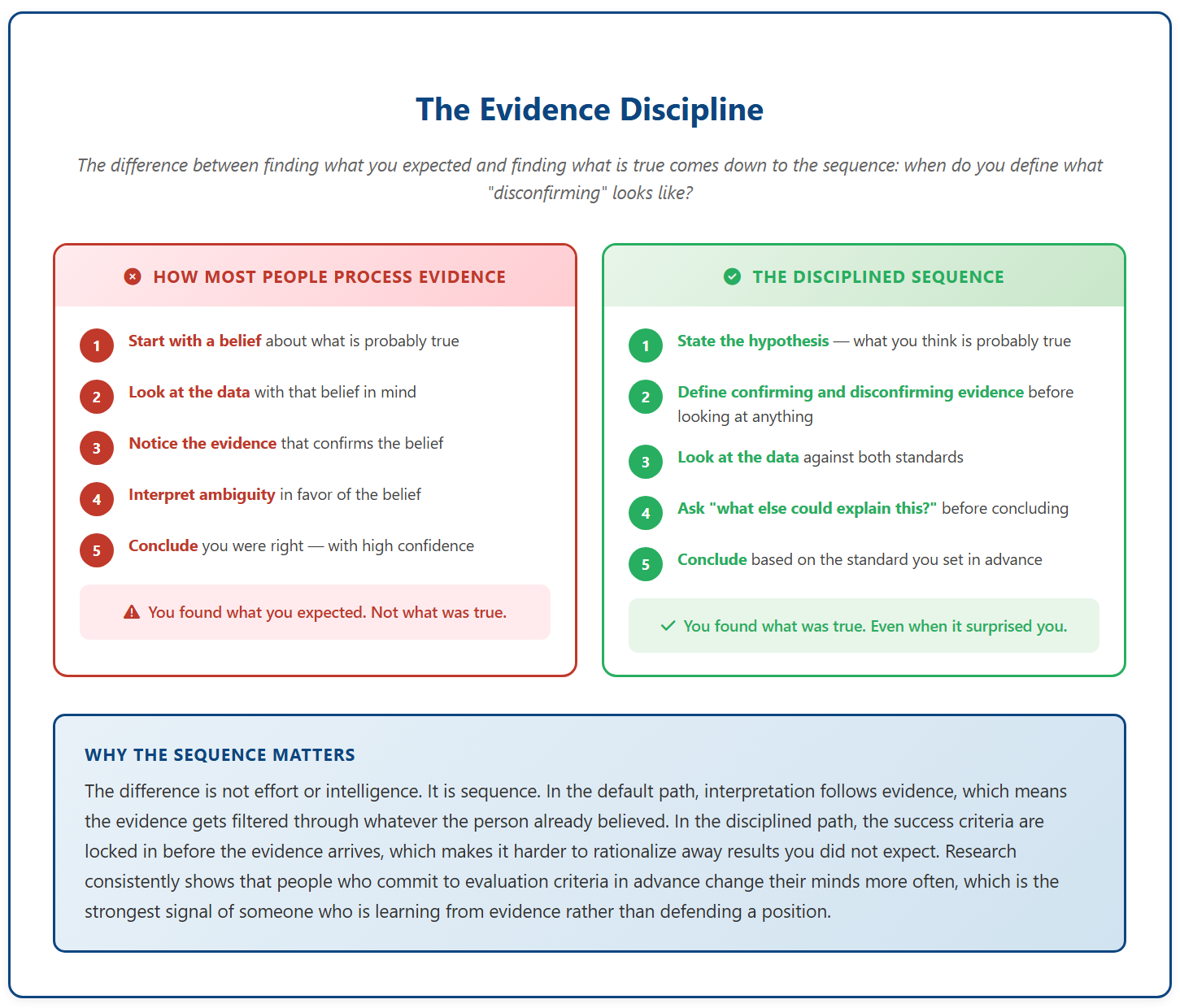
Most professionals look at data and then decide what it means. The interpretation happens after the evidence arrives, which means the evidence gets filtered through whatever the person already believed.
Research from the American Psychological Association found that nearly 70% of people prefer information that confirms their existing beliefs over information that might challenge them. This is not a character flaw. It is how human cognition works. Confirming evidence feels right. Contradicting evidence feels uncomfortable. Without a deliberate counter-measure, you will find what you expected to find almost every time.
The counter-measure is simple but requires discipline: before you look at any data, define what confirming evidence would look like and what contradicting evidence would look like. Write both down. Then look at the data.
This does two things. First, it forces you to take the possibility of being wrong seriously before the emotional pull of the evidence arrives. Second, it creates a standard you committed to in advance, which makes it harder to rationalize away results you did not expect.
The professionals who do this consistently make noticeably different decisions than those who do not. They change their minds more often, which sounds like a weakness but is actually the strongest signal of someone who is learning from evidence rather than defending a position.
3. Separate must-have from nice-to-have before you start gathering
Most data-gathering efforts fail not because the data is bad but because nobody defined what evidence would actually change the decision. Teams collect broadly, analyze extensively, and present comprehensively, producing detailed reports that answer questions nobody was asking while leaving the actual decision question untouched.
The behaviour is: before gathering any data, ask "if I had this data point, would it change which option I choose?" If the answer is no, it is nice-to-have. If the answer is yes, it is must-have. Gather the must-haves first. Everything else can wait.
This sounds obvious. In practice, it is remarkably rare. Most professionals start from what data is available rather than what data is needed. They ask "what do we have?" when they should be asking "what would change our mind?" The result is analysis that is convenient rather than useful: thorough on the questions the data can answer, silent on the questions the decision actually requires.
The discipline of separating must-have from nice-to-have also reveals something important: sometimes the must-have data does not exist. Discovering this early is not a failure. It is one of the most valuable findings you can make, because it tells you that the decision will be made on assumptions rather than evidence, which changes how much you should commit and how soon you should review.
4. Check back at a scheduled time
The most consequential behaviour in this entire list is also the simplest: put a review date in the calendar at the time you make the decision, and show up.
Not when something goes wrong. Not when someone raises a concern. Not at the annual review. At a predetermined point, set in advance, early enough that you still have time to adjust if the assumptions are not holding.
Most professionals experience relief when a decision is made. The hard part is over. They move on to the next thing. The initiative runs on its original logic, unexamined, until the quarterly numbers arrive or a crisis forces attention. By then, it is too late for adjustment. The options have narrowed to damage control or denial.
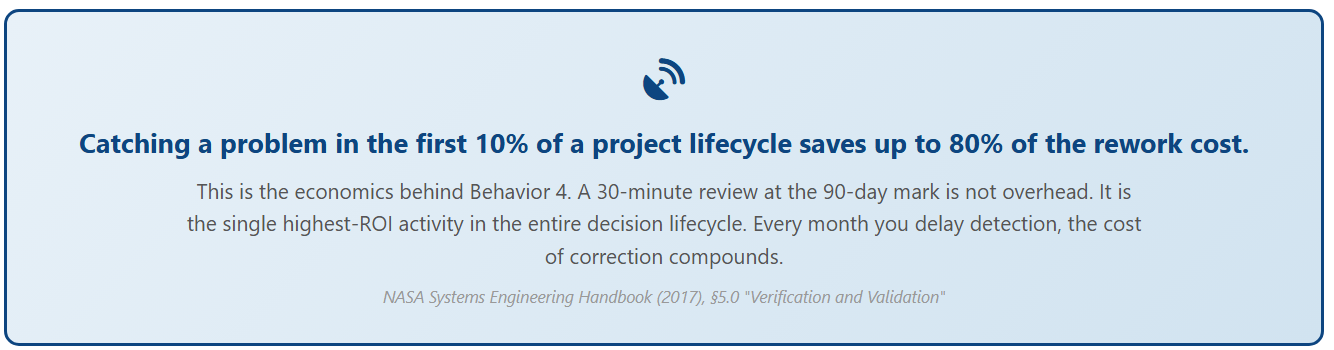
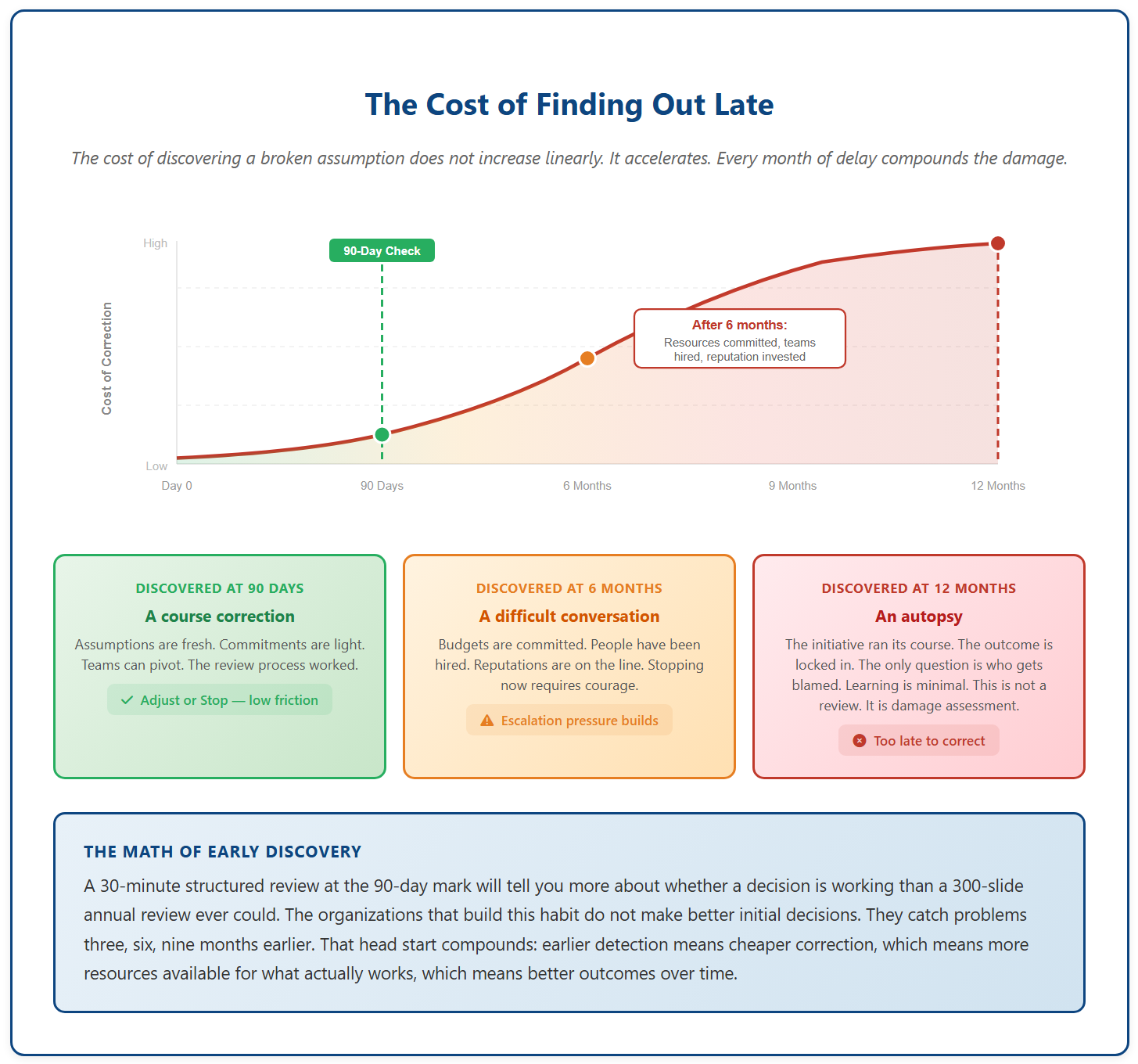
A 30-minute structured review at the 90-day mark, checking three things (are the assumptions holding, is the leading indicator moving, has new information arrived), will tell you more about whether a decision is working than a 300-slide annual review ever could.
The behaviour is not complex. It is just uncommon. The organizations that build this habit outperform those that do not, not because they make better initial decisions but because they catch problems three, six, nine months earlier.
5. Say stop when the evidence warrants it
This is the hardest behaviour on the list and the most important one for organizational health.
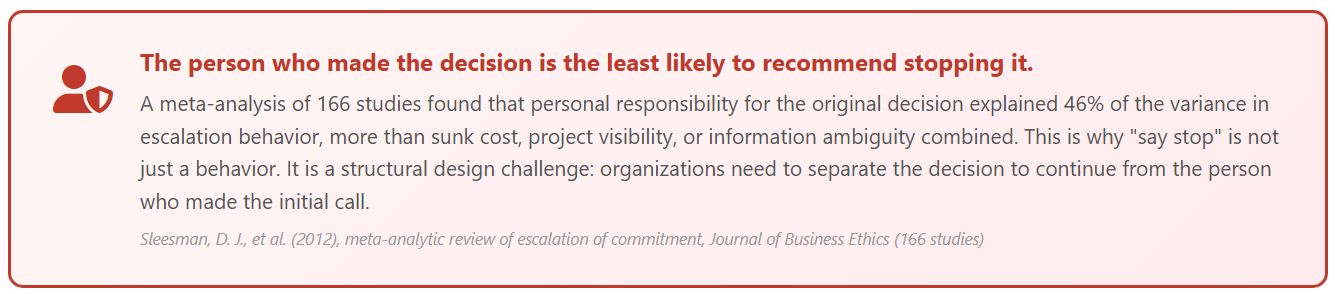
A 35-year meta-analysis of escalation of commitment research found that people commit the most resources to a failing course of action when they were personally responsible for the original decision. The more your identity is tied to having made the right call, the less likely you are to call stop, even when the evidence clearly supports it.
Most organizations have no structured mechanism for stopping. They have processes for starting initiatives, processes for funding them, processes for reporting on them. But there is no equivalent process that asks "should this still exist?" at regular intervals. The default is continuation. Stopping requires someone to actively intervene, which requires courage, which requires a culture that treats stopping as discipline rather than failure.
The behaviour is: when the evidence shows that key assumptions are broken, recommend stopping. Not quietly reducing investment. Not "deprioritizing." Stopping. And framing it correctly: the review process worked. We found out the assumptions were wrong while there was still time to redirect resources to something that will work. That is a success of the system, not a failure of the decision.
The Five Mindsets
Behaviours are what you do. Mindsets are the ways of thinking that sustain the behaviours when pressure arrives.
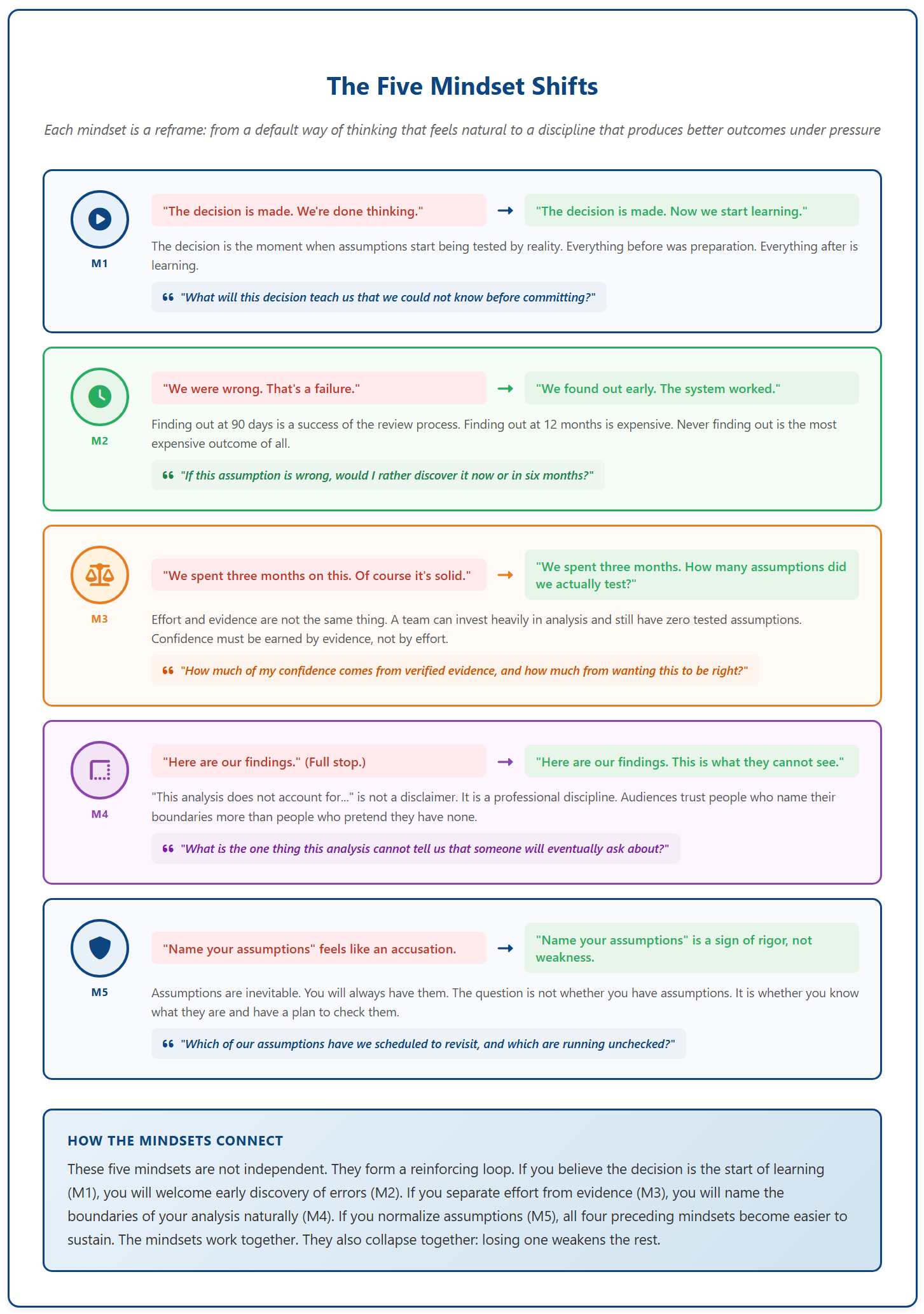
1.The decision is the start of the learning, not the end of the thinking
Most professionals treat a decision as a conclusion. The analysis is done, the call is made, the uncertainty is resolved. This mindset sees the decision differently: it is the moment when assumptions start being tested by reality. Everything before the decision was preparation. Everything after is learning. The decision itself is just the point where you committed a hypothesis to a real-world test.
2.Being wrong early is cheaper than being wrong late
Finding out at 90 days that an assumption is broken is a success of the review process, not a failure of the decision. Finding out at 12 months is expensive. Never finding out and continuing to invest in something that is not working is the most expensive outcome of all. This mindset reframes the discomfort of discovering you were wrong as a signal that the system is working.
3.Confidence should be earned, not assumed
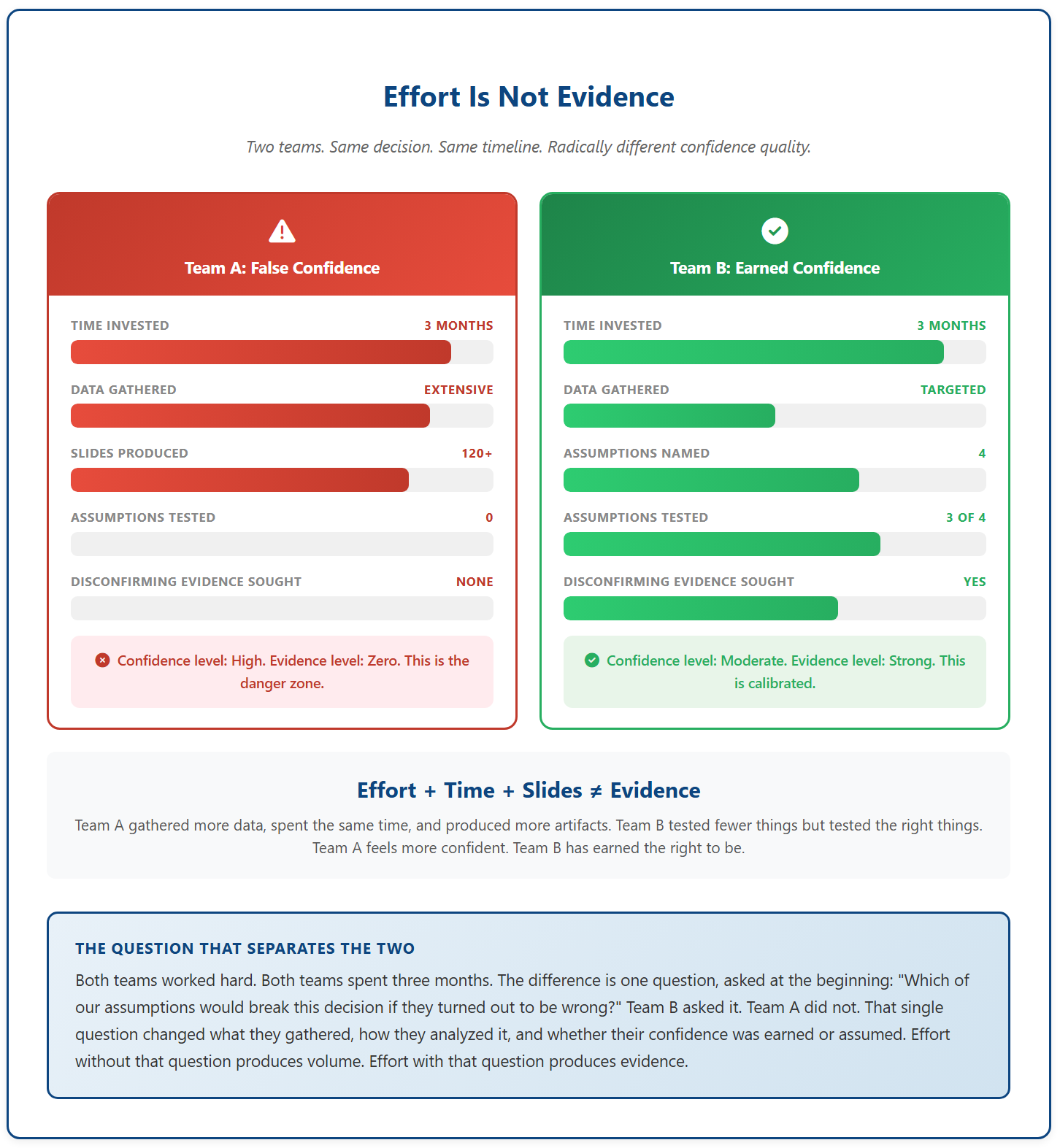
Most professionals feel confident in a decision because they spent a long time making it. But effort and evidence are not the same thing. A team that spent three months on an analysis may have high confidence and zero tested assumptions. This mindset asks: how much of my confidence comes from verified evidence, and how much comes from the fact that I worked hard and want this to be right?
4.Every recommendation has a boundary
The instinct is to present findings as complete and definitive. This mindset asks you to name what the analysis cannot see, every time. "This analysis does not account for..." is not a disclaimer. It is a professional discipline. Audiences trust people who name their boundaries more than people who pretend they have none.
5.Assumptions are not the enemy. Untested assumptions are.
Hearing "name your assumptions" can feel like an accusation: you were not rigorous enough. This mindset normalizes assumptions as an inevitable part of every decision. You will always have them. The question is not whether you have assumptions. It is whether you know what they are and have a plan to check them. An assumption you have named and scheduled to review is responsible decision-making. An assumption you have not named is negligence with a comfortable disguise.
The Beliefs Underneath
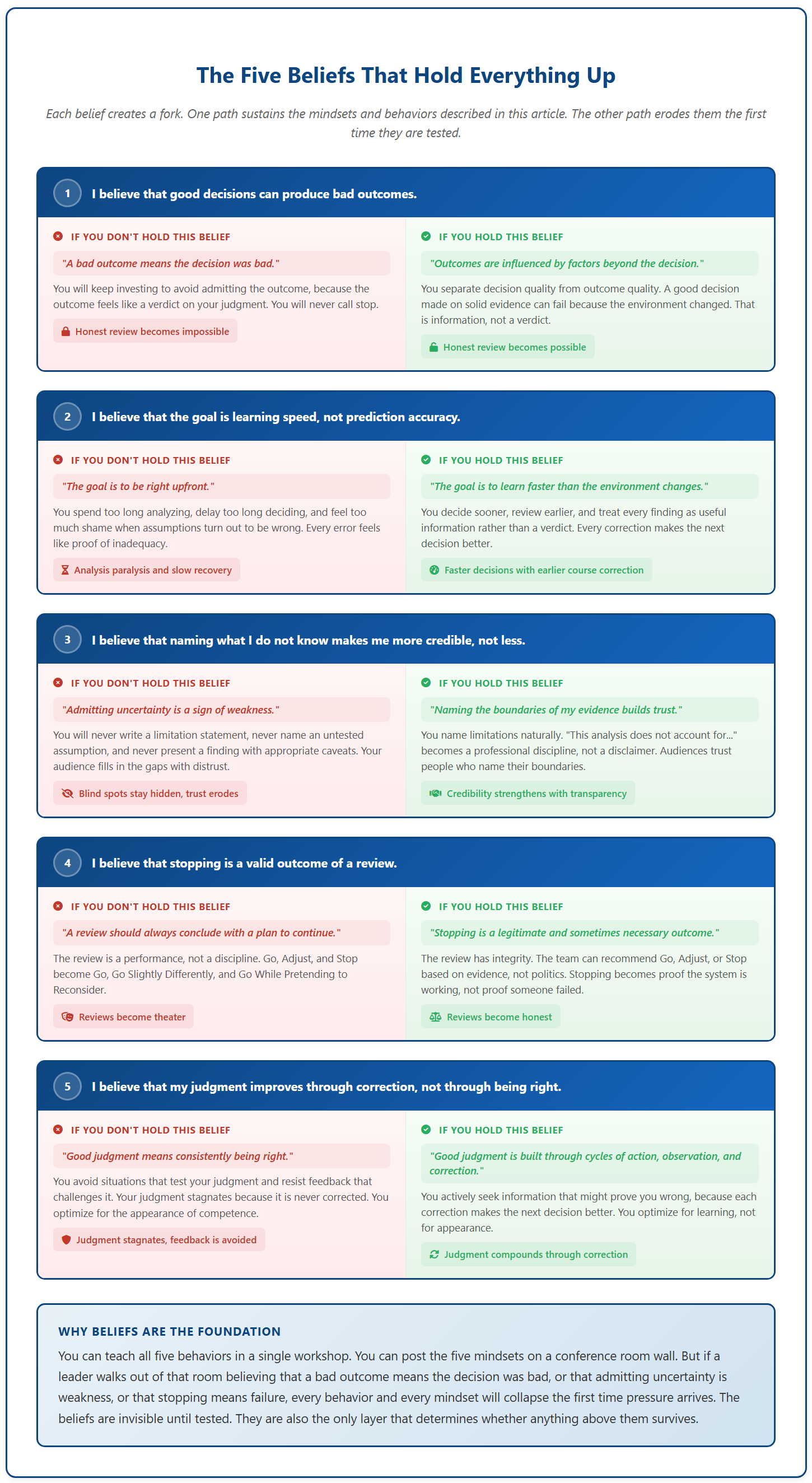
Behaviours are sustained by mindsets. Mindsets are sustained by beliefs. If the beliefs are wrong, the mindsets erode and the behaviours disappear the first time they are tested.
Here are the beliefs that need to be in place.
1.I believe that good decisions can produce bad outcomes. If you believe that a bad outcome means the decision was bad, you will never call stop. You will keep investing to avoid admitting the outcome, because the outcome feels like a verdict on your judgement. But outcomes are influenced by factors beyond the decision. A good decision made on solid evidence can fail because the environment changed. Separating decision quality from outcome quality is the belief that makes honest review possible.
2.I believe that the goal is learning speed, not prediction accuracy. If you believe the goal is to be right upfront, you will spend too long analyzing, delay too long deciding, and feel too much shame when assumptions turn out to be wrong. If you believe the goal is to learn faster than your environment changes, you will decide sooner, review earlier, and treat every finding as useful information rather than a verdict.
3.I believe that naming what I do not know makes me more credible, not less. If you believe that admitting uncertainty is a sign of weakness, you will never write a limitation statement, never name an untested assumption, and never present a finding with appropriate caveats. If you believe that naming the boundaries of your evidence builds trust, you will do all three naturally.
4.I believe that stopping is a valid outcome of a review. If you believe that a review should always conclude with a plan to continue, then the review is a performance, not a discipline. The belief that stopping is a legitimate and sometimes necessary outcome is what gives the review its integrity. Without it, Go, Adjust, and Stop become Go, Go Slightly Differently, and Go While Pretending to Reconsider.
5.I believe that my judgement improves through correction, not through being right. If you believe that good judgement means consistently being right, you will avoid situations that test your judgement and resist feedback that challenges it. If you believe that good judgement is built through cycles of action, observation, and correction, you will actively seek out information that might prove you wrong, because each correction makes the next decision better.
Where to Start
You do not need to adopt all five behaviors, all five mindsets, and all five beliefs simultaneously. That is a recipe for overwhelm and abandonment.
Start with one behavior: name three assumptions before your next decision. Just write them down. Do not try to test them yet. Do not try to build a full Decision Learning Loop around them. Just name them.
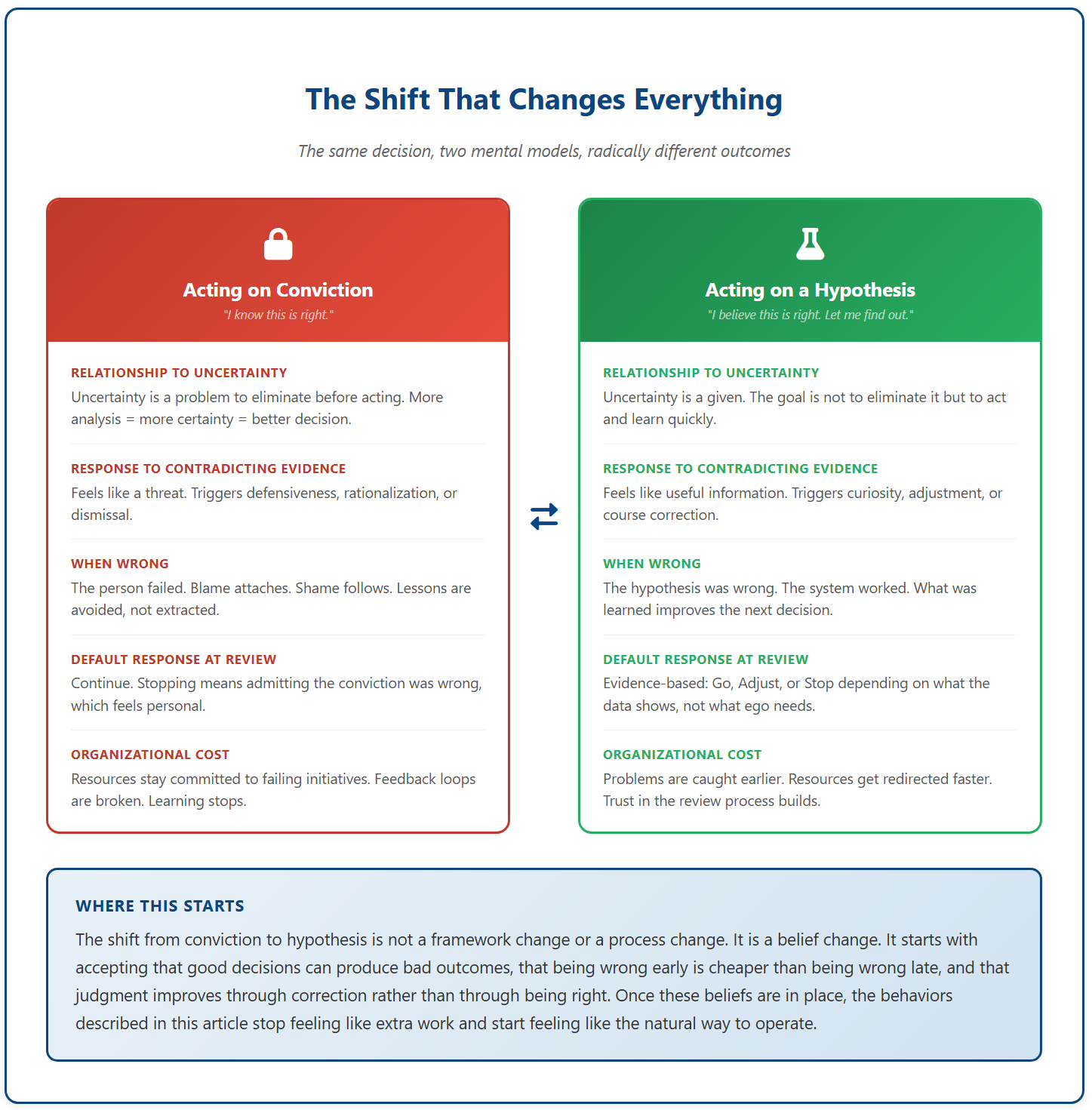
You will notice something immediately. The act of writing down assumptions changes how you think about the decision. Things you were treating as certain become visibly uncertain. Questions you had not considered become obvious. The decision does not change, but your relationship to it does. You are no longer acting on conviction. You are acting on a hypothesis.
That shift, from conviction to hypothesis, is where everything starts.
If you want to bring these concepts to your organization through a keynote, workshop, or full training program, get in touch. Every engagement is built around your team's real decisions, not hypothetical case studies.
Kevin is an author, speaker, and thought leader on topics including data literacy, data-informed decisions, business strategy, and essential skills for today. https://www.linkedin.com/in/kevinhanegan/
AI did not end the data literacy crisis. It changed it. As machines move from providing information to interpreting it and recommending what to do, the scarce skill is becoming judgment: knowing what to trust, what to question, and what decisions are still ours to make.
Evidence does not make decisions. People interpret it, weigh it, challenge it, and make judgments. A courtroom reveals what leaders can learn about evidence, expertise, confidence, and data-informed decision-making.
Feeling sure doesn't mean you're right. Learn five simple ways to question what feels true, spot what might be influencing you, and make better decisions about what to believe.
We teach data literacy as a ladder: data at the bottom, wisdom at the top, climb step by step. But the rungs are not where the work happens. The judgment lives in the gaps between them, and that is exactly where AI now carries us straight past.