AI did not end the data literacy crisis. It changed it. As machines move from providing information to interpreting it and recommending what to do, the scarce skill is becoming judgment: knowing what to trust, what to question, and what decisions are still ours to make.
Evidence does not make decisions. People interpret it, weigh it, challenge it, and make judgments. A courtroom reveals what leaders can learn about evidence, expertise, confidence, and data-informed decision-making.
Feeling sure doesn't mean you're right. Learn five simple ways to question what feels true, spot what might be influencing you, and make better decisions about what to believe.
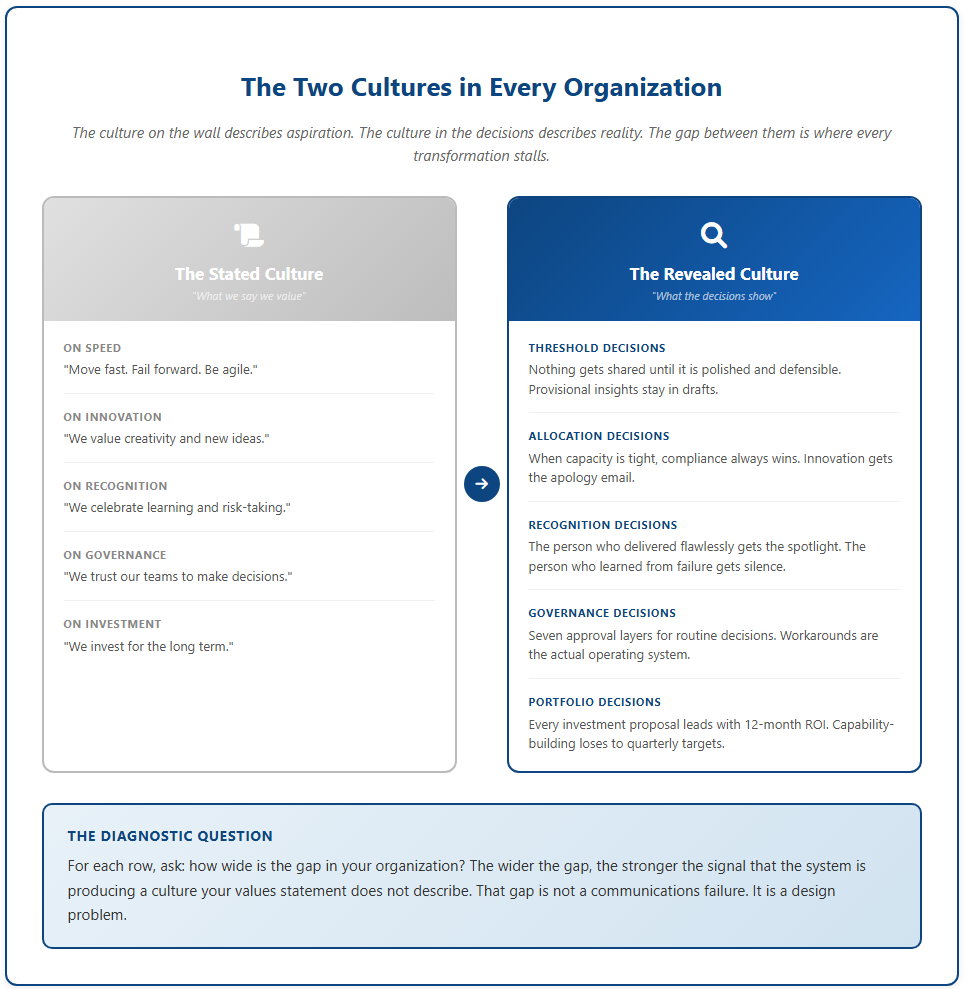
Culture is not what your organization says it values. It is what the system rewards when people face trade-offs under pressure. Five routine decision types reveal the gap between stated priorities and actual behavior. That gap is where every transformation stalls, and most never think to look.
Your organization does not have the culture it chose. It has the culture its systems produced.
90 Second Wisdom Audio Brief
0:00
/102.864399
What You Need To Know
Most organizations diagnose culture through surveys, values statements, and engagement scores. None of these capture what actually drives behavior. Culture is not what people say they value. It is what the system rewards when people face trade-offs under constraint. Five routine decision types, ones your teams face every week, reveal your operating culture more accurately than any assessment instrument ever could.
Why This Matters to You If your transformation programs are producing high awareness but low behavior change, the problem is not communication, training, or leadership alignment. It is that the structural conditions shaping daily decisions have not changed. The system is still rewarding the behaviors the transformation was supposed to replace. Until you can see that gap clearly, every intervention targets symptoms rather than causes. This article gives you the diagnostic lens to see it.
Who This Applies To This applies to anyone responsible for organizational outcomes who has noticed that stated priorities and actual behavior do not match. Leaders running transformation programs that stall after early momentum. Functional heads watching strategic priorities lose to compliance deadlines every quarter. Anyone who suspects the system is producing rational behavior that happens to be the wrong behavior.
What You Will Gain from Reading You will walk away with five specific decision types you can observe in your own organization starting this week. Each one exposes a different dimension of how your system actually operates, independent of what your values statement promises. You will also gain a structured diagnostic method for tracing observed behavior back to the structural element producing it. That connection point is where system redesign begins, and it is almost never where organizations are currently looking.
Your organization's values are probably accurate. They are also probably useless for understanding how your organization actually operates. If you want to know your real culture, do not read your values. Watch your trade-offs.
Your organization probably does value those things. Most organizations do. That is not the problem.
The problem is that values describe aspiration. Culture describes behavior. And behavior is not shaped by what leaders say in town halls. It is shaped by what the system rewards when people face real decisions under real constraints.
Every organization I work with has some version of those words on the wall. Or on the intranet. Or in the onboarding deck. And in nearly every case, the gap between what those words promise and what the system actually produces is where the real story lives.
If you want to know your real culture, stop reading the poster. Watch what happens when someone has to choose between two things the organization says it cares about. Speed or thoroughness. Innovation or compliance. Learning or certainty.
That is where culture lives. Not in the stated priorities but in the revealed ones.
Why Surveys and Assessments Miss the Point
"An engagement survey tells you what people believe. A trade-off tells you what the system rewards. Only one of those predicts behavior."
Most organizations measure culture through engagement surveys, pulse checks, and behavioral assessments. These instruments capture what people believe, what they feel, and what they say they would do in hypothetical situations.
They almost never capture what people actually do when the system puts them under pressure.
This ends the free preview.
The rest of this
content is for paid subscribers
Become a paid subscriber to get full access and unlock all paid content.
Evidence does not make decisions. People interpret it, weigh it, challenge it, and make judgments. A courtroom reveals what leaders can learn about evidence, expertise, confidence, and data-informed decision-making.
Feeling sure doesn't mean you're right. Learn five simple ways to question what feels true, spot what might be influencing you, and make better decisions about what to believe.
We teach data literacy as a ladder: data at the bottom, wisdom at the top, climb step by step. But the rungs are not where the work happens. The judgment lives in the gaps between them, and that is exactly where AI now carries us straight past.
Every organization keeps one scoreboard for mistakes and none for missed opportunities. So people optimize the one they can see, and the largest losses never appear as losses at all. They appear as things no one tried.