AI did not end the data literacy crisis. It changed it. As machines move from providing information to interpreting it and recommending what to do, the scarce skill is becoming judgment: knowing what to trust, what to question, and what decisions are still ours to make.
Evidence does not make decisions. People interpret it, weigh it, challenge it, and make judgments. A courtroom reveals what leaders can learn about evidence, expertise, confidence, and data-informed decision-making.
Feeling sure doesn't mean you're right. Learn five simple ways to question what feels true, spot what might be influencing you, and make better decisions about what to believe.
The Future of Work: Why Skills Alone Won’t Make You Future-Read
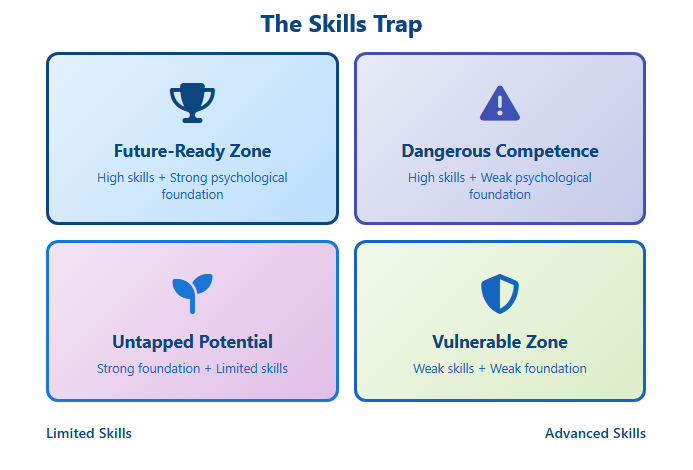
Companies keep buying skills and still stumble. The problem is not competence. It is missing humility, ethics, and adaptive mindsets. Learn the three-legged model for readiness and how to avoid dangerous competence
Train for competence. Coach for character. Lead for judgment.
High-Level Summary and Key Takeaways
Leaders keep investing in skills and certifications, yet results lag. The problem is not competence. It is mistaking technical skill for future readiness. History offers the warning signs. Wall Street’s brilliant quants missed fragile assumptions. Kodak’s engineers built digital first, then buried it. Theranos hired talent, then weaponized it without ethics. The pattern is consistent. Skills are tools, and tools only create value when traits and mindsets guide their use under pressure. Readiness is a three legged stool of skills, traits, and mindsets. Remove one and performance collapses when conditions change. Organizations that focus on skills alone pay predictable costs. Strategic blindness. Ethical mistakes. Slow adaptation. The AI era raises the stakes because speed is easy while judgment is scarce. The path forward is practical. Baseline where you are. Evolve the 10 Forever Skills into their modern forms. Build traits like humility, resilience, empathy, courage, and comfort with ambiguity. Cultivate mindsets for learning, systems responsibility, ethics, long-term value, and collaboration. The future belongs to teams that become wise, not just trained.
Key Takeaways
Skills are tools. Traits and mindsets decide outcomes
Future readiness = skills + traits + mindsets working together
Dangerous competence is real when humility and ethics are missing
The AI era raises stakes because speed is easy and judgment is scarce
Shift from a training catalog to a readiness operating system with diagnostics
Start now: evolve the 10 Forever Skills, build humility and resilience, cultivate learning, ethics, and long-term value
Your most skilled employees might be your biggest liability.
That's not hyperbole, it's what happens when organizations mistake technical competence for future readiness. Right now, companies are spending billions on reskilling programs, certifications, and "top 10 skills for 2030" lists. Meanwhile, some of their most technically proficient people are making catastrophic decisions.
The Skills Trap
Consider this: In 2008, Wall Street employed some of the most mathematically sophisticated minds on the planet. These weren't amateur analysts, they were PhD-level quants who could build risk models that would make NASA engineers weep with envy. Their technical skills were extraordinary.
Their intellectual humility was not.
When early warning signals emerged that their models relied on unrealistic assumptions about housing markets, these brilliant analysts dismissed the concerns. They had the skills to see the problem but lacked the trait of intellectual humility to question their own expertise. The result? A global financial collapse that their technical skills had actually helped create.
This pattern repeats across industries and eras. Kodak's engineers invented the digital camera in 1975, they had the technical skill to revolutionize photography. But the company's mindset was anchored in protecting film revenues, so revolutionary capability died in a filing cabinet. Theranos employed talented biochemists and engineers, but without ethical judgment and intellectual honesty, their skills became weapons of fraud rather than tools of innovation.
The uncomfortable truth is this: Skills without wisdom are dangerous. And in an era of exponential change, the danger is multiplying.
Why Traditional Approaches Fall Short
Most organizations are preparing for the future like generals fighting the last war. They identify what skills worked before, train their people in updated versions, and assume success will follow. But this approach has three fatal flaws:
This ends the free preview.
The rest of this
content is for free members
Create a free account to get full access. No payment required.
Evidence does not make decisions. People interpret it, weigh it, challenge it, and make judgments. A courtroom reveals what leaders can learn about evidence, expertise, confidence, and data-informed decision-making.
Feeling sure doesn't mean you're right. Learn five simple ways to question what feels true, spot what might be influencing you, and make better decisions about what to believe.
We teach data literacy as a ladder: data at the bottom, wisdom at the top, climb step by step. But the rungs are not where the work happens. The judgment lives in the gaps between them, and that is exactly where AI now carries us straight past.
Every organization keeps one scoreboard for mistakes and none for missed opportunities. So people optimize the one they can see, and the largest losses never appear as losses at all. They appear as things no one tried.