AI did not end the data literacy crisis. It changed it. As machines move from providing information to interpreting it and recommending what to do, the scarce skill is becoming judgment: knowing what to trust, what to question, and what decisions are still ours to make.
Evidence does not make decisions. People interpret it, weigh it, challenge it, and make judgments. A courtroom reveals what leaders can learn about evidence, expertise, confidence, and data-informed decision-making.
Feeling sure doesn't mean you're right. Learn five simple ways to question what feels true, spot what might be influencing you, and make better decisions about what to believe.
"The data says one thing, but my gut says another" is a familiar tension. The real problem is not intuition or data. It is leaving both unexamined. This article offers a framework for turning intuition into structured evidence.
Data does not replace judgment. It reveals where judgment is required.
How to Quantify Your Gut Instinct Without Replacing Human Judgment
At some point in almost every important decision, someone says a version of this sentence:
"The data says one thing, but my gut says another."
That moment is often framed as a conflict. Either you trust the data and suppress your intuition, or you trust your intuition and treat the data as secondary. This framing is not only unhelpful. It is wrong.The real issue is not data versus intuition. The issue is undisciplined intuition and unexamined data.
We audit data all the time. We question sources, definitions, assumptions, completeness, and relevance. We do not do the same for intuition, even though intuition frequently plays a decisive role in leadership, strategy, hiring, and judgment under uncertainty.
It is time to change that. This article introduces the Intuition Audit, a practical framework for treating intuition as structured evidence rather than a mystical override or a dangerous bias.
What Intuition Actually Is
Intuition is often misunderstood. It is not a feeling detached from reality. It is not a shortcut that bypasses thinking.
Intuition is unconscious pattern recognition.
What feels like gut instinct is often experience without calibration.
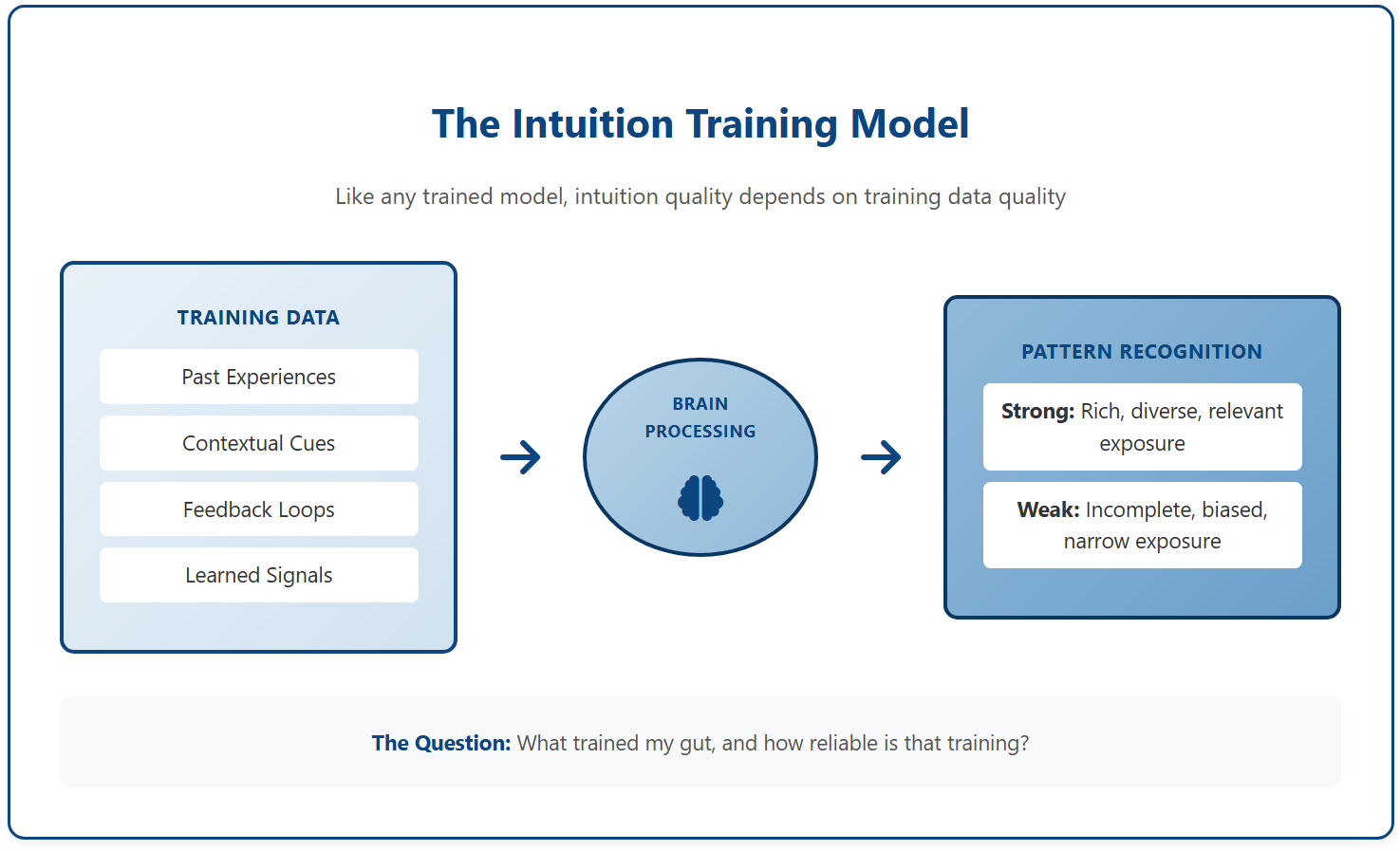
It is the brain rapidly synthesizing past experiences, contextual cues, feedback loops, and learned signals to generate a judgment before conscious reasoning catches up. In many ways, intuition functions like a trained model. It has been trained on data, just not data stored in spreadsheets.
This explains two important truths that often get overlooked. First, intuition can be extremely powerful when it is trained on rich, relevant, and diverse experience. Second, intuition can be dangerously misleading when it is trained on incomplete, biased, or narrow exposure.
The right question is not "Should I trust my gut?" The right question is "What trained my gut, and how reliable is that training?"
Why Intuition Fails in Organizations
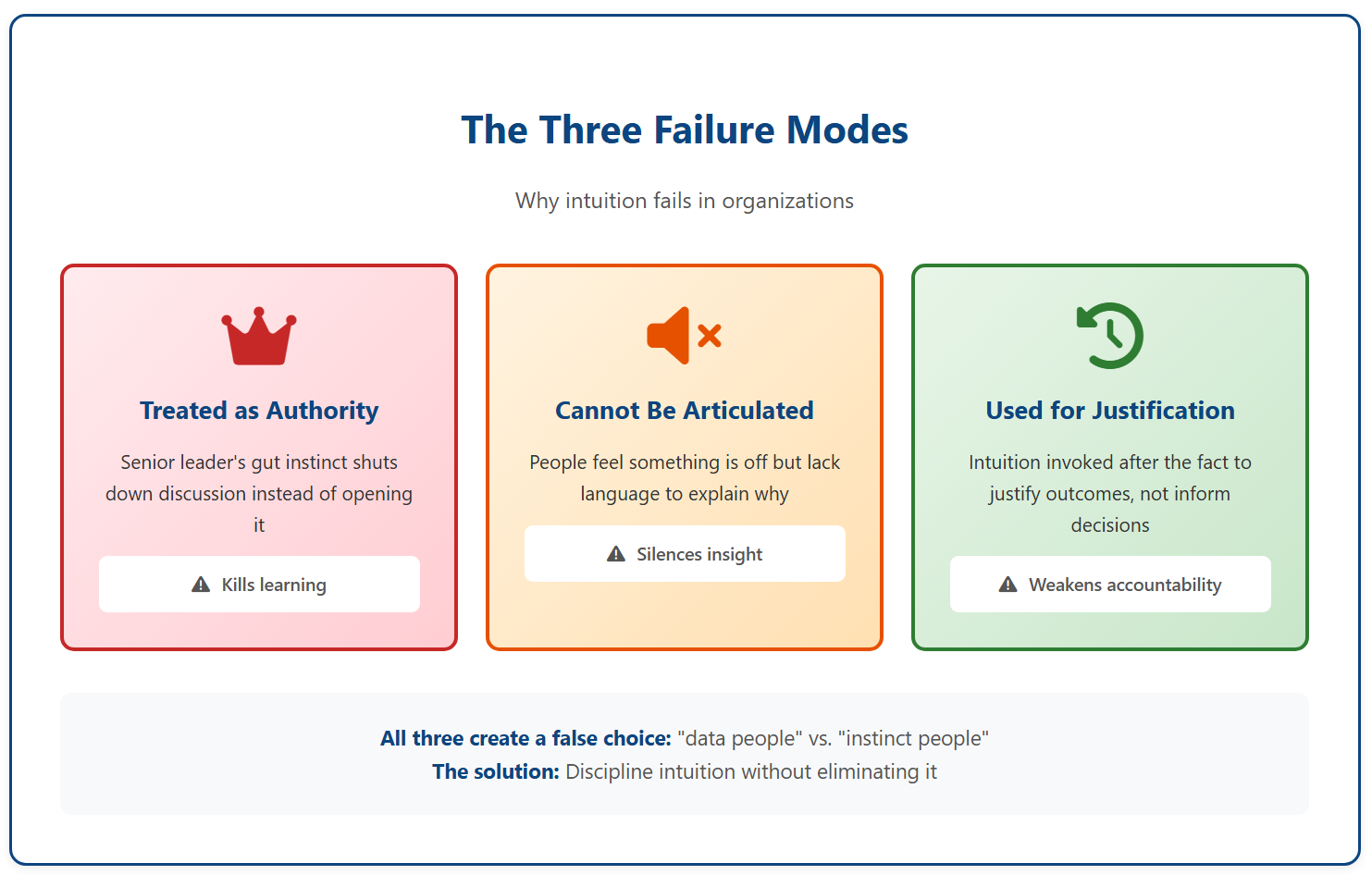
In organizations, intuition usually fails for one of three reasons.
Intuition is treated as authority rather than evidence. A senior leader's gut instinct shuts down discussion instead of opening it.
Intuition is ignored because it cannot be articulated. People feel something is off but lack the language or structure to explain why.
Intuition is used only after the fact to justify outcomes rather than inform decisions.
All three failure modes weaken learning, accountability, and trust. They also create a false choice between "data people" and "instinct people," which is a deeply unproductive divide.
The goal is not to eliminate intuition. The goal is to discipline it.
Introducing the Intuition Audit
To move beyond this stalemate, we need a way to examine intuition without dismissing it and without putting it on a pedestal.
If data can be audited, intuition can be audited too.
We audit data relentlessly. We rarely audit judgment.
An intuition audit does not attempt to slow decision-making to a crawl. It does not demand certainty. It introduces just enough structure to transform intuition from a private feeling into a shared, examinable input.
This ends the free preview.
The rest of this
content is for paid subscribers
Become a paid subscriber to get full access and unlock all paid content.
Evidence does not make decisions. People interpret it, weigh it, challenge it, and make judgments. A courtroom reveals what leaders can learn about evidence, expertise, confidence, and data-informed decision-making.
Feeling sure doesn't mean you're right. Learn five simple ways to question what feels true, spot what might be influencing you, and make better decisions about what to believe.
We teach data literacy as a ladder: data at the bottom, wisdom at the top, climb step by step. But the rungs are not where the work happens. The judgment lives in the gaps between them, and that is exactly where AI now carries us straight past.
Every organization keeps one scoreboard for mistakes and none for missed opportunities. So people optimize the one they can see, and the largest losses never appear as losses at all. They appear as things no one tried.