AI did not end the data literacy crisis. It changed it. As machines move from providing information to interpreting it and recommending what to do, the scarce skill is becoming judgment: knowing what to trust, what to question, and what decisions are still ours to make.
Evidence does not make decisions. People interpret it, weigh it, challenge it, and make judgments. A courtroom reveals what leaders can learn about evidence, expertise, confidence, and data-informed decision-making.
Feeling sure doesn't mean you're right. Learn five simple ways to question what feels true, spot what might be influencing you, and make better decisions about what to believe.
The Missing Middle in Data Literacy: Teaching People to Think, Not Just Analyze
Most teams can read data, but very few know how to think with it. This article breaks down the hidden cognitive layer that sits between dashboards and decisions, and why it’s the skill every organization is missing.
Understanding data is not the same as understanding what to do with it
90 Second Audio Recap
0:00
/86.772971
What You Need to Know
Data literacy teaches you to understand what happened. It doesn't teach you to reason about what it means, test what you think you know, or decide with confidence. That gap, the "missing middle", is where most people live. It's not new. Every information revolution (printing press, scientific method, internet) had the same gap between access and understanding. The cognitive infrastructure never builds itself. It requires deliberate design.
Why this matters to you If you're learning data literacy and feel like you're still guessing (just with more spreadsheets), this explains why and what's actually missing.
If you're leading data transformation and your program isn't improving decisions despite high completion rates, this reveals the layer most training skips entirely.
If you're wondering why some people "get it" while others struggle with the same dashboards, this shows it's not about skill level, it's about cognitive framing.
What you'll gain from reading Understanding of the four cognitive capabilities that sit between data knowledge and data-driven decisions. Recognition of the historical pattern we're repeating and why recognizing it accelerates the solution. A framework for distinguishing training that teaches tools from training that teaches thinking. Clarity on what "data maturity" actually means and how to build it deliberately.
You thought learning data literacy meant you'd know what to do with data.
You can read it. Interpret it. Question it. Explain it to others. But when it's time to decide, you realize that you are still guessing. Just with more information.
That's because data literacy, as it's usually taught, stops one step before the skill you actually need.
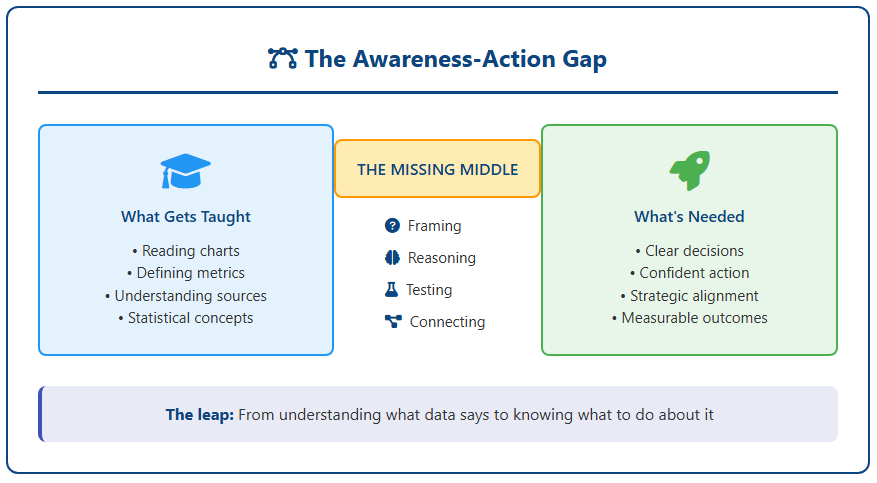
It teaches you to understand what happened. It doesn't teach you to reason about what it means, test what you think you know, or structure your thinking so you can decide with confidence instead of just more data.
And that gap between understanding and deciding is where most people live.
The Leap That Never Happens
The typical journey looks straightforward: learn what data is, learn how to read a chart, make better decisions.
But that leap from awareness to action? That's where everything collapses.
Knowing how to define a KPI is not the same as knowing how to reason about it. Understanding what a data source contains tells you nothing about whether it's relevant, reliable, or worth your attention. These aren't technical gaps. They emerge from thinking, not technique.
Without structured reasoning, data literacy becomes vocabulary training. You become fluent in terminology but not in thought. You can speak the language without knowing what to say.
Picture yourself and a colleague staring at the same dashboard. Same metrics. Same charts. Same information.
Your colleague spots a meaningful pattern and adjusts strategy within the week. You spend three meetings debating whether the baseline is calculated correctly and whether the trend is "real."
The difference isn't skill level. It's not about who knows more Excel functions or statistical terms. It's cognitive framing. How you approach the data. How you interpret uncertainty. How you move from observation to decision.
Technical skills take hours to learn. You can learn to build a pivot table in an afternoon. But cognitive skills like the ability to frame the right question, weigh conflicting evidence, see patterns across disconnected facts, those are what transform data from numbers into understanding.
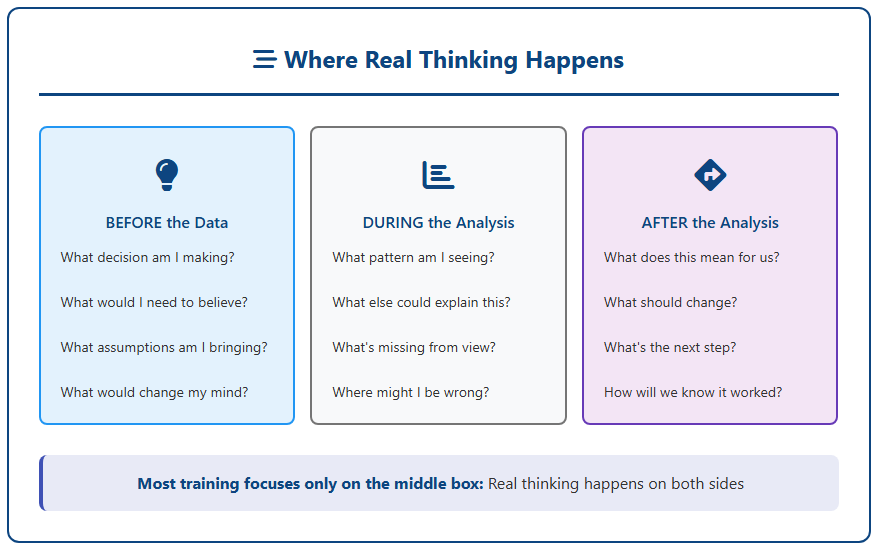
Traditional data upskilling focuses on inputs: tools, charts, formulas, visualization techniques. What you actually need is help with the thinking process that happens before and after the analysis. The part where you decide what problem you're solving. The part where you determine what the numbers mean for action.
That's the missing middle.
Bridging the Missing Middle
Our Data Fluency and Applied Data Thinking Pathways were built to fill the gap most programs skip, the thinking layer between reading data and using it. Level 1 develops the foundational habits of understanding, questioning, and interpreting data. Level 2 teaches the structured reasoning that transforms those habits into confident decisions.
The Invisible Scaffolding Between Information and Insight
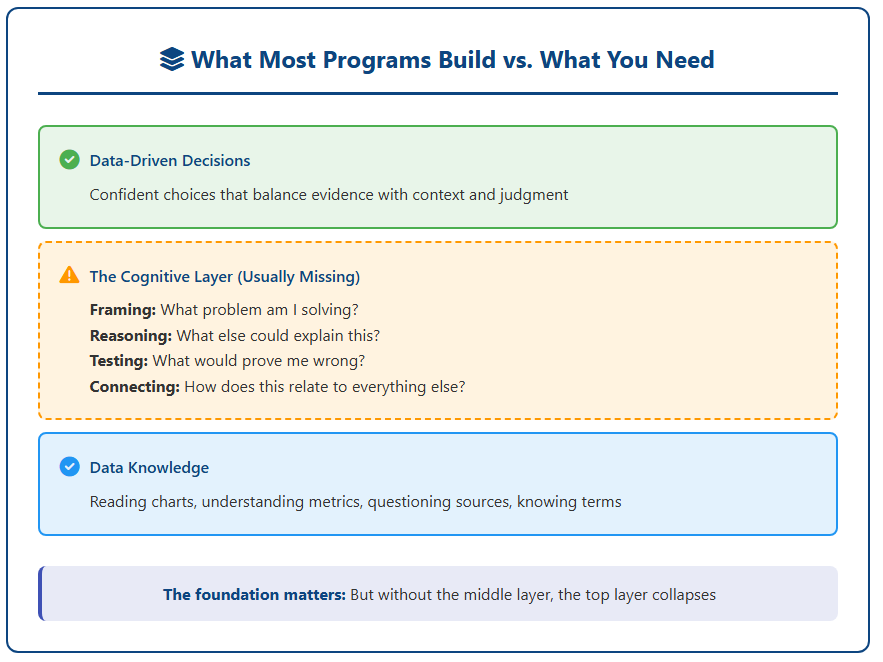
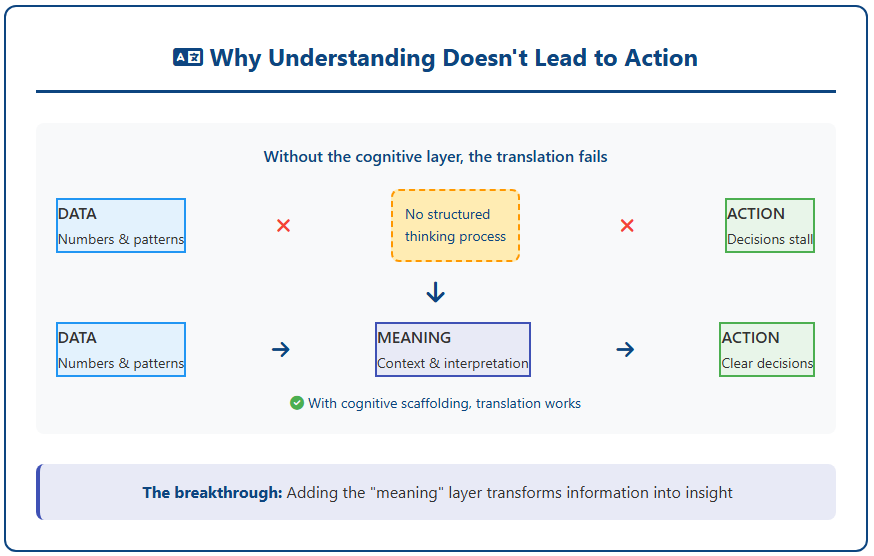
Between data knowledge and data-driven decisions sits a cognitive layer most programs skip entirely. Think of it as the scaffolding between information and insight. The translation layer where numbers become language, and language becomes choice.
A data point is never the answer. It’s only the beginning of a question.
This layer includes four interwoven capabilities.
Framing means defining the real problem before you look at any data. Not "What does this dashboard show?" but "What decision am I trying to make, and what would I need to believe for each option to be right?"
Reasoning means interpreting information through logic, context, and critical thinking rather than reacting to the first pattern you notice. It's the discipline of asking "What else could explain this?" before concluding "This explains everything."
Hypothesis logic means testing assumptions instead of just reporting results. It's the practice of saying "If X is true, I'd expect to see Y" and then looking for Y—or its conspicuous absence.
Sensemaking connects facts, causes, and implications across different contexts. It asks how a trend in customer behavior relates to an operational bottleneck, which connects to a talent challenge, which circles back to strategy.
When this cognitive layer is missing, you default to bias. You misread visuals. You chase data that doesn't matter and ignore data that does. You debate the numbers instead of their meaning.
When it's present, you stop fighting the data and start thinking with it.
A Pattern as Old as Progress: Every Revolution Fails Before It Thinks
If the "missing middle" in data literacy feels frustrating or familiar, that's because it is familiar. We've been here many times before.
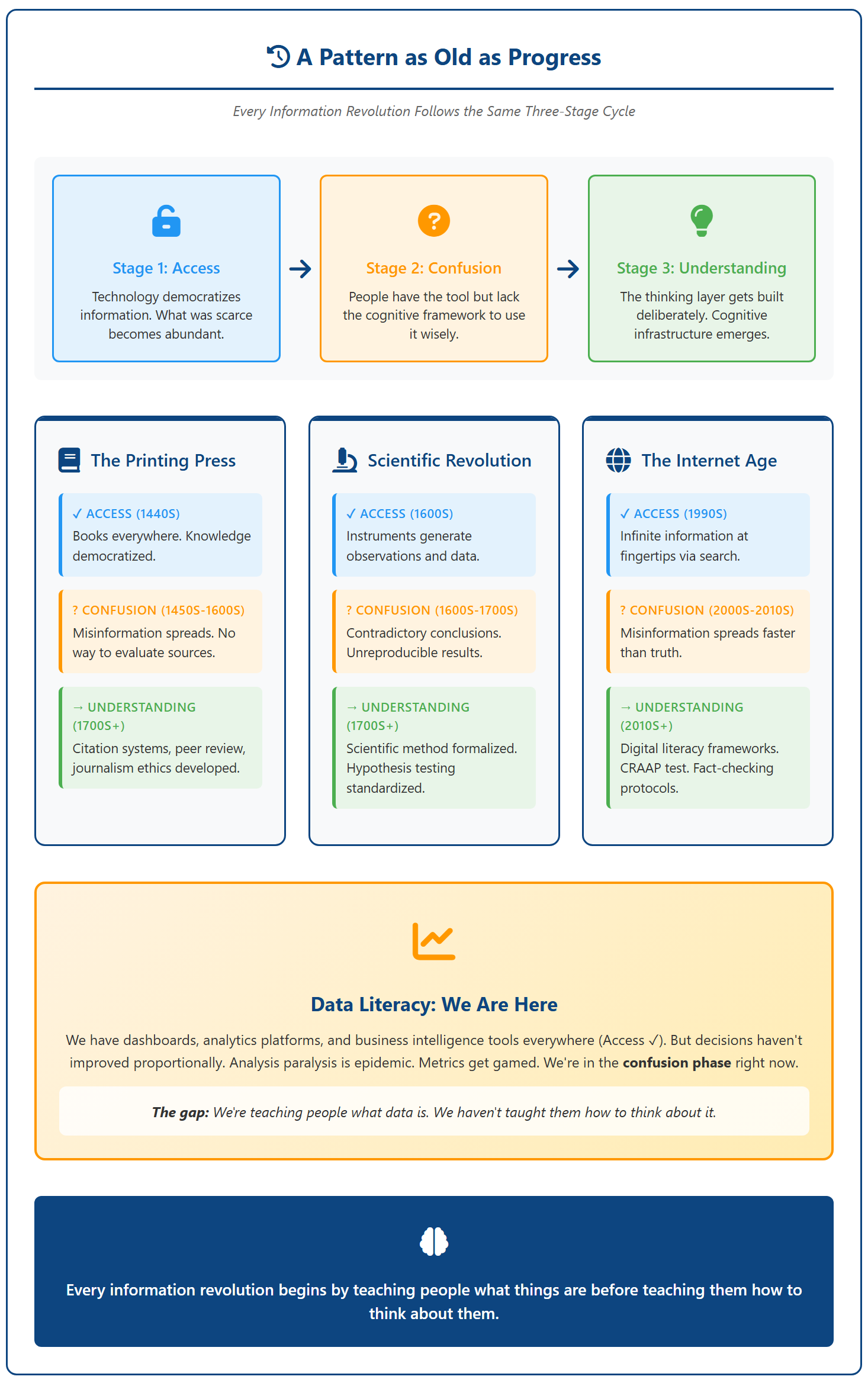
Every major knowledge revolution follows the same cycle: Access → Confusion → Understanding. We get the tool before we develop the reasoning needed to use it wisely.
The printing press democratized access to knowledge. Suddenly, information was everywhere. But early readers lacked shared interpretive norms. Misinterpretations exploded. Texts were copied, distributed, and weaponized long before society developed methods for evaluating reliability, context, or intent.
We had books before we had critical reading.
Early scientists had lenses, thermometers, and lab tools that generated "data" but not direction. Experimentation was a mix of intuition, anecdote, and guesswork. Only after the scientific method formalized hypothesis testing, replication, and peer review did observation become insight.
We had measurements before we had reasoning structures.
Search engines gave everyone infinite information with zero guidance on what was reliable. We assumed access would create understanding. Instead, misinformation spread faster than truth. Digital literacy emerged only after we realized the problem wasn't access, it was interpretation.
We had connectivity before we had sensemaking.
Every information revolution begins by teaching people what things are before teaching them how to think about them.
Data literacy today is simply the latest example of this 500-year-old pattern. We're in the confusion phase right now. Your team can read dashboards, understand metrics, and interpret charts. What they're missing is the reasoning architecture that turns information into decisions. This is the same cognitive layer that was missing after the printing press, after early computing, after the internet's arrival.
This is why "we're drowning in data but starving for insight" isn't a data volume problem. It's a thinking problem. And it's exactly as solvable as every other missing middle in history, once you recognize what's actually missing.
We will be exploring this historical pattern in depth in an upcoming series that examines how every information revolution has solved this same problem, what it means for individuals learning data literacy, what it means for organizations building data capabilities, and how we close the gap together. If you are not already, subscribe here to be notified when it launches.
From Fluency to Applied Thinking
Our framework separates these two stages deliberately. Not because one is better than the other, but because they serve different purposes.
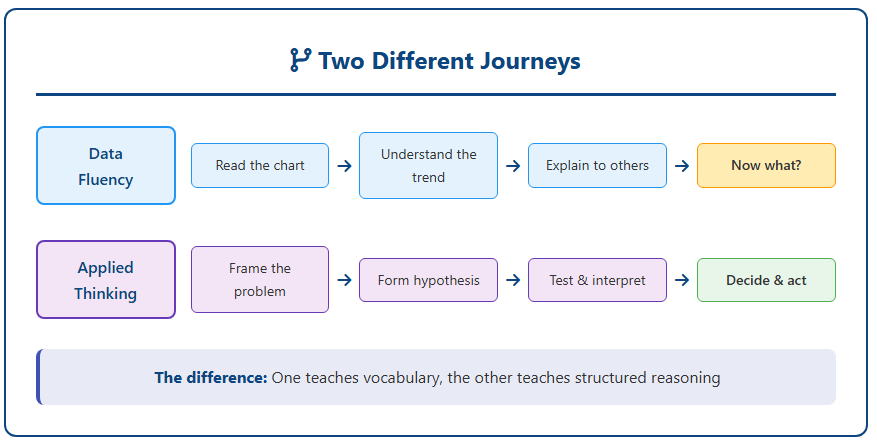
Data fluency builds comfort and confidence. You learn to read data, question it, understand where it comes from and what might distort it. This is foundational. You can't think critically about information you don't understand.
Applied data thinking builds structure. You learn to frame problems before analyzing them. You form hypotheses. You evaluate uncertainty. You make decisions even when the data is incomplete or contradictory.
At the fluency stage, you ask: "What does this data tell us?"
At the applied thinking stage, you ask: "What problem does this data help us solve, and what would change my conclusion?"
That shift from curiosity to structure, from observation to decision is where data maturity actually lives.
Here's what surprises people: data fluency starts in the mind, not in the dashboard. The cognitive work happens before you open the file. What question are you answering? What would count as evidence? What assumptions are you bringing to the interpretation?
Most programs teach what data is. The breakthrough comes from teaching what to do before you look at it, and what to do after.
Why the Thinking Layer Changes Everything
When you and your team share a thinking process and not just a toolset, three things shift.
Your decisions become consistent. You develop a shared mental model for evaluating evidence and weighing options. You stop relitigating basic questions about what counts as proof or how much uncertainty is acceptable. The process creates alignment even when you disagree on outcomes.
Your collaboration becomes faster. Instead of debating which data to use or whose numbers are more accurate, you align on how to think about the problem. The conversation moves from "Is this right?" to "What does this mean for us?"
Trust increases. When your reasoning is transparent, people have confidence in your conclusions even when those conclusions evolve. They understand not just what you decided, but why, and what evidence might change the answer.
This goes beyond analytics. It strengthens how you and your organization reason, communicate, and act together. It turns data from a source of endless debate into a foundation for coordinated action.
What Comes Next
The next frontier in data literacy isn't technical. It's cognitive.
As AI automates more analysis, your advantage won't come from calculation. It will come from how you define problems, how you interpret ambiguous signals, how you question assumptions, how you decide what matters.
The thinking layer isn't optional anymore. It's the foundation of data-informed leadership. True data literacy isn't knowing how to read a dashboard. It's knowing how to think before you look at one and what to do with what you find.
The question isn't whether you can interpret a chart. It's whether you can frame the right question, evaluate the answer critically, and translate insight into action.
That's the gap most people haven't closed yet. And it's the difference between data skills that impress in meetings and data skills that change outcomes.
AI is automating analysis. The only sustainable advantage left is how well you think.
Want to dive deeper into these ideas?
You’re invited to a free, live webinar on Tuesday December 9th, where I’ll be teaching Level 1 Module 1 of our full Data Fluency & Applied Data Thinking curriculum, the same material we use with teams across industries. We’ll explore why understanding data isn’t enough, how to strengthen the thinking layer, and what it takes to build confidence before the analysis even begins.
If this resonated with you, register for the webinar and get notified when the full “Think Differently About Data” series goes live.
Kevin is an author, speaker, and thought leader on topics including data literacy, data-informed decisions, business strategy, and essential skills for today. https://www.linkedin.com/in/kevinhanegan/
AI did not end the data literacy crisis. It changed it. As machines move from providing information to interpreting it and recommending what to do, the scarce skill is becoming judgment: knowing what to trust, what to question, and what decisions are still ours to make.
Evidence does not make decisions. People interpret it, weigh it, challenge it, and make judgments. A courtroom reveals what leaders can learn about evidence, expertise, confidence, and data-informed decision-making.
Feeling sure doesn't mean you're right. Learn five simple ways to question what feels true, spot what might be influencing you, and make better decisions about what to believe.
We teach data literacy as a ladder: data at the bottom, wisdom at the top, climb step by step. But the rungs are not where the work happens. The judgment lives in the gaps between them, and that is exactly where AI now carries us straight past.