AI did not end the data literacy crisis. It changed it. As machines move from providing information to interpreting it and recommending what to do, the scarce skill is becoming judgment: knowing what to trust, what to question, and what decisions are still ours to make.
Evidence does not make decisions. People interpret it, weigh it, challenge it, and make judgments. A courtroom reveals what leaders can learn about evidence, expertise, confidence, and data-informed decision-making.
Feeling sure doesn't mean you're right. Learn five simple ways to question what feels true, spot what might be influencing you, and make better decisions about what to believe.
The Shifting Value of Data: From Scarcity to AI Overload
AI doesn't reduce overload. It weaponizes it. Knight Capital lost $440M in 45 minutes. Watson spent $4B but couldn't grasp context. When outputs move at machine speed but judgment moves at human speed, organizations don't adapt, they collapse. This is the new bottleneck.
We're not in a data crisis. We're in a judgment crisis. Research proves that decision quality improves as information increases, but only to a point. Beyond that threshold, your brain doesn't work harder. It shuts down. More data, more dashboards, more AI outputs can make you worse at deciding than if you had nothing at all. The bottleneck has moved from access to cognition, and AI just accelerated us past the breaking point.
Why This Matters to You
Your organization is probably scaling data infrastructure while starving cognitive infrastructure. You're adding dashboards, not interpretation skills. You're accelerating outputs without cultivating judgment. The result: faster, larger, more expensive mistakes. Knight Capital lost $440 million in 45 minutes because no one asked the right questions before deployment. IBM Watson spent $4 billion but couldn't grasp clinical context. When consequences move at machine speed but judgment moves at human speed, you don't adapt. You collapse.
Who This Applies To
This applies to anyone making decisions under information overload, which is everyone. Leaders building data strategies without addressing how people think. Teams drowning in dashboards but starving for clarity. Individuals feeling the cognitive and emotional toll of constant information bombardment. If you've ever stared at a screen full of charts and felt paralyzed rather than empowered, this is for you.
What You'll Gain from Reading
You'll understand why the value of data has fundamentally shifted across four eras and what that means for how you must think differently now. You'll see the neuroscience behind why your brain shuts down under overload and why probabilistic thinking doesn't come naturally to humans. You'll recognize the pattern of historical bottlenecks and why judgment, not access, not tools, is the constraint that matters today. Most importantly, you'll stop confusing data abundance with decision capability and start building the cognitive skills that actually create wisdom.
For most of human history, information was scarce and precious. A manuscript might take months to copy. A book was a prized possession, reserved for the wealthy or the clergy. Fast-forward a few centuries and we find ourselves at the opposite extreme: information is infinite, instant, and everywhere.
When I use the term "information," I mean data in context. Data is the raw material. Information is data organized into something we can read. Wisdom is the meaning and action we derive. Over time, the value has never come from simply having data or information. It has always come from what people could do with it.
We are now at an inflection point. With AI generating content in seconds, the bottleneck is no longer access to information. The bottleneck is our ability to think, interpret, and act responsibly. To understand why this moment matters, it helps to look back at how the value of information has shifted across history.
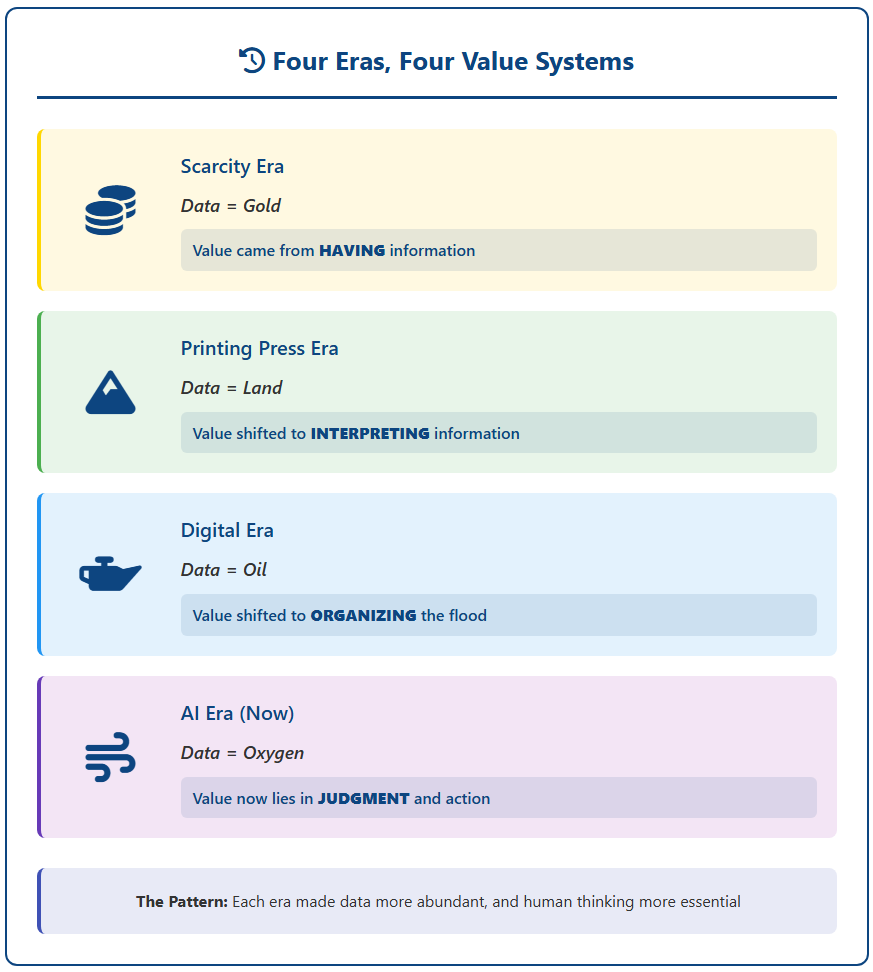
Stage One: The Scarcity Era (Pre-Printing Press)
For centuries, knowledge was scarce. Scrolls and manuscripts were guarded by scribes, monasteries, and elites. Information was:
Amount: Minimal. A few texts, oral traditions
Access: Restricted to privileged groups
Distribution: Localized and slow
Value Analogy: Knowledge was like gold: rare, hoarded, powerful
Trustworthiness: High. If it was written, it was believed
Human Relationship: Reverence. Knowledge was sacred
Data Parallel: Early organizations treated data the same way. It was siloed, controlled by specialists in finance or research, inaccessible to most employees. The assumption was that possession itself equaled power.
Lesson: Value came from having information, not using it.
Stage Two: The Printing Press Era
The printing press changed everything. Suddenly, information was abundant relative to before, though not everyone could read it. Information was:
Amount: Rapidly increasing
Access: Expanding, though literacy lagged
Distribution: Faster. Pamphlets and books circulated across regions
Value Analogy: Information became like land, spread more widely, democratizing opportunity
Trustworthiness: Mixed. Propaganda and truth both spread
Human Relationship: Aspiration. Literacy became a path to progress
Data Parallel: Dashboards today are the equivalent of the printing press. Everyone in an organization can "see" data, but not everyone can interpret it. Some leaders confuse access with literacy, as though handing someone a dashboard automatically creates understanding.
Lesson: Value shifted from access to interpretation.
Stage Three: The Digital Era
The rise of computing and the internet brought an explosion of data and information. Suddenly, everything was searchable and globally connected. Information was:
Amount: Exponential growth, the "big data" era
Access: Broad. Google and databases made information ubiquitous
Distribution: Global and nearly instant
Value Analogy: Data became the new oil: abundant, extracted, refined, and monetized
Trustworthiness: Fractured. Misinformation and "fake news" spread just as easily as truth
Human Relationship: Overload. The flood of content created stress and noise
Data Parallel: Companies treated data like oil, hoarding it, building massive warehouses, assuming more was always better. Yet people found themselves drowning in dashboards and reports, with little clarity.
Lesson: Value shifted to organizing, filtering, and making sense of the flood.
Stage Four: The AI Era (Now)
Today we stand at the start of a new era. AI doesn't just store and index information; it generates it. Information is:
Amount: Infinite. AI can produce content endlessly
Access: Instant. Every question has an answer in seconds
Value Analogy: Data is now like oxygen. Everywhere, invisible, essential, but polluted without filters
Trustworthiness: Probabilistic. Outputs must be validated, not assumed
Human Relationship: Dependence. We risk outsourcing thinking to algorithms
Lesson: Value now lies in sense-making, judgment, and action.
Four eras. Four value shifts. From hoarding gold to judging oxygen, human thinking becomes more essential as data becomes more abundant.
The Neuroscience of "Data-Rich but Wisdom-Poor"
We've all felt it: staring at a dashboard, drowning in charts, paralyzed by choice. Turns out, there's hard science behind that feeling.
The Inverted U-Curve
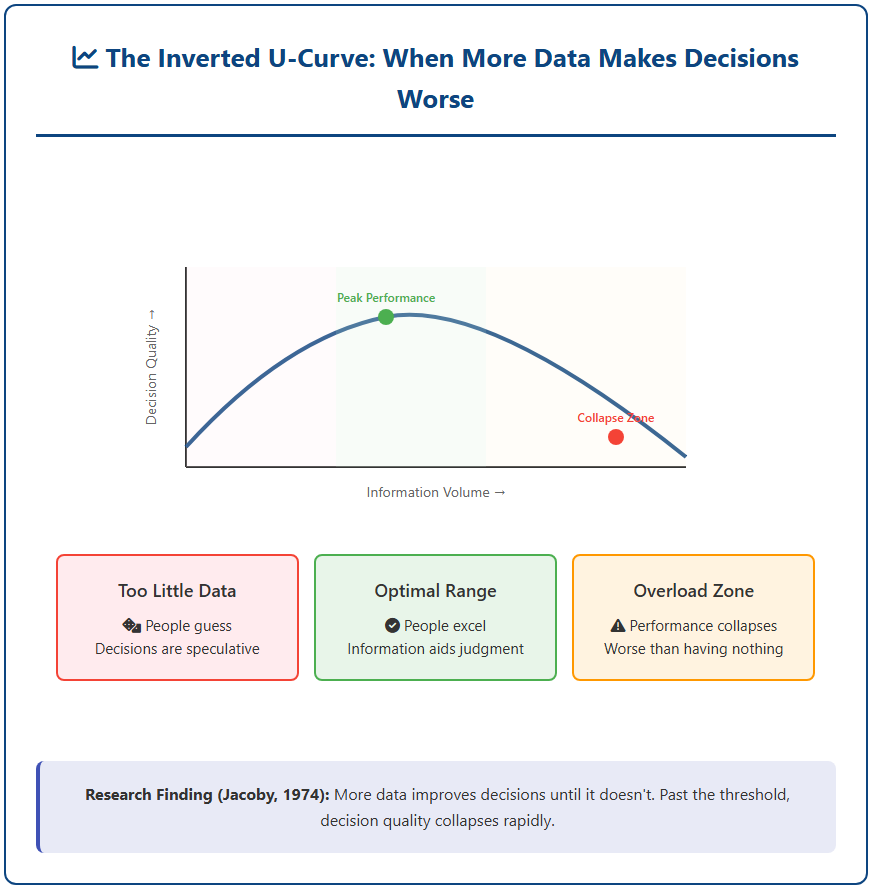
Back in the 1970s, researcher Jacob Jacoby discovered something counterintuitive: decision quality improves as information increases, but only up to a point. Beyond that threshold, performance doesn't just plateau. It collapses. This "inverted U-curve" has been replicated across domains: consumer choices, financial decisions, medical diagnoses, managerial judgment.
The pattern is consistent. Give people too little data, they guess. Give them the right amount, they excel. Give them too much, and they perform worse than if they'd had nothing at all.
The inverted U-curve: more information improves decisions until it destroys them. Past the threshold, you're worse off than having nothing.
What Happens in the Brain
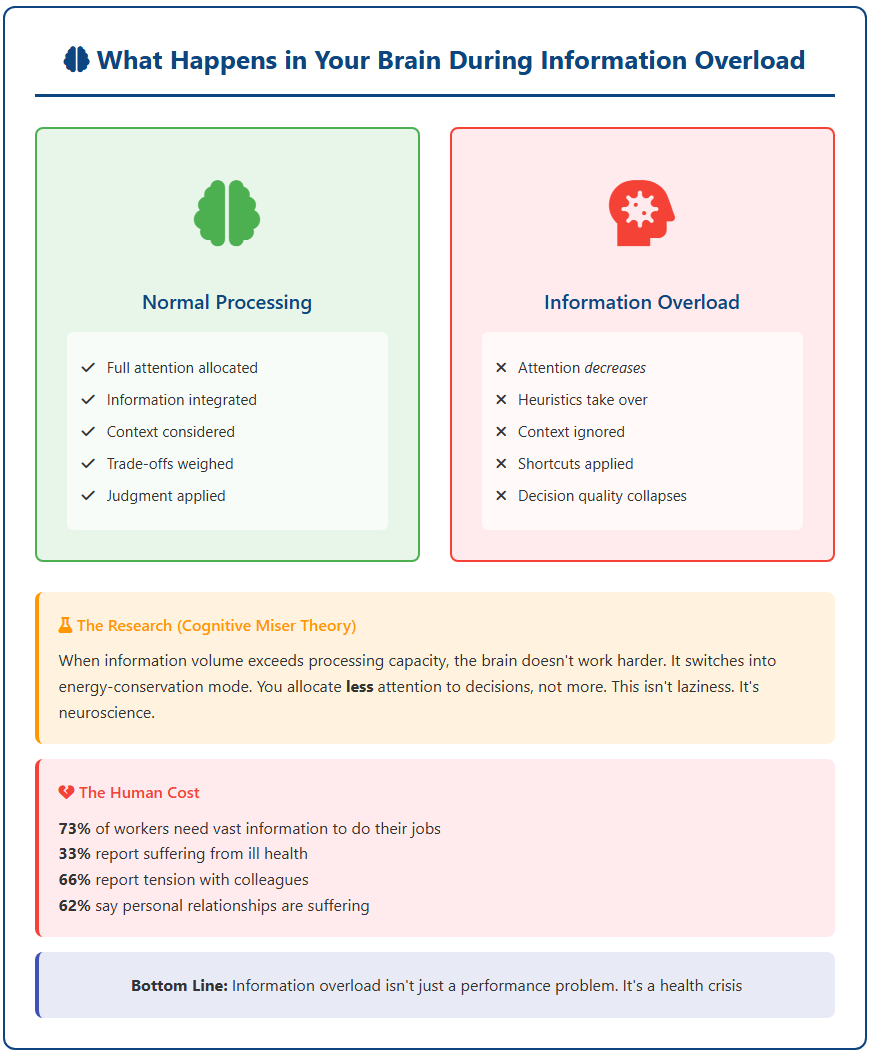
When faced with information overload, your brain doesn't just work harder. It shuts down. Neuroscience studies using brain imaging show that when information volume exceeds processing capacity, people allocate less attention to decisions, not more. The technical term is "cognitive miser theory": your brain, sensing overwhelm, switches into energy-conservation mode. You stop integrating information. You grab at heuristics. You make faster, worse decisions.
Information overload shuts your brain down. Attention decreases. Shortcuts replace analysis. 62% of workers say their relationships suffer. This is neuroscience, not weakness.
And it's not just about volume. A meta-analysis of 31 studies found that both information diversity (too many different types of data) and information repetitiveness (the same data shown multiple ways) degrade decision quality. More dashboards don't help. More metrics don't help. More views of the same data definitely don't help.
The Human Cost
A global study across five countries found that 73% of workers say they need vast amounts of information to do their jobs. But the consequences are brutal: 33% report suffering from ill health, 66% report tension with colleagues and diminished job satisfaction, and 62% admit their personal relationships are suffering.
Information overload isn't just a performance problem. It's a health crisis.
Why We Can't Think Probabilistically
Here's where it gets worse: the AI era doesn't just flood us with data. It floods us with probabilistic data. Confidence intervals. Likelihoods. Ranges. Uncertainty.
And humans are catastrophically bad at this.
Five decades of research shows that we struggle with probabilistic reasoning, not just laypeople, but doctors, lawyers, executives, and experts. Our brains evolved in what scientists call "Middle Land": a world of certainties at human scale. We see objects we can touch, at speeds we can track, over timescales we can witness. We're not wired for atoms or galaxies, glacial drift or light speed, or probabilities of 0.001% vs. 0.01%.
Studies show we systematically distort probabilities including overestimating rare dramatic events (plane crashes), underestimating common invisible ones (heart disease). We either panic at low-probability high-impact risks or ignore them entirely. There's no middle ground, because probabilistic thinking isn't native to human cognition.
The AI Acceleration
AI doesn't reduce overload. It accelerates it. It doesn't fix cognitive bias. It operationalizes it at scale.
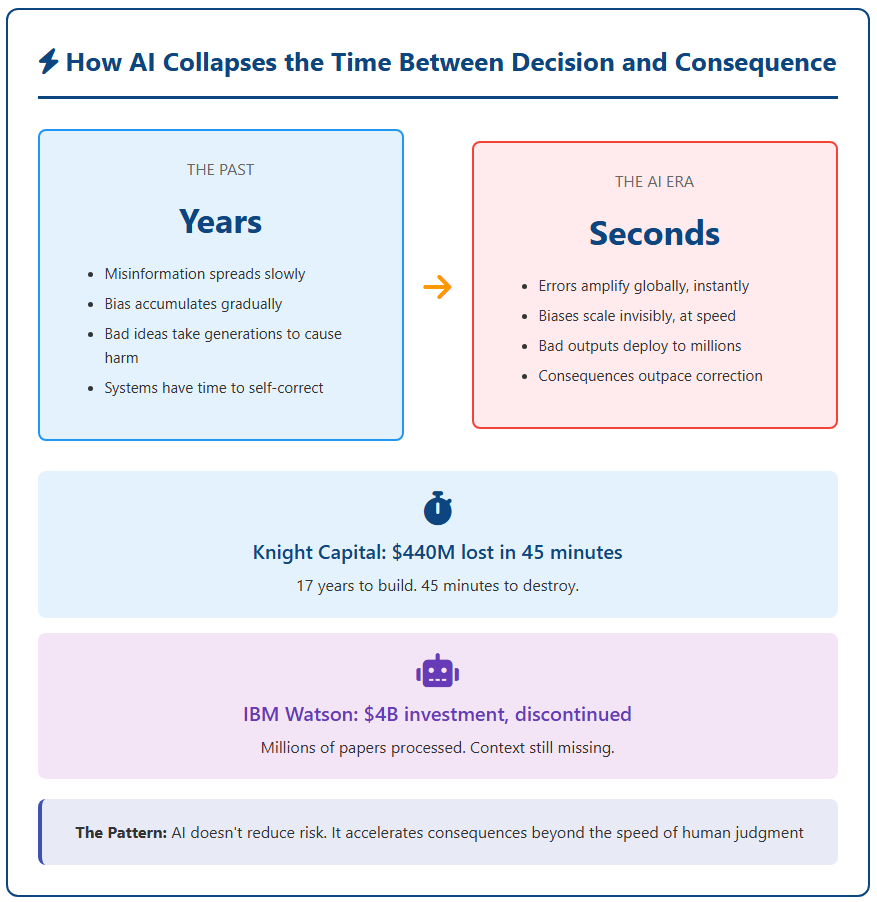
AI collapses time. What took years now takes seconds. Knight Capital: 45 minutes. IBM Watson: context still missing. Speed without judgment is collapse.
This is where cognition, systems, and technology collide. We've built tools that generate infinite outputs, but our brains still operate at human speed, with human limitations, in human bodies. AI collapses the traditional cycle of raw data → information → insight into a single, polished output. But that output can be misleading, biased, or incomplete. Without human judgment, AI amplifies errors and false confidence, not gradually, but instantly, globally, irreversibly.
The real risk isn't bad models. It's cultures that reward fast answers over slow thinking.
The Danger of Not Pivoting
History repeats itself. Early readers of the printing press could pronounce words without grasping their meaning. Today, many workers can "read" dashboards or AI outputs but cannot interpret what they mean for real decisions.
But the difference now is speed and scale.
Consider Knight Capital, once the largest trader in U.S. equities. In August 2012, a deployment error activated old code in their trading system. Within 45 minutes, the software executed over 4 million erroneous trades across 154 stocks. The loss: $440 million. By the next day, 75% of Knight's equity value had vanished. It took 17 years to build the company. It took 45 minutes to destroy it.
What went wrong wasn't the technology. It was judgment. No one asked the critical questions: "How do we verify this deployment?" "What safeguards exist if something goes wrong?" The system designed to detect anomalies failed because it was calibrated for price swings, not volume spikes. Human sense-making couldn't keep pace with algorithmic speed.
Or consider IBM Watson for Oncology, a $4 billion bet that AI could revolutionize cancer treatment. Watson could process millions of research papers but it couldn't understand clinical context. Its recommendations, heavily biased toward one hospital's practices, failed to translate to real-world cases. After years of unsafe outputs and eroded trust, the program was quietly discontinued in 2023.
Even in seemingly low-stakes domains, the consequences compound. When Air Canada's chatbot gave incorrect bereavement fare information to a grieving customer, the company tried to argue "the chatbot was responsible for its actions." The tribunal disagreed: organizations are accountable for their AI's outputs. This wasn't one customer service rep making a mistake. This was an error deployed to every customer who asked the same question, indefinitely.
When Judgment Works
But it doesn't have to be this way.
Consider the Qantas Flight 32 incident in 2010. An uncontained engine failure triggered 650 error messages in the cockpit within minutes: a cascade of alarms, contradictions, and system failures. The crew didn't panic. They didn't defer to automation blindly. Captain Richard de Crespigny and his team systematically prioritized critical systems, cross-checked conflicting data, and made decisions based on deep expertise and collaborative judgment. They landed a damaged A380 safely, saving 469 lives.
The difference? A culture that valued slow, deliberate thinking under pressure. A team trained not just to read instruments, but to interpret them. Systems designed with human judgment at the center, not as an afterthought.
Judgment plus systems plus data can do extraordinary things. But only when we design for human cognition, not against it.
The constraint moved from scarce information to scarce judgment. Every era creates a new bottleneck. Today's is human cognition at the speed of AI.
The New Mandate: Data Citizenship
The answer is not more data tools. It is not faster dashboards or bigger warehouses. The answer is cultivating data citizenship, the skills and mindsets to use, question, and apply data responsibly.
Being a data citizen means asking better questions before rushing to answers. It means recognizing bias, assumptions, and uncertainty in the data. It means thinking probabilistically rather than expecting certainty. It means connecting data to context, people, and purpose. It means ensuring inclusivity so every role and every cognitive style can engage with data.
The skills we developed across these eras: interpretation, sense-making, stewardship, are not optional today. They converge into what we now call data citizenship: a civic skill as fundamental as reading or writing. Just as literacy became the foundation of democratic societies, data citizenship will become the foundation of organizations and communities that thrive in the age of AI.
The Call To Action
We've gone from gold to land to oil to oxygen. Each shift has made data and information more abundant, more essential, and more dangerous when misused.
The next frontier of value will not come from collecting more data. It will come from cultivating people who can think critically, interpret wisely, and decide responsibly.
But understanding that the value has shifted is only half the story. The other half is understanding how human capabilities must evolve to meet this moment. If the scarcity era demanded possession, the printing press demanded interpretation, and the digital era demanded sense-making, what does the AI era demand of us?
In the next article, we'll explore how human skills have adapted alongside each information revolution and why the AI era now requires something unprecedented: all of these skills at once. We'll examine the converging capabilities that form data citizenship, and why this moment in history demands a new baseline literacy for everyone.
Tools will change. Thinking lasts. The time to pivot is now.
Kevin is an author, speaker, and thought leader on topics including data literacy, data-informed decisions, business strategy, and essential skills for today. https://www.linkedin.com/in/kevinhanegan/
AI did not end the data literacy crisis. It changed it. As machines move from providing information to interpreting it and recommending what to do, the scarce skill is becoming judgment: knowing what to trust, what to question, and what decisions are still ours to make.
Evidence does not make decisions. People interpret it, weigh it, challenge it, and make judgments. A courtroom reveals what leaders can learn about evidence, expertise, confidence, and data-informed decision-making.
Feeling sure doesn't mean you're right. Learn five simple ways to question what feels true, spot what might be influencing you, and make better decisions about what to believe.
We teach data literacy as a ladder: data at the bottom, wisdom at the top, climb step by step. But the rungs are not where the work happens. The judgment lives in the gaps between them, and that is exactly where AI now carries us straight past.