AI did not end the data literacy crisis. It changed it. As machines move from providing information to interpreting it and recommending what to do, the scarce skill is becoming judgment: knowing what to trust, what to question, and what decisions are still ours to make.
Evidence does not make decisions. People interpret it, weigh it, challenge it, and make judgments. A courtroom reveals what leaders can learn about evidence, expertise, confidence, and data-informed decision-making.
Feeling sure doesn't mean you're right. Learn five simple ways to question what feels true, spot what might be influencing you, and make better decisions about what to believe.
The Skills Gap Is Misdiagnosed. The Real Workforce Problem Is Judgment
Organizations keep investing in technical skills training. The gap persists. The real problem is not what employees know how to operate. It is how well they think with what they know. This article reframes the crisis as a judgment gap and introduces a six-domain capability framework for closing it.
The most dangerous employee is not the one who lacks data. It is the one who has data and never learned to question it.
The modern workforce advantage is not knowledge. It is judgment. In an environment flooded with data and AI-generated insights, the most valuable professionals are those who can interpret information, challenge assumptions, and turn insights into decisions.
90 Second Wisdom Audio Brief
0:00
/91.9278
What You Need To Know About
Organizations have spent a decade treating the workforce readiness problem as a skills gap. It is not. The deeper problem is a judgment gap: employees have more data, more dashboards, and more AI-generated insights than ever, but many have never been trained to interpret that information critically, question the assumptions behind it, or turn it into sound decisions. The most in-demand workforce capability is not a tool or a certification. It is the ability to think well with information.
Why This Matters to You If your organization is investing heavily in technical upskilling and still finding that decisions are slow, data is misread, and AI outputs are accepted without scrutiny, the training is not failing. It is solving the wrong problem. The cost of weak judgment is measurable: millions lost to poor data interpretation, AI-driven errors that go unchallenged, and recommendations that look confident but collapse under examination. Closing this gap is the difference between a workforce that operates tools and a workforce that produces outcomes.
Who This Applies To This is for anyone responsible for how an organization builds capability: CLOs, CPOs, HR leaders, and L&D professionals who suspect that course completion rates are not telling the full story. It is also for managers and senior leaders who depend on their teams to interpret data, evaluate AI outputs, and make decisions under uncertainty, and who have noticed that proficiency with the tools has not translated into proficiency with the thinking.
What You Will Gain from Reading You will walk away with a clear framework for the six capabilities that determine whether technical skills produce good outcomes, and a way to diagnose which ones your organization is underbuilding. You will understand why AI raises the stakes for human judgment rather than replacing it. And you will have a concrete lens for evaluating whether your current development programs are building the thinking capability that actually drives decision quality.
For the past decade, leaders have been told the same story. There is a skills gap in the workforce. Employees need to be upskilled. Organizations must invest more in training and professional development.
CLOs, CPOs, and HR leaders have responded accordingly. They have built learning academies, expanded training catalogs, invested in learning platforms, and launched large-scale upskilling initiatives.
Yet despite these efforts, the narrative has not changed. Leaders still say their workforce is not prepared for the future.
Which raises an uncomfortable question. What if the problem is not a lack of training? What if the skills gap has been misdiagnosed entirely?
The Nature of Work Has Changed
For most of the past century, professional development followed a relatively stable pattern. Organizations hired people for specific roles. Employees learned the knowledge and technical skills required for those roles. Training focused on building expertise and proficiency.
That model worked when work itself was stable. Today it is not.
Modern work environments are defined by constant information flow, rapidly changing technology, cross-functional collaboration, AI-assisted workflows, and increasingly complex decisions.
The challenge facing employees today is no longer simply knowing how to do a task. The challenge is figuring out what the right task is in the first place.
And that requires something different than traditional skill development. It requires stronger thinking capability.
The Workforce Skill Base Is Rapidly Shifting Global employer surveys show that about 44% of core workforce skills will change within the next five years as technology and automation reshape work.
This means the traditional model of teaching fixed technical skills is increasingly fragile. What lasts longer are capabilities like analytical thinking, problem framing, and adaptability.
The Real Gap: Interpretation, Judgment, and Decision-Making
Consider what many employees are actually dealing with today. They are looking at dashboards filled with metrics. They are receiving recommendations from AI systems. They are being asked to interpret data and communicate insights. They are navigating competing priorities and incomplete information.
In these situations, the issue is rarely a lack of access to information. The issue is what to do with it.
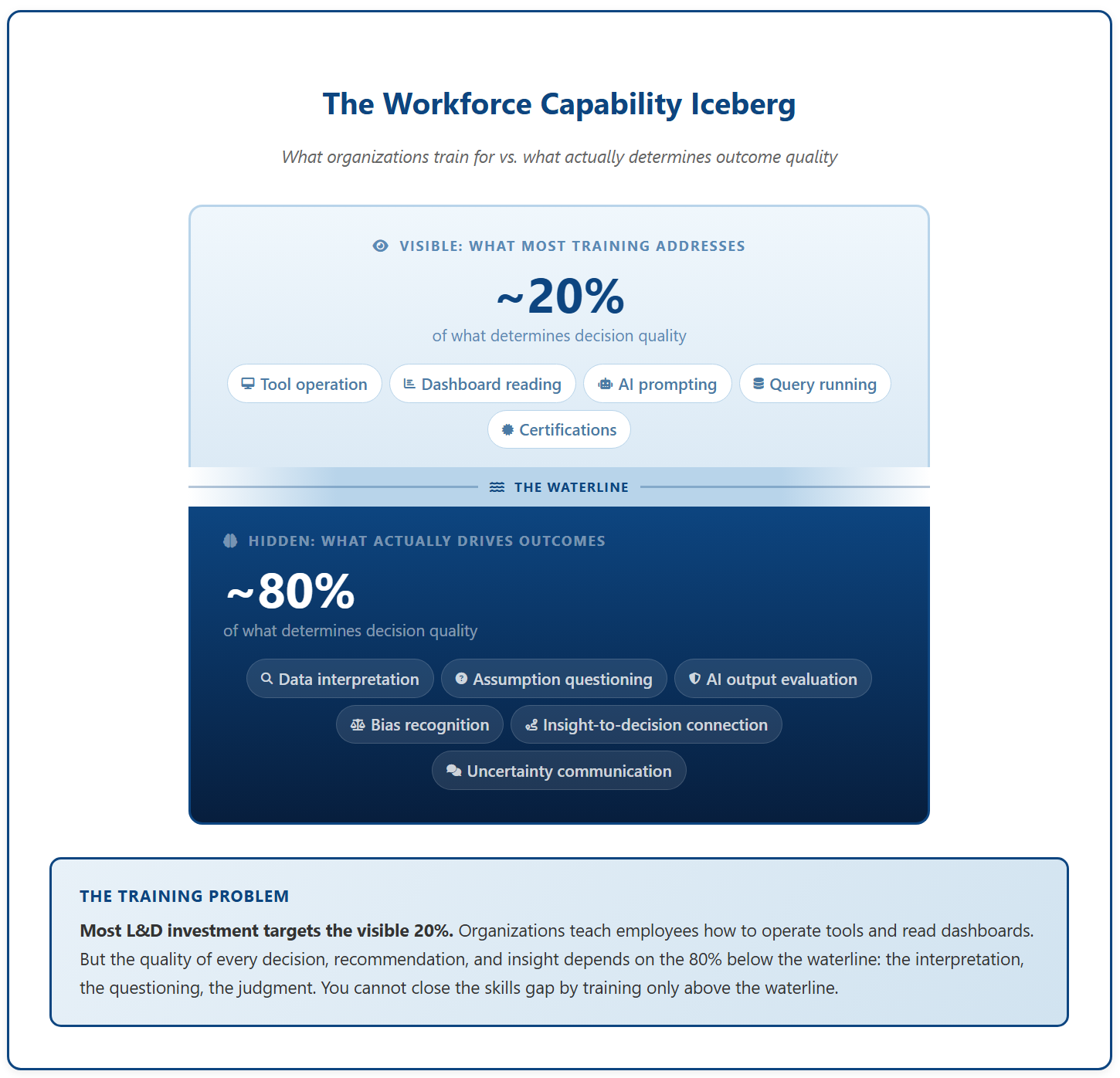
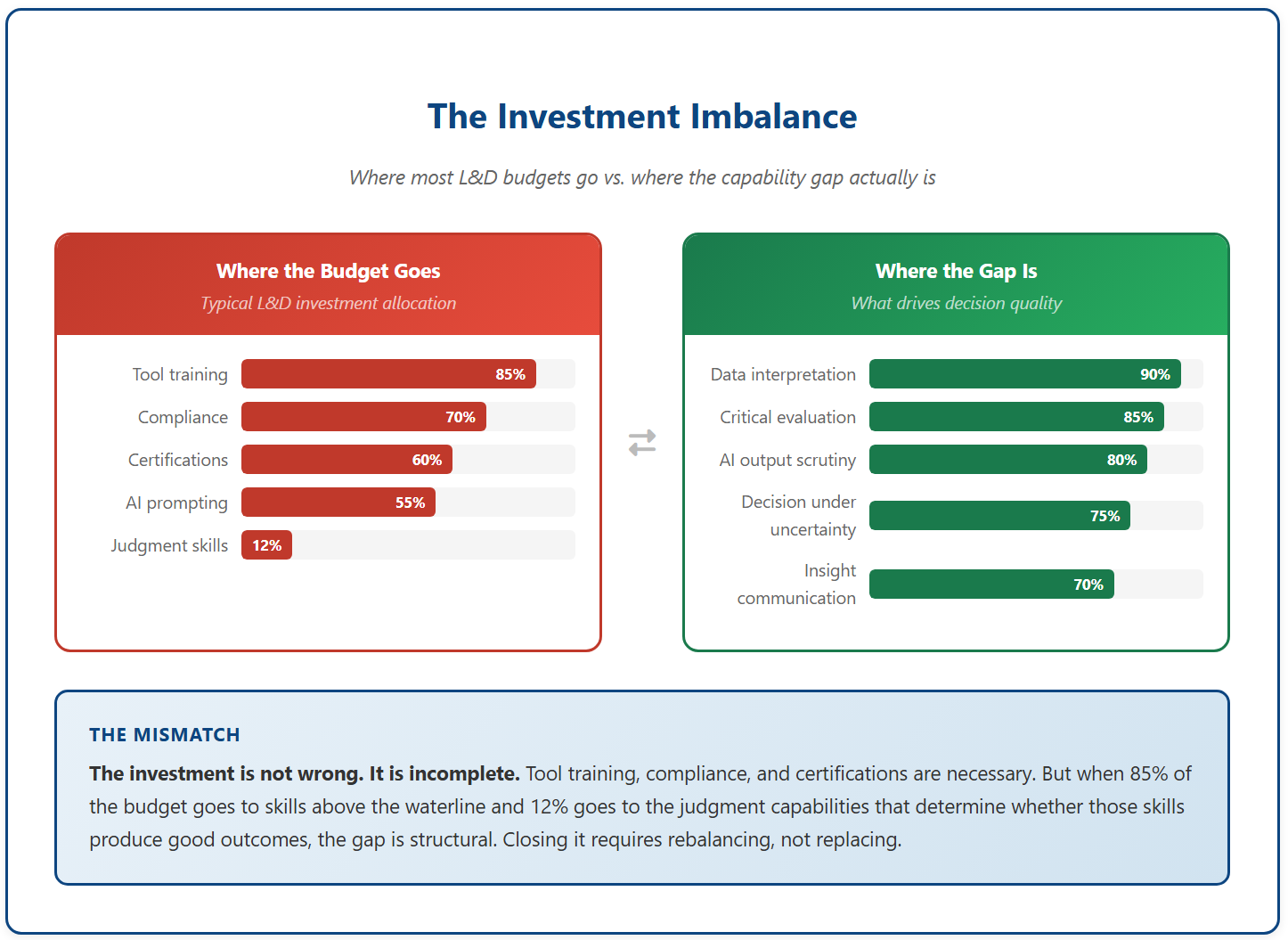
Think of it like an iceberg. The visible part above the surface is the technical skill: operating the tool, running the query, reading the dashboard. But the mass below the waterline is what actually determines the quality of the outcome. That is the interpretation, the questioning, the judgment.
Many organizations assume the solution is to teach more technical skills. Analytics tools. AI tools. Data platforms. New software systems.
Those skills are useful. But they sit above the waterline. They do not address the underlying problem.
The underlying problem is that many employees have never been trained to interpret data critically, question assumptions behind metrics, evaluate AI-generated outputs, recognize bias in analysis, connect insights to decisions, or communicate implications clearly.
In other words, they have not been trained to think with information. And that capability is now central to almost every professional role.
Analytical Thinking Tops the Global Skills List The World Economic Forum reports that analytical thinking is the most sought-after skill among employers, with roughly 7 out of 10 organizations identifying it as essential for the future workforce.
That finding is telling. The most in-demand capability is not a tool or a platform. It is the ability to interpret information, reason through problems, and make sound judgments in complex environments.
The Financial Cost of Poor Data Interpretation The consequences of weak interpretation are not abstract. Research shows that more than a quarter of organizations lose over $5 million annually to poor data quality, and 7% lose $25 million or more. Gartner estimates that bad data costs organizations an average of $12.9 million per year, and McKinsey has documented a 20% productivity drop and 30% cost increase attributable to poor-quality data.
These losses are rarely caused by missing data. They are caused by data that is misread, misunderstood, or acted on without adequate scrutiny.
What Happens When Judgement is Missing
The gap between having information and interpreting it well is not a theoretical problem. It shows up in documented, costly ways.
The headlines tell the story clearly enough. A securities firm loses hundreds of millions to a data entry error that verification processes should have caught. A ride-sharing company underpays drivers for months because no one scrutinized the operational data closely enough to surface the discrepancy. A retailer's facial recognition system produces discriminatory false identifications, and the FTC bans the technology for five years because staff were never trained to recognize when the system was failing.
Each of these cases illustrates the same pattern: the technology worked as designed, but the people interacting with it lacked the capability to interpret outputs critically, question anomalies, or exercise judgment under pressure.
AI Is Raising the Stakes
Artificial intelligence is making this gap even more visible.
AI Adoption Is Already Widespread Recent workforce research shows that about 75% of knowledge workers are already using generative AI in their jobs, often experimenting with tools before formal organizational policies catch up.
The implication is clear: the workforce is already interacting with AI. The real question is whether employees have the capability to interpret and apply AI outputs responsibly.
AI systems can now generate analysis, recommendations, forecasts, written summaries, and strategic suggestions. This has led many organizations to focus on AI skills training: how to prompt, how to operate the tools, how to integrate them into workflows.
But learning how to prompt a tool is only a small part of the challenge. The more important question is what happens after the output appears.
Here is what that looks like in practice.
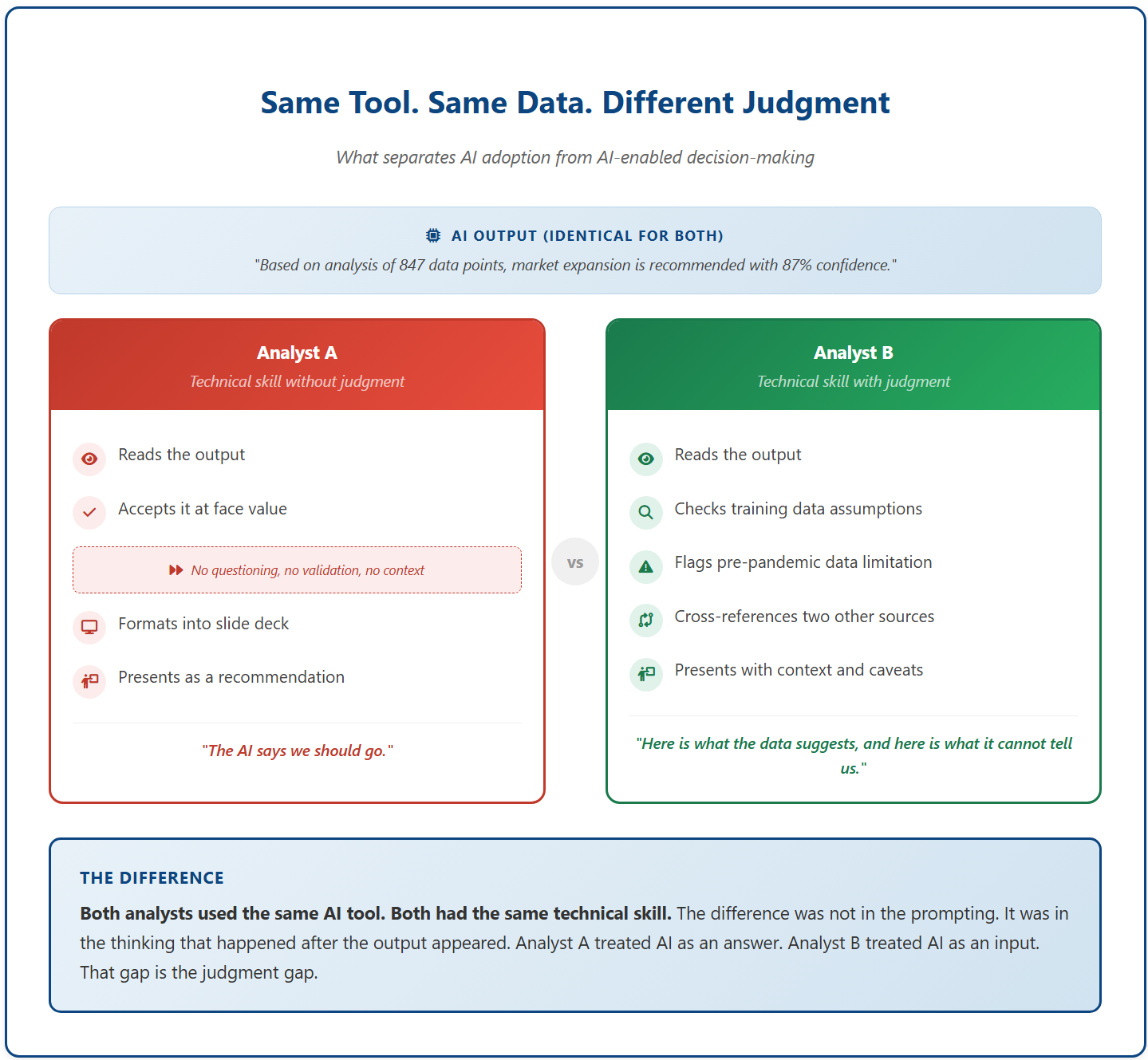
Imagine two analysts at the same company receive the same AI-generated market forecast. One takes it at face value, formats it into a slide, and presents it to leadership. The other pauses. She checks the underlying assumptions. She notices the model was trained on pre-pandemic data and flags that limitation. She cross-references the forecast against two other sources. She presents the insight with context, caveats, and a recommendation.
Both analysts used the same AI tool. Both had the same technical skill. The difference was not in the prompting. It was in the thinking that happened after the output appeared.
That difference is what separates AI adoption from AI-enabled decision-making. And it is the difference organizations should be investing in.
AI Is Moving Faster Than Organizational Readiness Most organizations rank generative AI as a high priority. Far fewer feel prepared to deploy it responsibly. That gap between enthusiasm and governance is where judgment failures are most likely to occur. AI does not remove the need for human judgment. It raises the stakes for it. Employees who lack the ability to evaluate and contextualize AI outputs can easily move faster in the wrong direction.
A Cautionary Tale: When AI Outpaces Human Oversight When a major retailer deployed facial recognition for loss prevention, the system produced false identifications that led to discriminatory treatment and a federal ban on the technology. The employees had been trained to use the tool. What they had not been trained to do was question its outputs, recognize patterns of failure, or exercise independent judgment when the system flagged an individual. That is the precise gap the capability stack addresses: the difference between knowing how to operate a system and knowing when to override it.
The New Workforce Capability Stack
If the skills gap is misdiagnosed, then the solution must change as well.
The future of professional development is not just about adding more courses or certifications. It is about building a capability stack that helps employees navigate complex information environments.
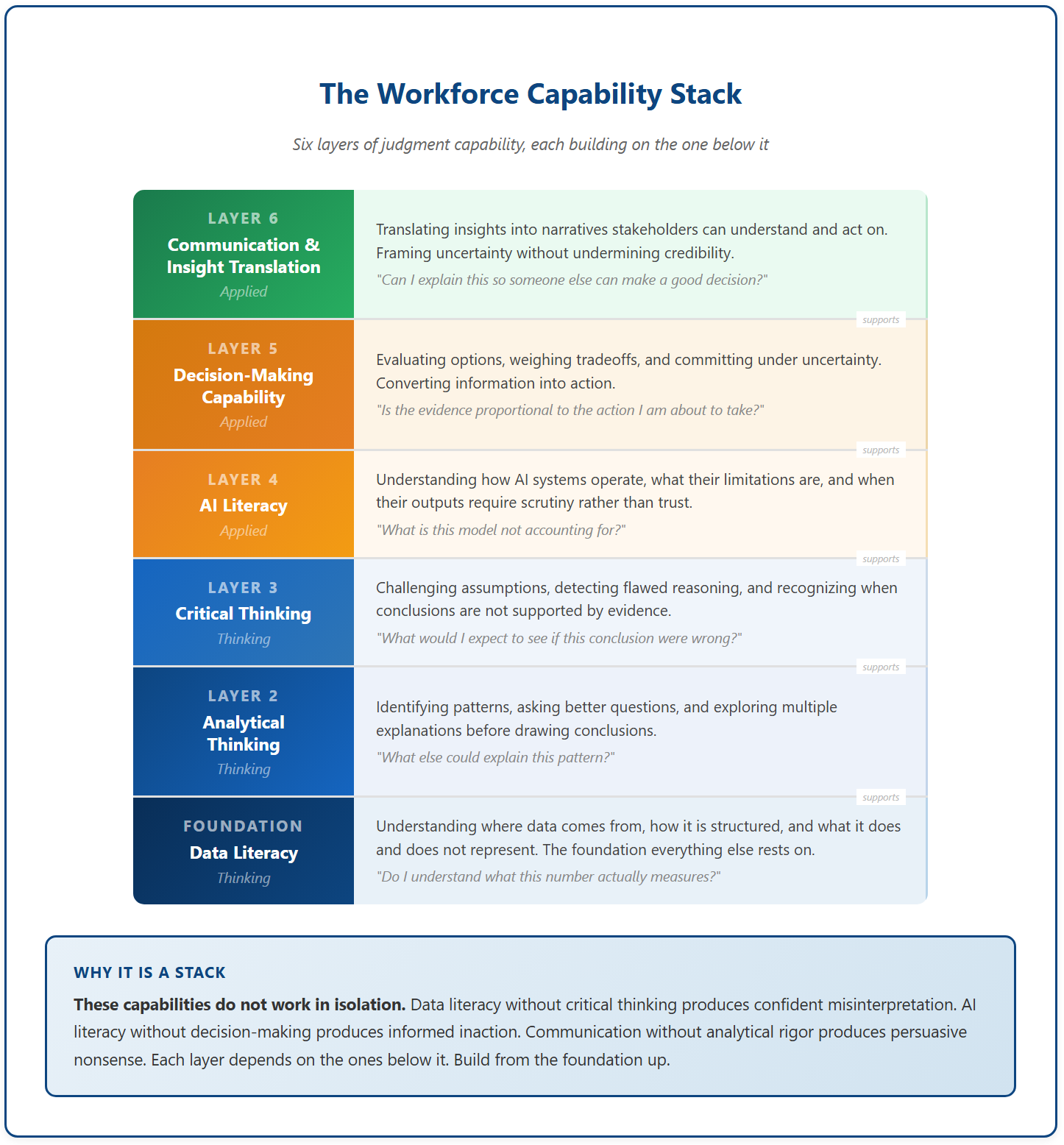
Think of this stack as scaffolding. Each layer supports the next. Without a strong foundation, the layers above become unreliable.
Data Literacy forms the base. Employees must be able to understand where data comes from, how it is structured, and what it does and does not represent. Without this foundation, dashboards and analytics tools often create false confidence rather than better decisions. Data literacy is not a technical skill. It is a thinking skill.
Analytical Thinking builds on that foundation. Employees need the ability to identify patterns, ask better questions, and explore multiple explanations before drawing conclusions. This capability separates observation from insight. It is the difference between seeing a number go up and understanding why it matters.
Critical Thinking adds a layer of rigor. It allows employees to challenge assumptions, detect flawed reasoning, and recognize when conclusions are not supported by evidence. In a world flooded with data and AI-generated content, critical thinking is one of the most important safeguards against poor decision-making.
AI Literacy addresses the new reality. As AI becomes embedded in workflows, employees must understand how AI systems operate, what their limitations are, and when their outputs require scrutiny. AI literacy is not just about using the technology. It is about working responsibly with it.
Decision-Making Capability sits near the top. Ultimately, insights only matter if they influence action. Employees must be able to evaluate options, weigh tradeoffs, and make decisions under uncertainty. This is the capability that converts information into results.
Communication and Insight Translation completes the stack. Even the best analysis has little impact if it cannot be communicated effectively. Employees must be able to translate insights into clear narratives that stakeholders can understand and act upon.
None of these capabilities work in isolation. They connect. They reinforce each other. And together, they represent the real investment organizations need to make.
AI Rewards Complementary Human Skills Studies analyzing millions of job postings show that AI adoption tends to increase demand for complementary human capabilities, including digital literacy, collaboration, and critical reasoning, rather than simply replacing human roles.
This reinforces a key point: the workforce advantage in an AI-enabled world comes from combining technology with strong human judgment.
What This Looks Like in Practice
In our work with organizations across industries and across more than 25 countries, a consistent pattern emerges when teams begin building these capabilities.
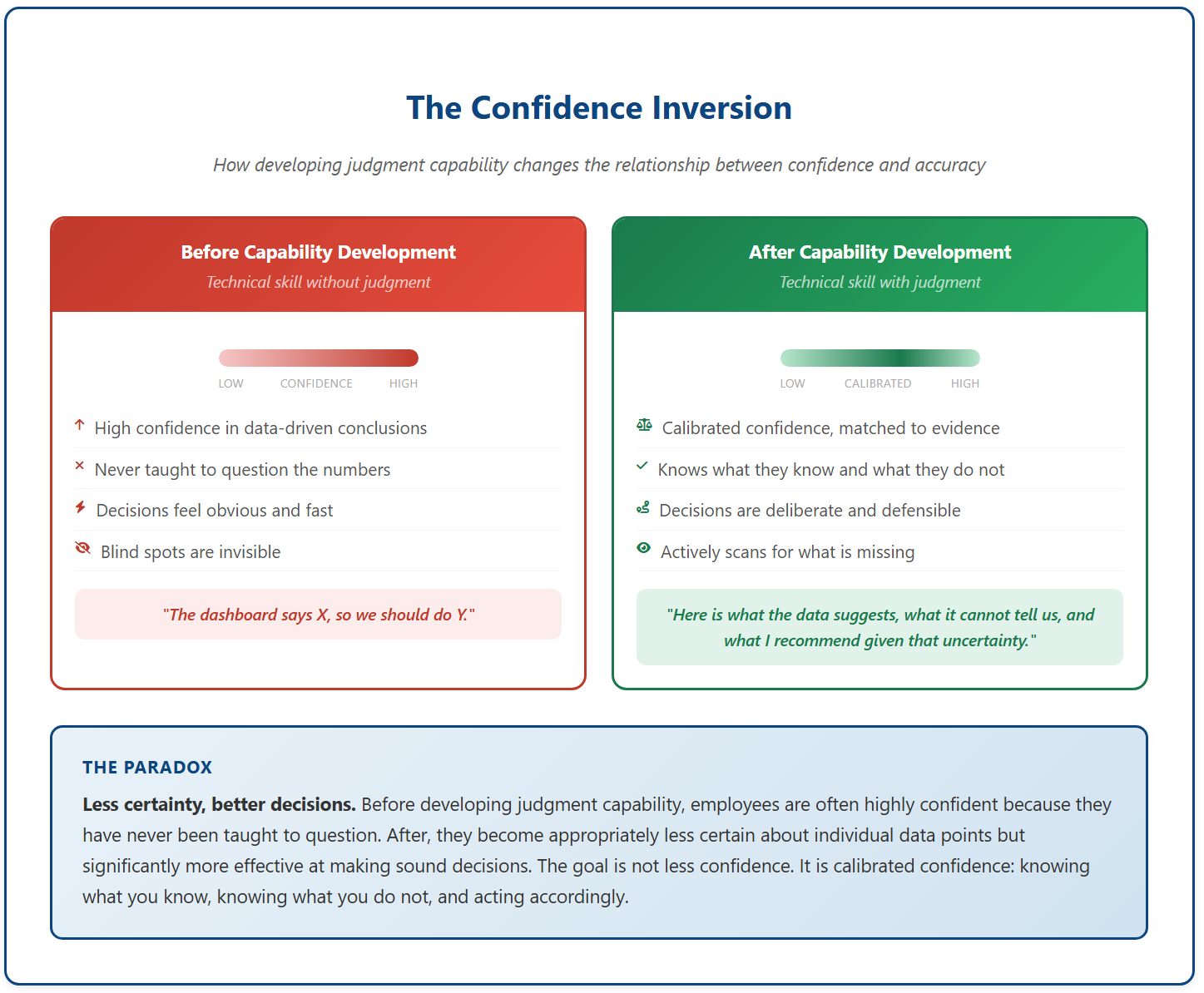
Before capability-focused development, most teams treat dashboards and reports as answers. They accept metrics at face value, present AI outputs without scrutiny, and frame decisions around whatever data is most readily available. Meetings are filled with data but empty of interpretation. People know the numbers but cannot explain what the numbers mean, why they might be wrong, or what they should do about them.
After capability-focused development, the conversation changes. Teams begin asking different questions: Where did this data come from? What assumptions are built into this metric? What would we expect to see if this conclusion were wrong? What is this AI output not accounting for?
The shift is observable in how people talk about information. They move from reporting what the dashboard says to interpreting what the dashboard means. They move from accepting AI recommendations to evaluating them. They move from presenting data to presenting arguments supported by data.
One pattern we see repeatedly is what we call theconfidence inversion. Before building these capabilities, employees are often highly confident in their data-driven conclusions because they have never been taught to question them. After developing analytical and critical thinking skills, they become appropriately less certain about individual data points but significantly more effective at making sound decisions. They develop what experienced practitioners recognize as calibrated judgment: knowing what you know, knowing what you do not know, and acting accordingly.
This is not abstract. It shows up in decision speed, in the quality of recommendations that reach leadership, in the number of costly misinterpretations that get caught before they cause damage, and in the ability of teams to work productively with AI rather than being either intimidated by it or blindly trusting it.
Beyond Training: Systematic Judgment as an Operating Model
The most compelling evidence that judgment capability drives organizational performance may come not from L&D case studies but from an organization that built decision discipline into its operating model from the ground up.
Bridgewater Associates, the world's largest hedge fund, has codified its approach to decision-making into a systematic investment process that integrates human judgment with machine intelligence. The goal is to apply thinking consistently, test it against reality, and continuously improve decision-making over time. Every investment decision gets translated into documented criteria. Errors are systematically logged, diagnosed, and converted into principles that prevent recurrence.
The result: Bridgewater's flagship fund delivered average annual returns of 11.4% over three decades with significantly less volatility than the broader market, including a positive return during the 2008 financial crisis when most funds suffered massive losses.
This is not a training program. It is an organizational system that demands judgment capability at every level. And it illustrates the point that sits at the heart of this article: the advantage is not in having more data or better tools. It is in the quality of the thinking applied to them.
A Shift from Skill Development to Capability Development
For CLOs, CPOs, and HR leaders, this represents a meaningful shift.
Traditional upskilling models often focus on teaching people how to do specific things. How to use a platform. How to run a report. How to operate a system. But the emerging workforce challenge is different. It is not about what employees can operate. It is about how employees can think.
Organizations must help employees develop the ability to navigate complexity, evaluate information, collaborate with AI, make informed decisions, and adapt as conditions change.
This is less about isolated training modules and more about building organizational thinking capability. It requires learning experiences that help people practice interpreting data, questioning assumptions, and applying insights to real-world decisions.
What does that look like? It looks like programs that put people in front of messy, ambiguous scenarios and ask them to work through them. Not multiple-choice assessments. Not compliance modules. Real practice with the kind of judgment calls they face every day.
It also requires a broader understanding of how data, analytics, AI, and human judgment work together. Not as separate disciplines. As an integrated system.
An Important Nuance This argument is not that technical skills do not matter, or that all current L&D efforts are misguided. Technical skills like AI, big data, and cybersecurity are rising quickly in importance. And some training programs do improve judgment when they are scenario-based, reflective, and capability-oriented.
The sharper claim is that many programs stop at tool use, certification, or compliance rather than decision quality. The imbalance is not either/or. It is that the current investment is too skill-heavy and too capability-light.
The Organizations That Will Win
The organizations that succeed in the next decade will not necessarily be the ones with the most data or the most advanced AI. Many companies will have access to similar technologies. The real differentiator will be the capability of the workforce using them.
Organizations that invest in stronger thinking and decision capability will make better use of analytics and AI, identify opportunities faster, avoid costly misinterpretations of data, and adapt more quickly to change.
Most importantly, they will have employees who can turn information into sound decisions and meaningful action.
Rethinking the Skills Conversation
The conversation about workforce development needs to evolve. Technical skills matter. Digital fluency matters. AI training matters.
But those are not the entire story. The deeper challenge organizations face today is not a shortage of skills. It is a shortage of capability to interpret information, evaluate evidence, and make good decisions in complex environments.
The problem is not just what employees know. It is how well they think with what they know. That is the capability modern organizations must now learn to build.
Close Your Judgment Gap
This article introduced the problem. The resources below help you act on it.
Experience It: The Judgment Gap Simulation Step into three realistic business scenarios where you receive data, AI recommendations, and a decision to make. Your free-form responses are scored by AI across six capability domains, and you receive a personalized Judgment Profile that reveals where your thinking instincts are strong and where your blind spots are. Takes 7-10 minutes. Take the Simulation
Learn It: The Judgment Gap Learning Module A short interactive module that introduces the iceberg problem, walks you through the difference between technical skill and judgment capability, and lets you practice spotting the gap in realistic scenarios. Includes two hands-on activities. Takes 10-12 minutes. Start the Module
Assess Your Organization: The Judgment Gap Maturity Model A four-stage diagnostic framework for L&D leaders. Benchmark where your organization sits on the spectrum from skill-focused to capability-focused development, identify which of the six capability domains need the most attention, and get concrete action steps for advancing to the next stage. Available as a downloadable reference guide and as an interactive online assessment. Read about the Maturity Model | Take the Online Assessment
Go Deeper: Work With TDIW Turning Data Into Wisdom helps organizations build the thinking capabilities their workforce needs to turn information into sound decisions. From capability assessments and scenario-based training to AI literacy programs and decision quality measurement, TDIW works with L&D leaders to close the judgment gap at scale. We have trained professionals in over 25 countries across industries, including financial services, pharmaceuticals, government, and higher education.
Book a free 30-minute consultation to discuss where your organization's judgment gaps are and what it would take to close them. Contact us to schedule and learn more.
Kevin is an author, speaker, and thought leader on topics including data literacy, data-informed decisions, business strategy, and essential skills for today. https://www.linkedin.com/in/kevinhanegan/
AI did not end the data literacy crisis. It changed it. As machines move from providing information to interpreting it and recommending what to do, the scarce skill is becoming judgment: knowing what to trust, what to question, and what decisions are still ours to make.
Evidence does not make decisions. People interpret it, weigh it, challenge it, and make judgments. A courtroom reveals what leaders can learn about evidence, expertise, confidence, and data-informed decision-making.
Feeling sure doesn't mean you're right. Learn five simple ways to question what feels true, spot what might be influencing you, and make better decisions about what to believe.
We teach data literacy as a ladder: data at the bottom, wisdom at the top, climb step by step. But the rungs are not where the work happens. The judgment lives in the gaps between them, and that is exactly where AI now carries us straight past.