AI did not end the data literacy crisis. It changed it. As machines move from providing information to interpreting it and recommending what to do, the scarce skill is becoming judgment: knowing what to trust, what to question, and what decisions are still ours to make.
Evidence does not make decisions. People interpret it, weigh it, challenge it, and make judgments. A courtroom reveals what leaders can learn about evidence, expertise, confidence, and data-informed decision-making.
Feeling sure doesn't mean you're right. Learn five simple ways to question what feels true, spot what might be influencing you, and make better decisions about what to believe.
The World Cup is the Best Decision-Making Classroom on Earth
A good decision can lose, and a bad one can win. The scoreboard does not know the difference, and most performance reviews use the scoreboard. A month of public matches, with win probabilities on screen and reasoning visible in real time, exposes the gap your quarter never will.
Most leadership lessons from sports study the winners, which is exactly the trap the article is about.
TL;DRWhy we keep grading judgment by the result it produced
What you need to know
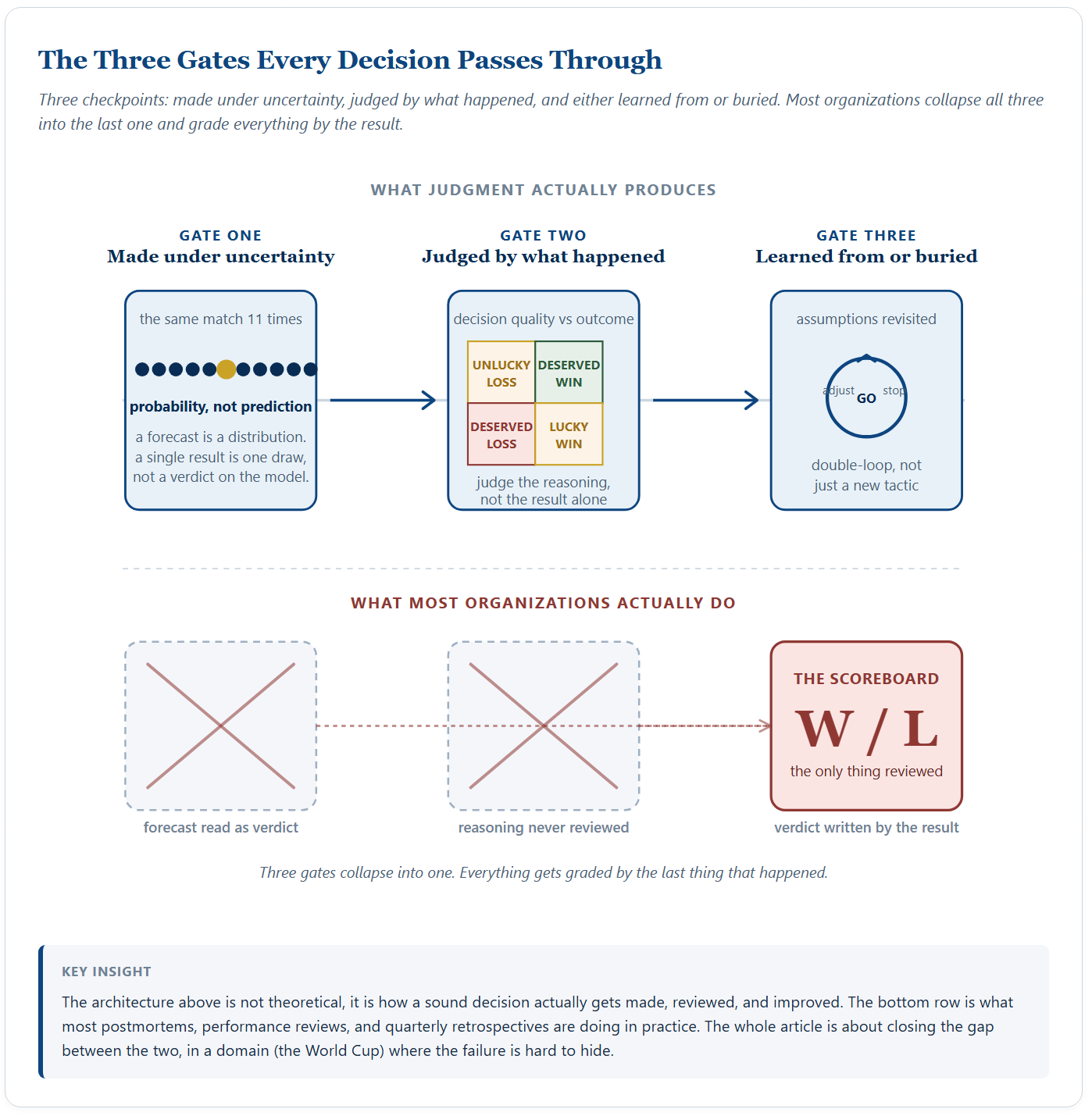
Every decision passes through three gates. It is made under uncertainty, judged by its outcome, and either learned from or buried. Most organizations collapse all three into the last one and grade everything by the result. That is not a minor evaluation error. It is why good decisions get punished, lucky ones get rewarded, and the same mistakes repeat for years. The World Cup is useful here for one reason: it runs all three gates in public, on a ninety-minute clock, where the gap between a decision and its outcome is impossible to hide.
Why this matters to you
Inside your organization the feedback loop is long, the data is private, and the post-mortems are written by the people whose decisions are being audited. So the failures stay invisible. You promote the executive whose bet happened to land, quietly sideline the one whose sound call got unlucky, and call it accountability. The cost is not one bad call. It is a culture that learns to optimize for defensible outcomes instead of defensible reasoning, and a set of lessons that never get written down because no one was looking.
Who this applies to
Anyone who evaluates decisions they did not personally make. Leaders running post-mortems. Executives carrying bets they cannot easily reverse. Boards and operators who have watched a reorg change the names on the org chart without changing the results it produces. The common thread is not a title. It is the daily difficulty of separating the quality of a decision from the quality of its outcome when only the outcome is visible.
What you'll gain from reading
A way to hold decision quality and outcome quality apart under pressure, and the language to defend a sound call that failed. You will be able to name which of the three gates your organization leaks at, catch outcome bias while it is happening rather than in hindsight, and see why replacing people without changing structure keeps producing the same result. The next time a favorite loses or a quarter misses, you will know the difference between a broken plan and a bad break.
What I love about events like the World Cup is that they are some of the best classrooms for decision-making you'll ever find. Not because they teach us how to win, but because they make the invisible parts of decision-making visible. Every decision and outcome is public, and every debate happens in real time. You get to watch reasoning, adaptation, uncertainty, and learning unfold in front of millions of people.
People have been using sports to teach leadership for decades. The problem is they usually look at the wrong thing. They study the teams that won, reverse-engineer a handful of virtues, and tell us to be more like the champions. But the pattern we extract from the winners is rarely the pattern that causes winning. It is the pattern that correlates with winning in the sample we bothered to look at. That is the failure mode I built this article around.
Every decision passes through three gates. It gets made under uncertainty, before anyone knows how it will turn out. It gets judged after the fact, by what actually happened. And the system around it either learns from the gap between the two or buries that gap and moves on. Most organizations fail at all three gates, and they fail invisibly. The decision was made in someone's head, the evaluation happens in a room with no record, and the learning never gets written down because the people auditing the decision are the people who made it.
This ends the free preview.
The rest of this
content is for free members
Create a free account to get full access. No payment required.