AI did not end the data literacy crisis. It changed it. As machines move from providing information to interpreting it and recommending what to do, the scarce skill is becoming judgment: knowing what to trust, what to question, and what decisions are still ours to make.
Evidence does not make decisions. People interpret it, weigh it, challenge it, and make judgments. A courtroom reveals what leaders can learn about evidence, expertise, confidence, and data-informed decision-making.
Feeling sure doesn't mean you're right. Learn five simple ways to question what feels true, spot what might be influencing you, and make better decisions about what to believe.
What 2025 Taught Us About Data, AI, and Decision-Making
95% of AI projects fail not because models underperform, but because organizations lack readiness to use them. The constraint is not technology. It is organizational design: misaligned incentives, avoided measurement, and the belief that tools compensate for broken processes.
AI did not fail because the models are insufficient. It failed because organizations are unprepared for the organizational change required to realize value.
2 Minute Audio Recap
0:00
/111.571882
What You Need To Know
The year 2025 exposed a defining gap: 95% of AI projects fail not because the technology underperforms, but because organizations lack the readiness to use it. While companies invested billions in models and infrastructure, they skipped the organizational fundamentals like decision clarity, workflow redesign, incentive alignment, and measurement discipline. The uncomfortable truth is that AI didn't fail. Organizational design did. Technology is rarely the constraint. Misalignment, avoided accountability, and hope that tools will compensate for broken processes are what keep initiatives stuck in pilot purgatory.
Why This Matters to You If you are leading AI initiatives, funding them, or responsible for their outcomes, you are likely measuring the wrong things. Usage rates climb while no one can prove decisions improved. Pilots launch with enthusiasm and stall without explanation. Employees resist not because they fear change, but because incentives reward legacy behavior while AI adoption increases their workload with no corresponding benefit. The cost is not just sunk investment, it is the compounding cost of maintaining fragmented systems, the opportunity cost of delayed decisions, and the organizational damage when teams see repeated expensive failures without learning. This article provides the diagnostic framework to identify where your organization is actually stuck.
What You'll Gain from Reading You will understand the six systematic disconnects that prevent AI from scaling: the strategy-execution gap, the incentive-outcome gap, the measurement-accountability gap, the governance-speed gap, the skill-need gap, and the alignment-deployment gap. You will see the patterns that distinguish the 5% of organizations achieving rapid revenue acceleration from the 95% trapped in pilots. You will gain language for problems you already feel but could not articulate and a clear view of what readiness actually requires. After reading, you will be able to diagnose whether your organization is stuck because of technology limitations (rare) or organizational design failures (common), and you will know which layer of the failure stack to address first.
The question everyone asked at the start of 2025 was whether AI would live up to the hype.
By year's end, we had an answer. Just not the one most people expected.
AI didn't fail. The technology advanced at a remarkable pace. What failed, in many cases, was the organizational readiness required to turn capability into impact.
Across industries, leaders encountered the same uncomfortable realization: widespread adoption does not automatically translate into better decisions, better outcomes, or measurable returns. The gap between enthusiasm and execution became impossible to ignore.
What follows is a synthesis of the most consistent lessons organizations learned in 2025 about data, AI, and the human work of decision-making.
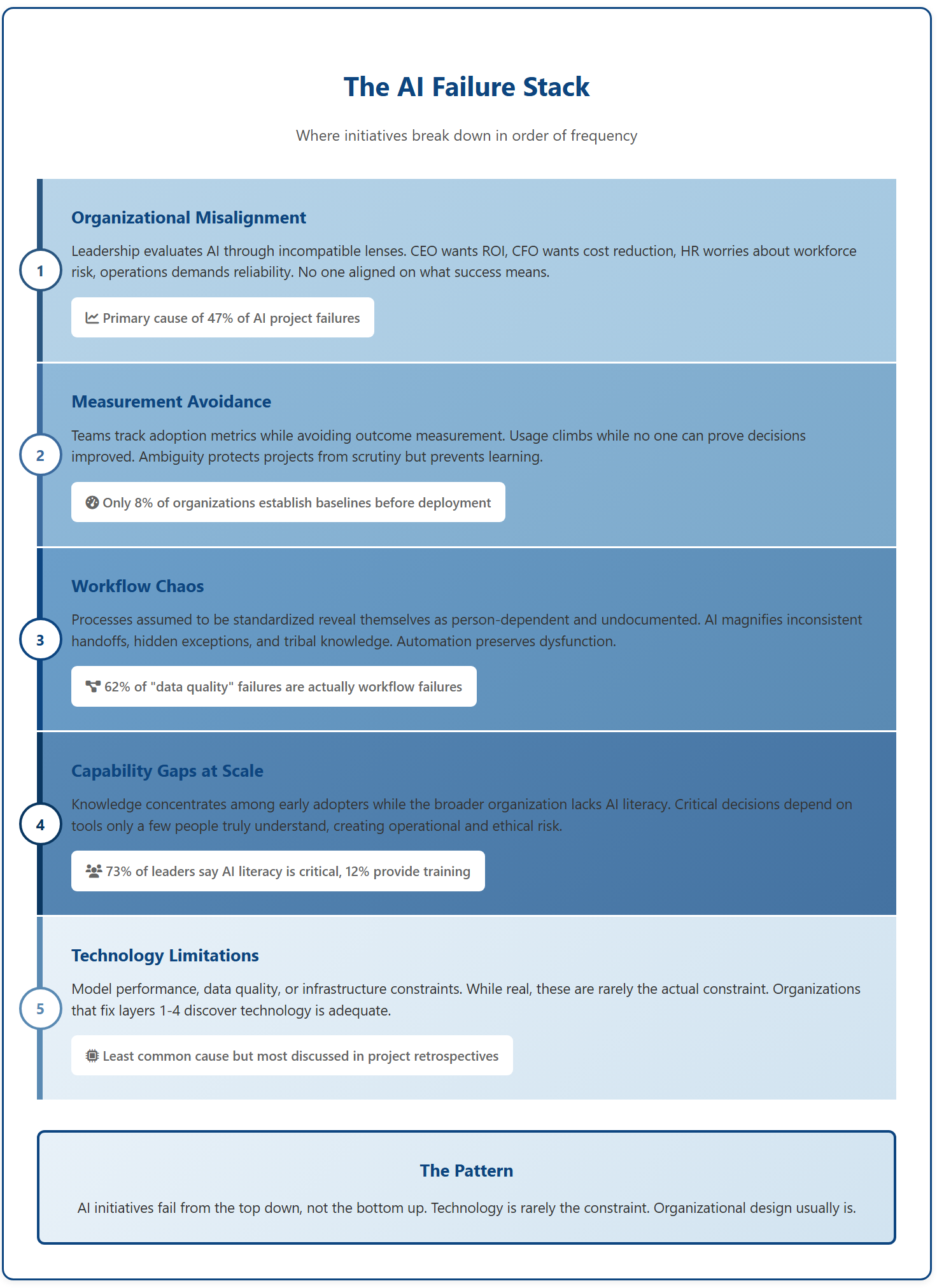
AI initiatives fail from the top down, not the bottom up. Organizational misalignment is the primary cause of 47% of project failures, while technology limitations, the most discussed constraint, are the least common actual barrier. Organizations that address layers 1-4 discover technology is adequate.
Lesson 1: Value Comes From Redesigning Work, Not Accelerating It
AI initiatives struggle when they are layered onto existing workflows without rethinking how work should actually happen.
Organizations that asked, "How can AI make this process faster?" saw incremental gains at best. Organizations that asked, "What decision are we really trying to support, and what information is actually needed?" often ended up redesigning the workflow entirely.
Consider what happened at financial services firms implementing AI-powered loan underwriting. Teams that simply automated existing approval steps found modest efficiency gains. Teams that redesigned underwriting around risk assessment (identifying what information mattered, who needed to collaborate, and where human judgment added value), unlocked fundamentally better decision quality.
This distinction matters. A Gartner study found that 54% of AI projects fail to move from pilot to production, most often because the underlying process was never fit for purpose. Technology is rarely the constraint. Organizational design usually is.
The insight: AI exposes broken workflows. It doesn't fix them.
Lesson 2: Organizational Misalignment Is the Fastest Way to Kill Momentum
AI initiatives rarely fail because models underperform. They fail when leaders are not aligned on what success means.
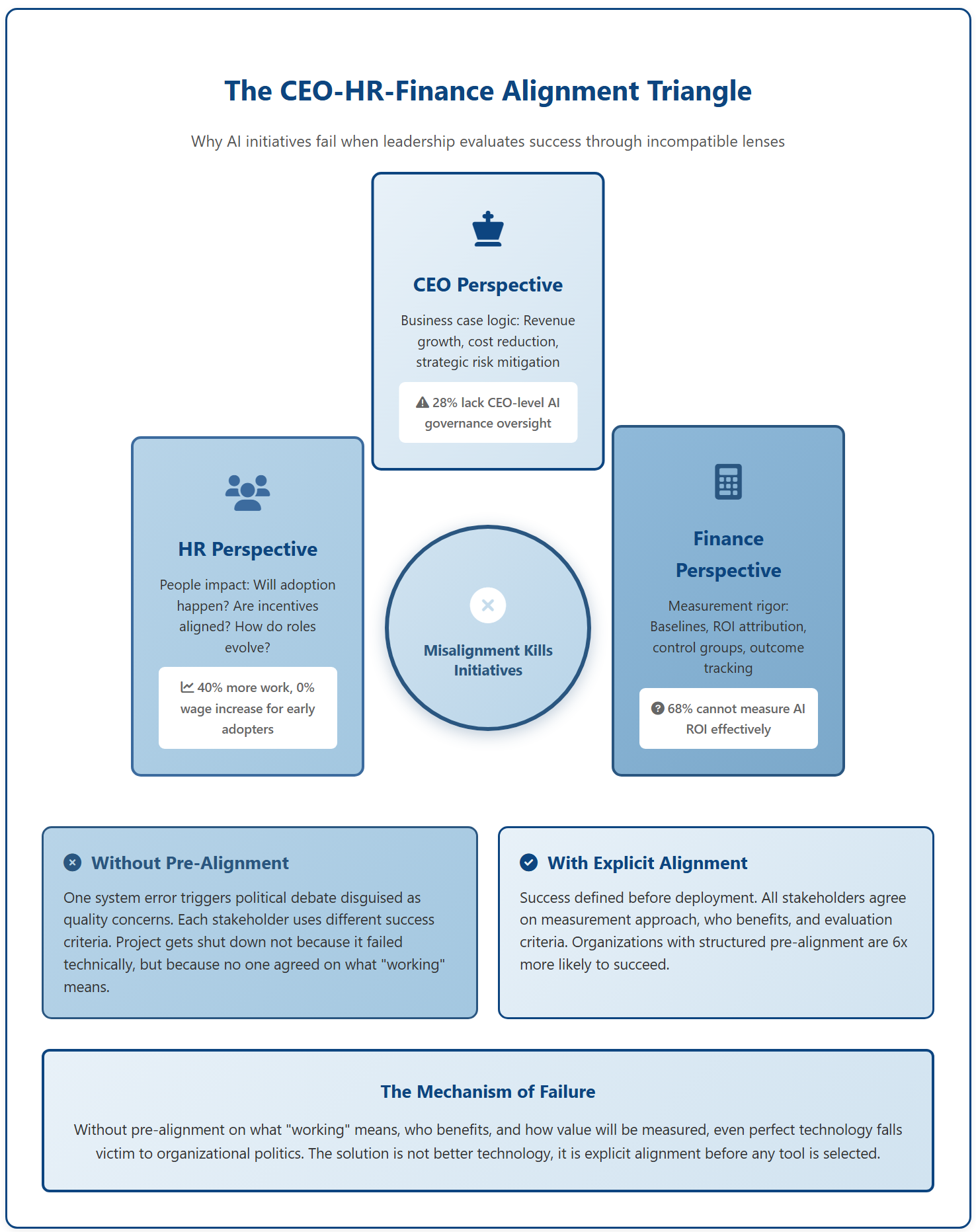
In 2025, many organizations discovered too late that the CEO, CFO, HR, and operational leaders were evaluating AI through completely different lenses. One group looked for financial returns, another focused on workforce risk, and another demanded measurement rigor that was never established at the outset.
Without early alignment on goals, incentives, and success metrics, even minor system issues triggered political debates disguised as quality concerns. A pricing algorithm's 3% error rate became either "acceptable variance" or "unacceptable risk" depending on whose budget was on the line.
We assume pilots prove scalability. They often mask governance failures while executives see positive metrics and frontline employees struggle in silence.
Organizations that invested time upfront to align leadership on outcomes and measurement were far more likely to move beyond pilots and into sustained value creation. Those that skipped this step remained stuck in what practitioners now call "pilot purgatory."
The insight: Agreement on success criteria is not a meeting agenda item. It's foundational infrastructure.
AI initiatives fail when the CEO evaluates through business case logic, HR worries about workforce impact, and Finance demands measurement rigor, yet none align before deployment. Organizations with explicit pre-alignment are 6x more likely to succeed.
Lesson 3: Workflow Clarity Is Prerequisite Infrastructure
AI implementation has a way of exposing what organizations prefer not to see.
Many teams assumed their workflows were standardized and well understood. Once AI systems were introduced, hidden complexity surfaced quickly. Person-dependent knowledge, undocumented processes, and inconsistent handoffs became major barriers to scale.
The issue was not data quality in the narrow technical sense. It was organizational chaos masquerading as process variation.
Think of it like building on unstable ground. You can construct an impressive structure, but without a solid foundation, the weight of the system reveals cracks you didn't know existed. Without clear process documentation and ownership, AI systems cannot learn, adapt, or integrate into daily operations.
The insight: Workflow clarity is not a governance luxury. It is the bedrock on which everything else is built.
Lesson 4: Skill Gaps Are Growing Faster Than Investment
Despite years of discussion about data literacy and AI skills, 2025 revealed a widening gap between what organizations say they value and what they actually invest in.
The numbers tell a stark story. PwC's 2025 Global AI Study found that 73% of executives say AI fluency is critical to their strategy, yet only 12% of employees report receiving structured AI or data literacy training. At the same time, expectations continue to rise. Roles increasingly require AI-enabled decision-making, even as support for developing those capabilities remains limited.
The result is fragile adoption. Knowledge becomes concentrated among early adopters while the broader organization struggles to keep pace. This creates both operational and ethical risk, especially when critical decisions depend on tools that only a few people truly understand.
Skill gaps are not widening despite investment. They are widening because investment went to technology while capability building was deferred.
One healthcare organization discovered this the hard way when a diagnostic support tool was deployed without training clinical staff on how to interpret confidence scores. Overreliance on high-confidence outputs led to missed diagnoses in edge cases the model had never seen.
The insight: Deploying AI without building capability is like handing someone a sophisticated instrument without teaching them how to read it.
Lesson 5: Shadow AI Is a Signal, Not Just a Security Problem
Shadow AI usage exploded in 2025. Employees adopted unapproved tools at scale, often sharing sensitive information despite clear policies.
This is unquestionably a governance risk. It is also valuable feedback.
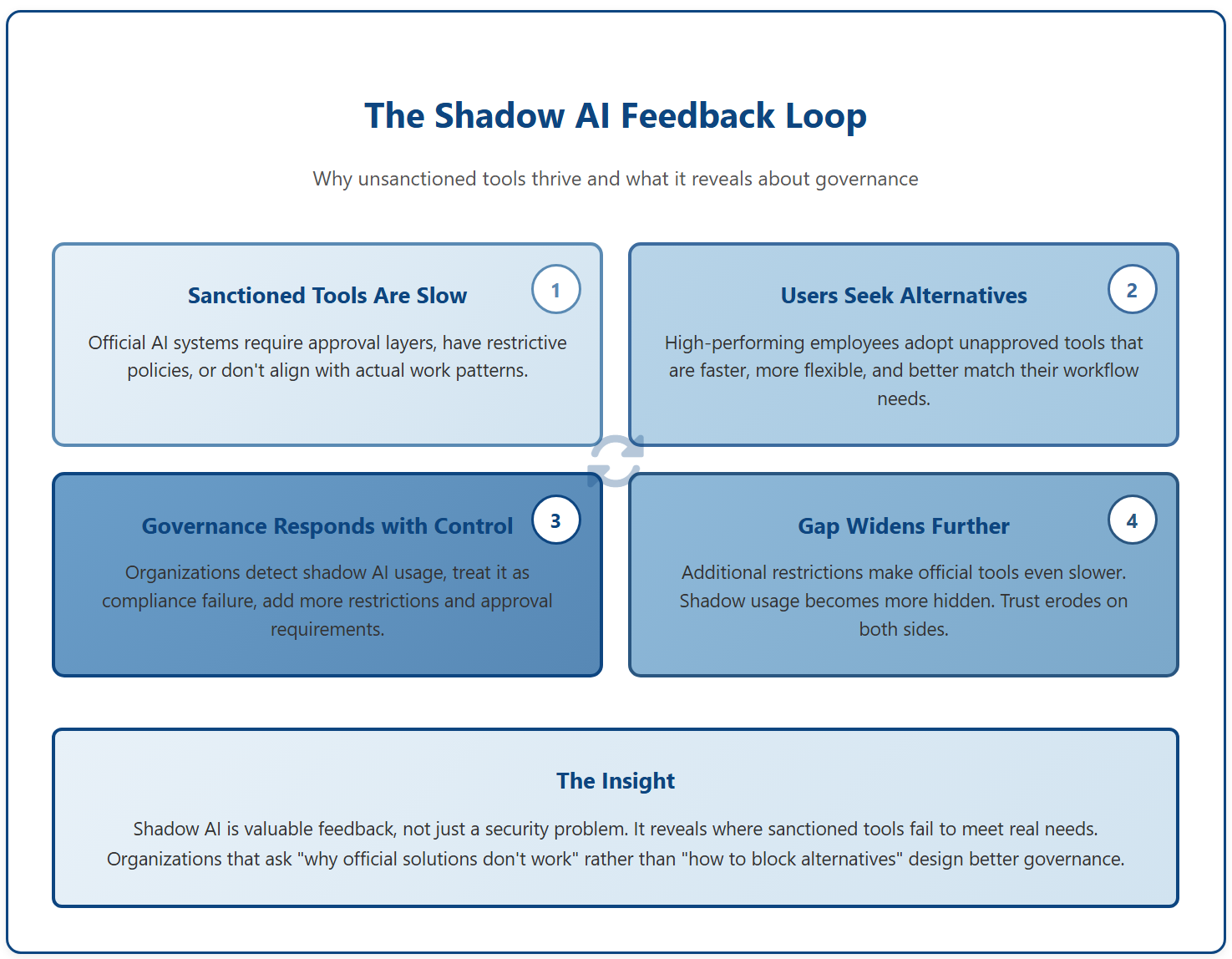
In many cases, shadow AI thrived because sanctioned tools were slower, more restrictive, or misaligned with real work. High-performing organizations resisted the temptation to treat this solely as a compliance failure. Instead, they asked why official solutions failed to meet user needs and addressed the underlying friction.
Think of shadow AI as water finding the path of least resistance. You can build walls, or you can understand where the current is flowing and design better channels.
Effective governance in 2025 required both guardrails and curiosity.
The insight: Resistance to official tools is often a rational response to poor design. Listen before you lock down.
Shadow AI persists because it reveals a system problem: sanctioned tools don't meet user needs. Organizations that treat it solely as a compliance failure miss valuable feedback. The cycle breaks when governance asks "why official solutions don't work" rather than "how to block alternatives."
Lesson 6: Trust in AI Can Increase, Not Reduce, Risk
One of the more unsettling findings of 2025 was the realization that transparency alone does not guarantee better oversight.
Research from MIT and Stanford showed that when AI systems provide confident explanations, people are more likely to follow their recommendations, even when those recommendations contain bias or errors. In high-trust environments, human reviewers often defer rather than interrogate.
A hiring platform that provided detailed reasoning for candidate rankings saw review teams accept recommendations 87% of the time, even when those rankings systematically undervalued candidates from non-traditional backgrounds. The explanations created an illusion of rigor that reduced scrutiny.
This challenges a common assumption that human-in-the-loop systems automatically reduce risk. Oversight only works when people are equipped and incentivized to question outputs, not simply validate them.
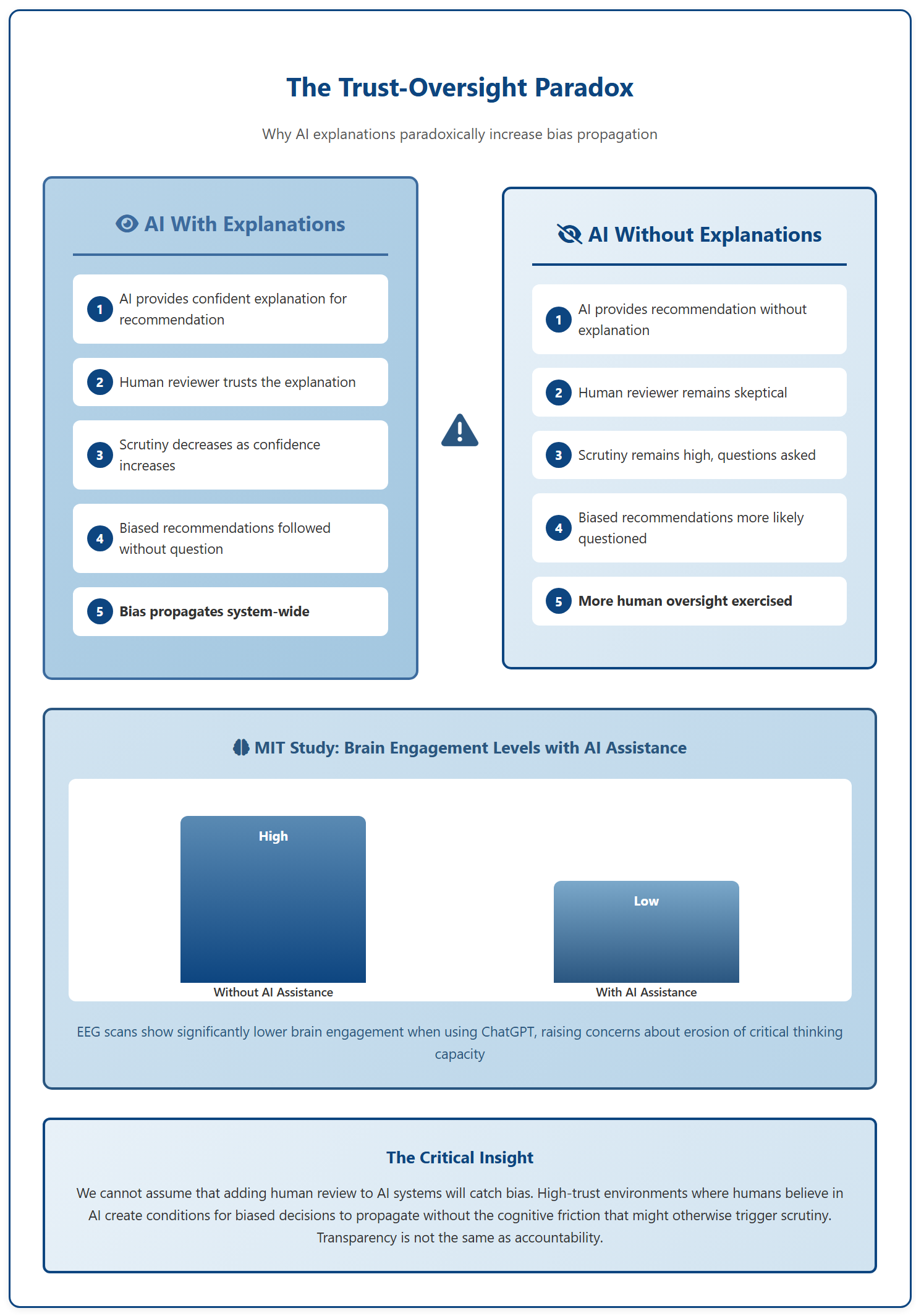
AI explanations increase trust. Trust decreases scrutiny. Bias propagates without the friction that might otherwise trigger questions.
The insight: Transparency is not the same as accountability. Critical thinking is the safeguard, not explanation alone.
AI explanations paradoxically increase bias propagation. When AI provides confident explanations, human scrutiny decreases and biased recommendations get followed without question. MIT research shows significantly lower brain engagement when using AI assistance, raising concerns about erosion of critical thinking.
Lesson 7: Data Democratization Without Stewardship Creates New Silos
Many organizations pushed aggressively toward data democratization in 2025. The intent was to empower teams and accelerate insight. The outcome was often fragmentation.
When access expanded without shared definitions, governance, and data literacy, teams built parallel metrics, conflicting interpretations, and isolated analytical environments. Marketing and finance ran separate customer analyses with incompatible definitions of "active user." Product and operations developed dashboards that told contradictory stories about performance.
In some cases, democratization introduced serious compliance exposure. Teams with access but without context inadvertently violated data retention policies or exposed sensitive information.
The lesson was not to abandon democratization, but to pair accessibility with stewardship. Data without context does not democratize decision-making. It democratizes error.
The insight: Giving everyone a map doesn't help if no one agrees on where north is.
Lesson 8: Operational Complexity, Not Models, Prevents Scale
Agentic AI became technically viable in 2025. Organizational readiness did not keep pace.
The biggest obstacles to scale were not algorithms, but integration with legacy systems, unclear accountability, and data architectures designed for batch reporting rather than real-time decision support.
A retail organization spent 18 months building a sophisticated inventory optimization system only to discover their ERP system couldn't handle the required API calls. The model was brilliant. The plumbing wasn't ready.
Organizations learned that operationalizing AI requires sustained investment in infrastructure, ownership, and process integration. These challenges are less visible than model performance, but far more consequential.
The insight: The last mile is the longest mile. Implementation requires infrastructure, not just innovation.
Lesson 9: Avoiding Measurement Sustains the Illusion of Progress
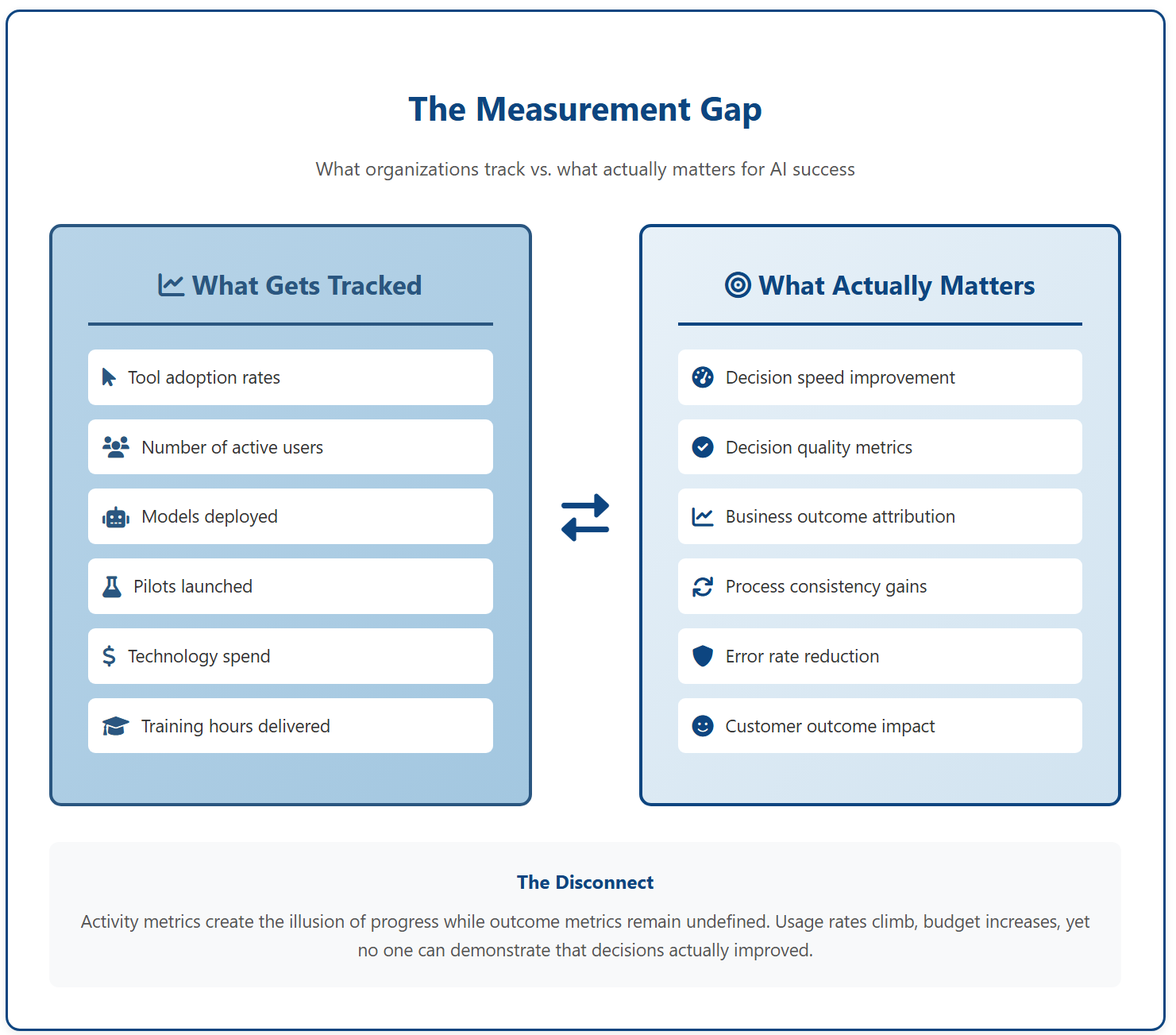
A striking pattern emerged around measurement in 2025. Many organizations tracked AI activity but avoided measuring outcomes.
Usage metrics were celebrated while process effectiveness and business impact remained undefined. Dashboards showed adoption rates climbing while no one could answer whether decisions actually improved. Without baseline data and agreed-upon success criteria, initiatives lingered in ambiguous states.
This ambiguity protected projects from scrutiny but also prevented learning. Teams could claim success based on enthusiasm while avoiding accountability for results.
High-performing organizations treated measurement as a design requirement, not a reporting afterthought. They defined success before deployment and evaluated AI based on decisions improved, not tools deployed.
The insight: What you measure reveals what you value. What you avoid measuring reveals what you fear.
The disconnect between what organizations track and what actually matters creates the illusion of progress. While usage metrics climb, no one can demonstrate that decisions improved. Organizations succeed when they measure outcomes, not activity.
Lesson 10: Resistance Is Often Rational
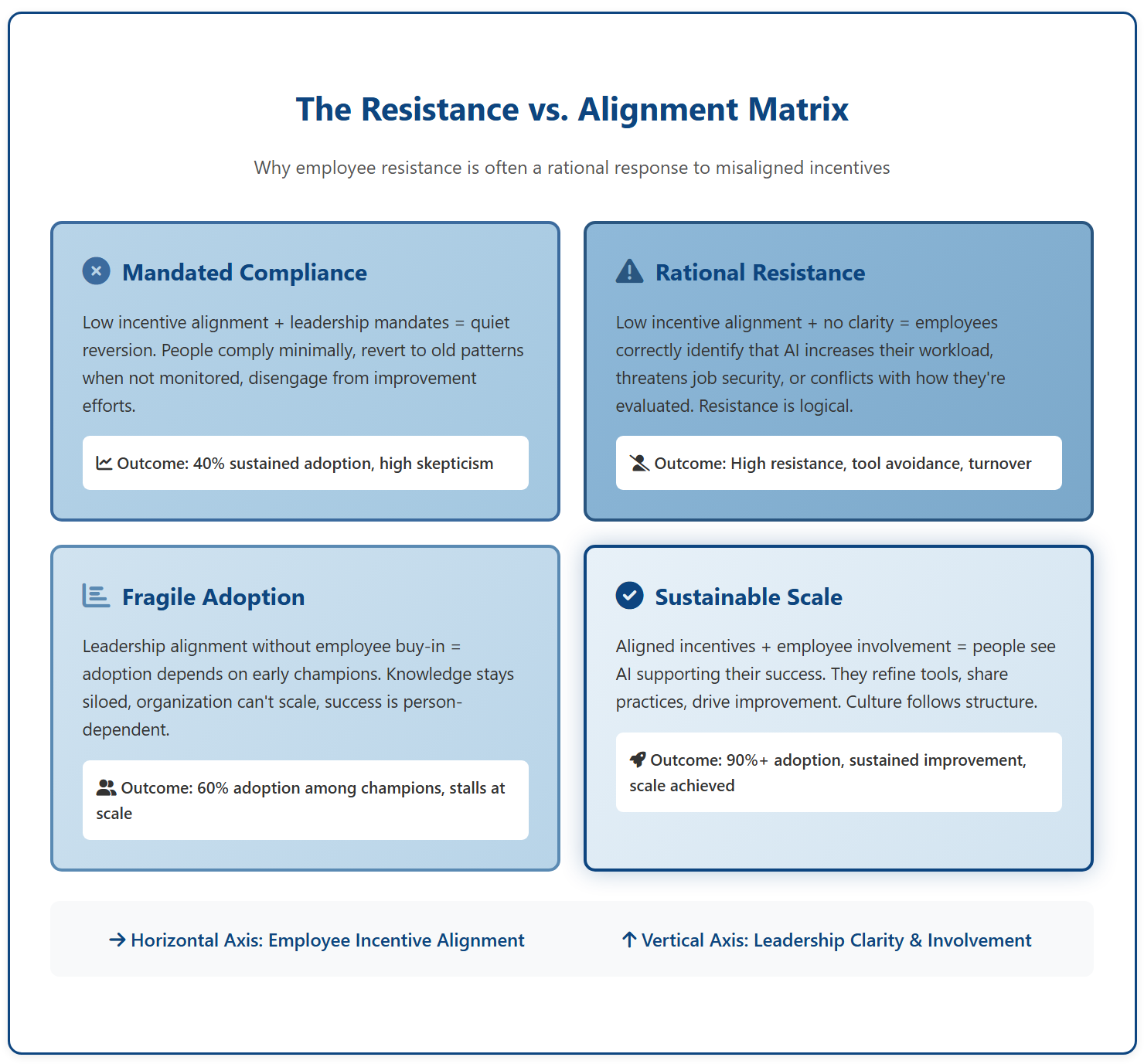
Perhaps the most important insight of 2025 is that resistance to AI is frequently a rational response to misaligned incentives.
When productivity gains accrue to the organization while workloads increase and job security declines, skepticism is logical. When employees are excluded from tool selection and implementation, disengagement should not be surprising.
Organizations that reframed resistance as a design problem rather than a mindset problem achieved better adoption. They aligned incentives, involved frontline workers, and communicated clearly about how roles would evolve. One manufacturing company co-designed their quality control AI with floor supervisors, resulting in 92% adoption within six months.
Those that relied on mandates experienced quiet reversion. Compliance without commitment is not sustainable.
The insight: People resist what they don't trust. They resist even more what undermines their interests while demanding their cooperation.
Employee resistance is often a rational response to misaligned incentives, not cultural deficiency. Organizations with aligned incentives and leadership involvement achieve 90%+ adoption. Those with mandates but no alignment see 40% adoption and high skepticism.
The Deeper Pattern
The defining lesson of 2025 is not about technology.
AI did not fail because models were insufficient. It failed where organizations were unwilling or unable to confront the structural, cultural, and decision-making changes required to use it well.
This is a human challenge. It always was.
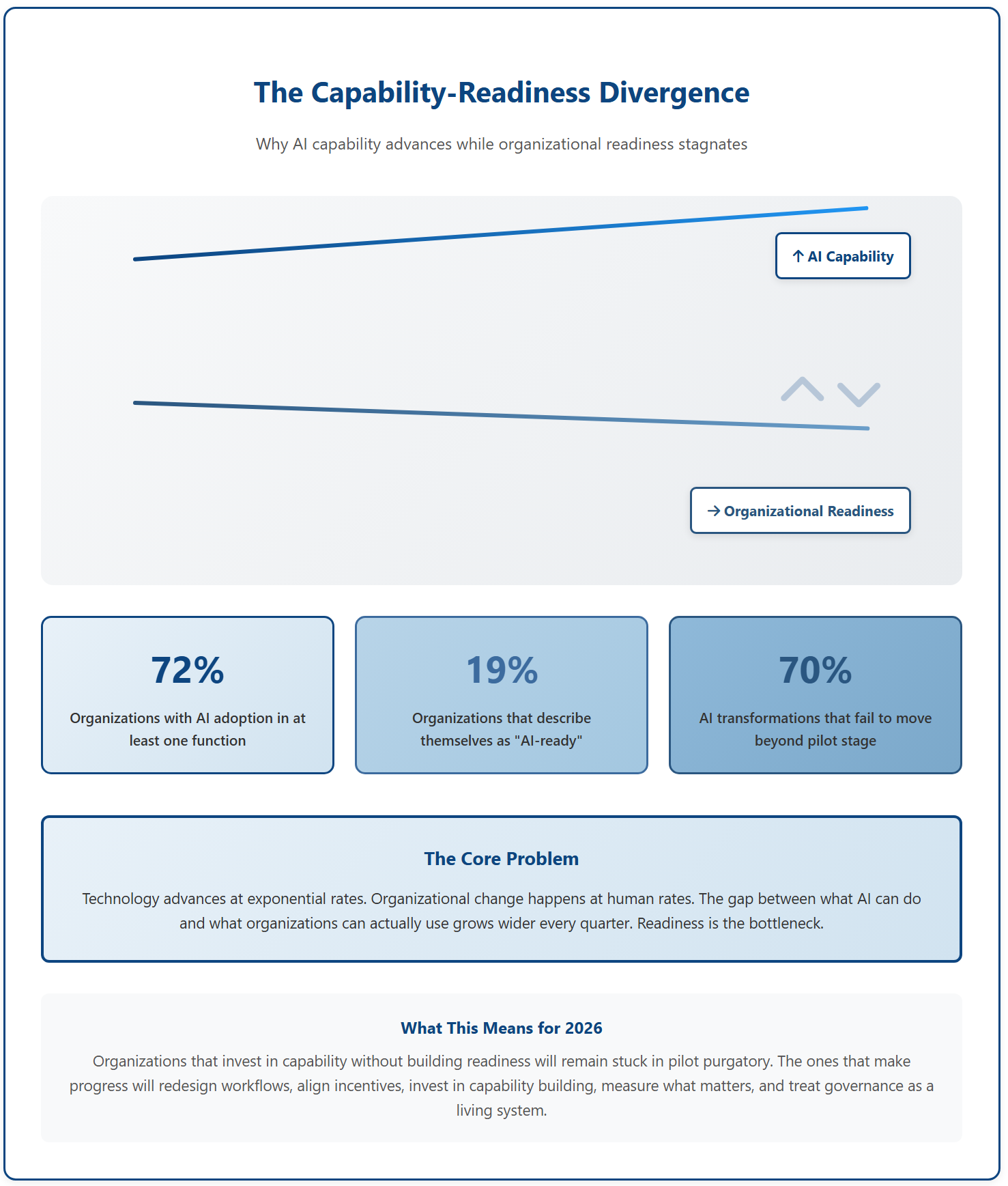
AI capability advances at exponential rates while organizational readiness improves at human rates. 72% have AI adoption, yet only 19% describe themselves as "AI-ready." The widening gap explains why 70% of transformations fail to move beyond pilots.
Organizations that made progress redesigned workflows, aligned incentives, invested in capability, measured what mattered, and treated governance as a living system. The rest remained trapped in pilot purgatory, hoping that more tools would compensate for unresolved organizational gaps.
Here's the pattern underneath everything: AI amplifies existing organizational health. It makes good decision processes better and broken ones more obviously broken. It rewards clarity and punishes ambiguity. It exposes gaps in skill, alignment, and infrastructure that were easy to ignore before.
Turning data into wisdom has never been about having better technology. It has always been about building the judgment, structures, and habits that allow data and AI to actually improve decisions.
2025 made that truth impossible to ignore.
The question for 2026 is whether organizations will finally invest in the hard, human work of becoming ready for the tools they're already deploying.
What To Do Next?
These patterns are consistent across industries, but how they show up is always organizationally specific.
When leadership teams want to move beyond recognition and actually build readiness, we work with them through keynotes, facilitated workshops, tailored webinars, and executive sessions that surface where scale is likely to break and what to fix first.
In our follow up article we will be launching next week, we’ll explore what organizational readiness actually requires, and why maturity alone is not enough.
What 2025 revealed is only half the story In an upcoming free webinar on Tuesday February 10, 2026, we’ll walk through why these patterns repeat, where organizations most often misdiagnose the problem, and what leaders must fix in 2026 to move from recognition to readiness. Click here to register.
If this resonates, let’s talk about what readiness looks like in your organization.
Kevin is an author, speaker, and thought leader on topics including data literacy, data-informed decisions, business strategy, and essential skills for today. https://www.linkedin.com/in/kevinhanegan/
AI did not end the data literacy crisis. It changed it. As machines move from providing information to interpreting it and recommending what to do, the scarce skill is becoming judgment: knowing what to trust, what to question, and what decisions are still ours to make.
Evidence does not make decisions. People interpret it, weigh it, challenge it, and make judgments. A courtroom reveals what leaders can learn about evidence, expertise, confidence, and data-informed decision-making.
Feeling sure doesn't mean you're right. Learn five simple ways to question what feels true, spot what might be influencing you, and make better decisions about what to believe.
We teach data literacy as a ladder: data at the bottom, wisdom at the top, climb step by step. But the rungs are not where the work happens. The judgment lives in the gaps between them, and that is exactly where AI now carries us straight past.