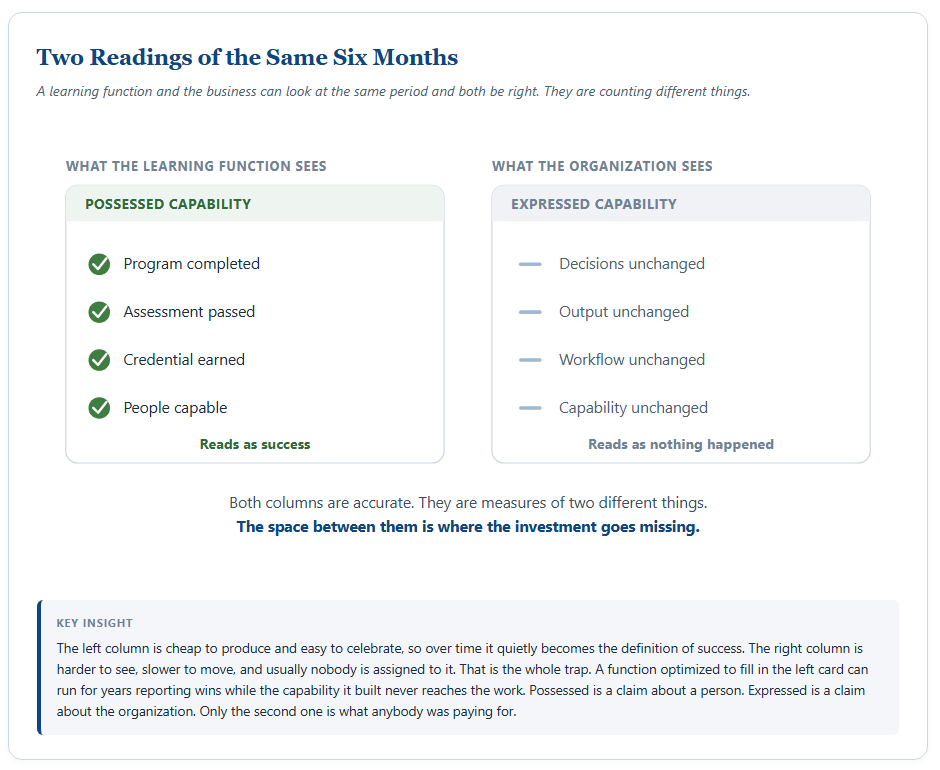
A learning function can report clear success while the business sees nothing change. That gap has a name: possessed capability versus expressed. Building the skill is half the job. The other half is a work system that rewards, governs, and creates the occasion to use it.
AI did not end the data literacy crisis. It changed it. As machines move from providing information to interpreting it and recommending what to do, the scarce skill is becoming judgment: knowing what to trust, what to question, and what decisions are still ours to make.
Evidence does not make decisions. People interpret it, weigh it, challenge it, and make judgments. A courtroom reveals what leaders can learn about evidence, expertise, confidence, and data-informed decision-making.
A learning function can report clear success while the business sees nothing change. That gap has a name: possessed capability versus expressed. Building the skill is half the job. The other half is a work system that rewards, governs, and creates the occasion to use it.
You can employ a hundred people who can do the thing and still be an organization that doesn't.
TL;DRWhy training can succeed completely and change nothing
What you need to know
A learning function can report a clear win while the business sees nothing move, and both accounts are true. One measured capability possessed: people completed the program, passed the assessment, can do the thing. The other needed capability expressed: the skill showing up in the work and staying there. The gap between the two is where most learning investment quietly disappears, and it is rarely a learning problem. It is what the capability meets when it tries to enter the work.
Why this matters to you
If your people keep getting trained and the work keeps looking the same, the reflex is to reteach. That fixes nothing, because the capability landed fine. It met a reward system built for the old way, or it never got an occasion to be used at all. People adapt to what the work system makes possible, visible, and consequential, not to what a course taught or a launch announced.
Who this applies to
Anyone accountable for capability that has to change how work gets done. Learning and talent leaders, executives who sponsor academies and upskilling, and the managers who own the gates, incentives, and workflows the newly trained walk back into. If you have ever funded training and waited for a change that never came, this is about the layer you were not looking at.
What you'll gain from reading
A sharper way to diagnose why a capability goes unused, and the two very different failures behind it. Four practical places to look in the system that decides use: recognition, governance, opportunity and work design, and feedback. A reason to design backward from use rather than forward from content, and a smarter way to measure it than counting completions. It ends on the shift that matters: the learning function's job is not finished when capability has been built, but when the organization actually uses it.
A corporate learning function can report a clear success while the business, looking at the same stretch of time, sees nothing change. Both accounts are true. High completion, strong assessment scores, an engaged cohort, real capability built, and yet there is no visible difference in how the work gets done.
This is one of the most common outcomes in corporate learning, and one of the most misread because it looks like a measurement error, but in reality, it is a category error.
Possessed Capability Is Not Expressed Capability
The category error is treating having a capability as equivalent to using it. Someone can learn, demonstrate the skill, pass the assessment, and leave genuinely more capable than they arrived. I call that possessed capability: the capability exists in the person.
What the organization ultimately needs is different. The capability has to show up when the work calls for it and persist once it gets there. I call that expressed capability: the capability is actually used in the work rather than remaining something a person merely knows or can demonstrate.
The function measured capability possessed but the organization needed capability expressed.
Those are not actual academic terms, I am using them as practical labels. But there is research behind them. Learning-transfer research separates acquiring a skill from generalizing and maintaining it on the job. Organizational research separates individual expertise from capability embedded in routines and collective action. The terms change from field to field, but they are all describing the same underlying problem. Being able to do something is not the same as reliably doing it where it matters.
Why Possessed Capability Stays Trapped
The learning often worked. The problem begins when people try to use what they learned in the way work actually gets done.
The common case looks like this. A function stands up a well-designed program around some capability, say sharper, earlier decisions about which projects to stop. The curriculum is sound, the cohort engaged, people finish capable and often energized. But six months later almost nothing has changed. The capability is real, and yet it goes unused.
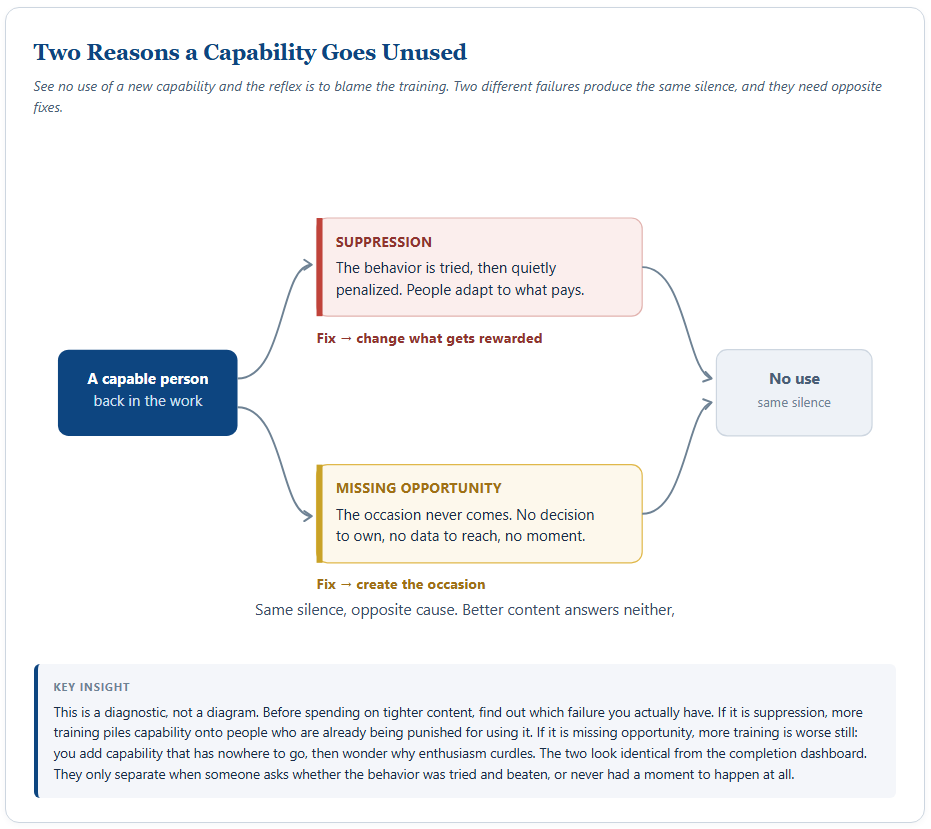
Leaders often see this and assume the training failed, so they look for better content or tighter assessments. But better content will not solve the problem if people learned what they were supposed to learn. The problem starts when they return to work and try to use it. That attempt can fail in two different ways.
The first is suppression. The person gets a chance to use the new capability, but the way work operates pushes them back toward the old behavior. The new behavior gets quietly penalized, and it fades. People adapt to the behaviors their work system makes possible, visible, and consequential, not to what a course taught or a launch announced. Those three properties shape behavior more than any curriculum ever could.
The second is missing opportunity. The person never gets a real chance to use the capability in the first place. An unused capability has not necessarily been rejected. Sometimes the organization never creates the moment to use it. The person has the skill, the motivation, even the support, and still no occasion arrives. They do not own the decision, cannot reach the relevant data, or enter the process after the call has effectively been made. That is neither a learning failure nor a motivation failure.
Both problems become visible at the same critical point: the first real chance to use what was learned. Functions pour enormous energy into the last hour of learning and almost none into that first hour of use. Does the opportunity come soon enough? Does the person recognize it? Do they have permission to work differently? What happens if the new way is slower or harder at first? Those early experiences can determine whether the capability gets used again or quietly disappears.
A Model That Includes The Output
Most corporate learning is built and measured around content: how the function organizes what it teaches, whether around skills, behaviors, roles, or competencies. That is a real design question, and teams spend years on it. But content tells us whether capability was built, not whether it gets used.
A model of capability has to include three things: what builds it, what shapes whether it gets expressed, and whether it ultimately shows up in the work. I think of those as Content, System, and Use.
This ends the free preview.
The rest of this
content is for free members
Create a free account to get full access. No payment required.
AI did not end the data literacy crisis. It changed it. As machines move from providing information to interpreting it and recommending what to do, the scarce skill is becoming judgment: knowing what to trust, what to question, and what decisions are still ours to make.
Evidence does not make decisions. People interpret it, weigh it, challenge it, and make judgments. A courtroom reveals what leaders can learn about evidence, expertise, confidence, and data-informed decision-making.
Feeling sure doesn't mean you're right. Learn five simple ways to question what feels true, spot what might be influencing you, and make better decisions about what to believe.
We teach data literacy as a ladder: data at the bottom, wisdom at the top, climb step by step. But the rungs are not where the work happens. The judgment lives in the gaps between them, and that is exactly where AI now carries us straight past.