AI did not end the data literacy crisis. It changed it. As machines move from providing information to interpreting it and recommending what to do, the scarce skill is becoming judgment: knowing what to trust, what to question, and what decisions are still ours to make.
Evidence does not make decisions. People interpret it, weigh it, challenge it, and make judgments. A courtroom reveals what leaders can learn about evidence, expertise, confidence, and data-informed decision-making.
Feeling sure doesn't mean you're right. Learn five simple ways to question what feels true, spot what might be influencing you, and make better decisions about what to believe.
Why Data Literacy Training Fails. It's Not About the Skills, It's About the Beliefs
Your team doesn’t have a skills gap, they have a belief gap. Data literacy isn’t about skills, it’s about rewiring how people think. Discover why belief, not training, drives change.
Data literacy doesn’t fail because people don’t understand. It fails because they don’t unlearn.
High-Level Summary and Key Takeaways
Most organizations are treating data literacy as a skills problem. It’s not. It’s a belief problem.
Your team doesn’t need another dashboard training. They need to rewire how they think about evidence, expertise, and uncertainty.
What looks like resistance to analytics is often something deeper:
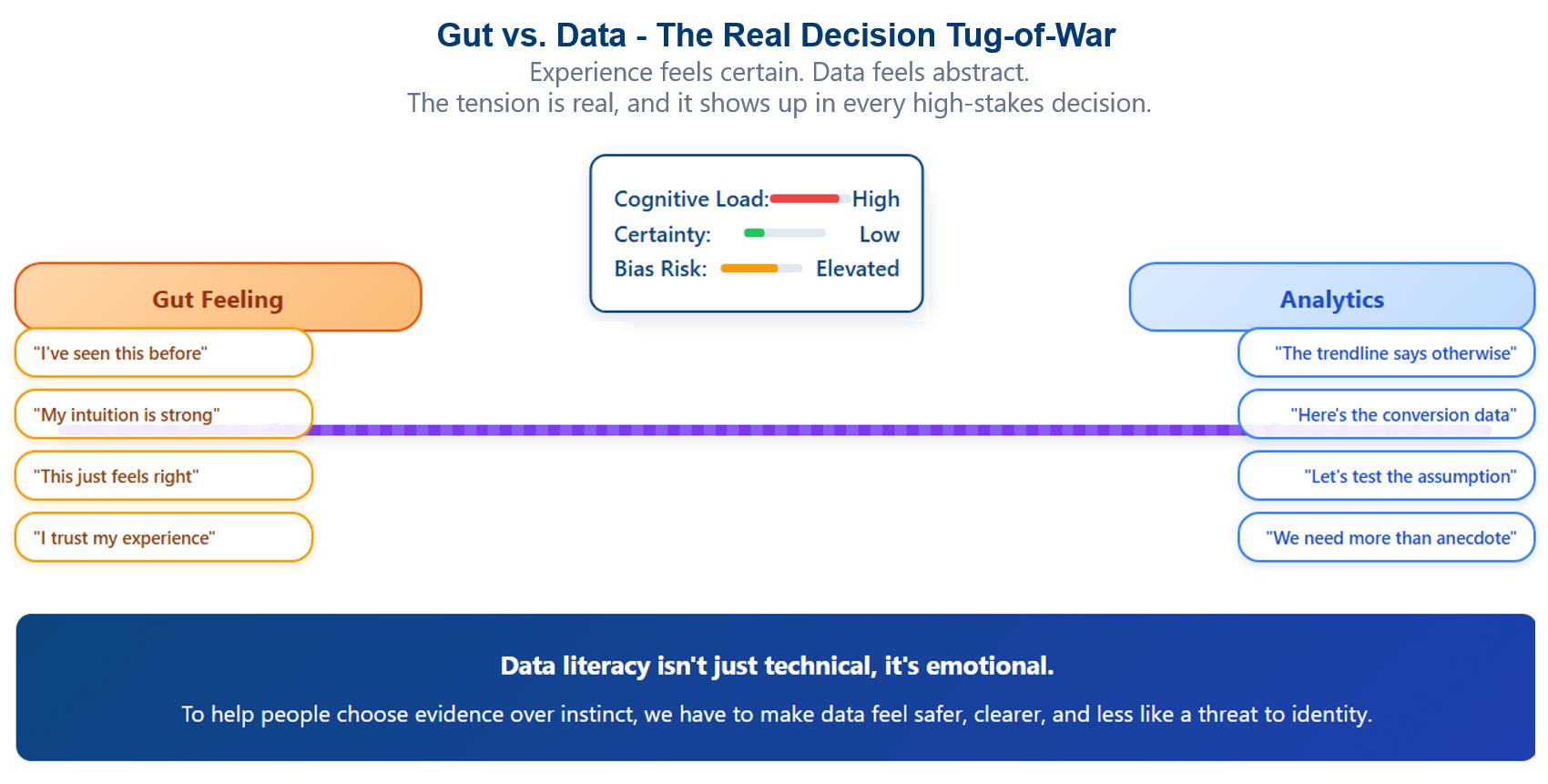
Gut instinct feels safer than ambiguity
Identity is tied to “being right,” not changing your mind
Experience is trusted more than external data
And “confidence” is still rewarded over nuance
That’s why traditional data training fails: it installs new tools onto an outdated cognitive operating system.
This article unpacks:
Why people revert to instinct even after successful training
The hidden belief barriers that block data-driven behavior
The Backwards Bike problem of unlearning old decision reflexes
How to apply a DecisionOS upgrade to build real data fluency
You don’t change how people act on data until you change how they think about truth itself.
If your team finishes training but still makes the same old decisions, you’re not facing a skills gap. You’re facing a belief gap.
Key Takeaways
Data literacy isn’t a skills problem—it’s a belief problem. Training fails when it doesn’t address how people think about evidence, uncertainty, and expertise.
People default to intuition under pressure. Without rewiring decision habits, new data skills won’t stick.
Cognitive dissonance blocks data adoption. When data threatens someone’s identity, they’re more likely to reject the data than rethink their judgment.
Belief-first transformation works better than skill-first training. To create real change, start by surfacing hidden assumptions, not by teaching tools.
Rewiring your team’s “DecisionOS” means changing defaults. That includes how meetings are structured, what gets rewarded, and how uncertainty is framed.
Organizations are pouring millions into data literacy programs, including advanced analytics training, dashboard workshops, and statistical modeling courses, yet most initiatives deliver disappointing results. People complete the training, understand the concepts, but continue making decisions the same way they always have.
The problem isn't the curriculum. It's that we're treating data literacy like a technical skill when it's actually a cognitive transformation.
The Backwards Bike of Data Literacy
Consider the famous "backwards bike" experiment: a bicycle where turning the handlebars left makes the bike go right. The concept is simple, the mechanics are clear, but it took an engineer 8 months of daily practice to ride it smoothly. His brain had to rewire decades of automatic motor patterns.
Data literacy works exactly the same way. Your marketing director might perfectly understand statistical significance in a workshop, but when facing a real campaign decision with conflicting data points, they revert to gut instinct. Their brain is riding the "normal bike" of intuitive decision-making that served them well for years.
The insight: Data literacy isn't about learning new skills on top of old decision-making patterns. It's about rewiring how you think about evidence, uncertainty, and truth itself.
The Hidden Belief Barriers
Most data literacy programs focus on technical competency like how to read charts, interpret statistics, use analytics tools. But the real barriers are cognitive and emotional.
Research on cognitive dissonance shows that when data threatens someone's self-perception as a competent decision-maker, they're more likely to dismiss the data than to revise their mental model. This isn't irrational, it's protective. As Festinger's landmark research found, when individuals hold two conflicting cognitions like "I'm a smart decision-maker" and "This data suggests my decision was flawed", they experience psychological discomfort and often resolve it by discrediting the data rather than questioning their judgment.
This dynamic isn’t just theoretical, it plays out in real-time, especially when data contradicts our lived experience or professional intuition.
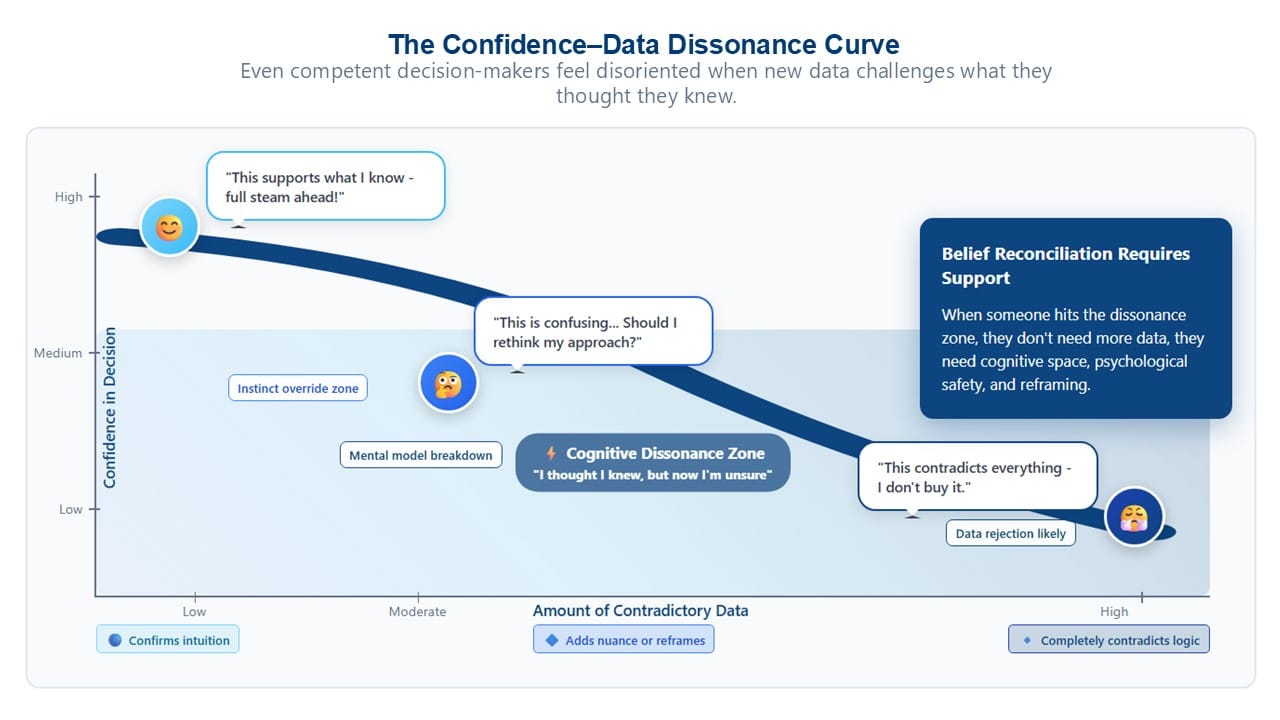
The chart below shows how even competent decision-makers experience disorientation as contradictory data increases, and why belief reconciliation, not more data, is often the missing support mechanism.
The Confidence–Data Dissonance CurveAs contradictory data increases, confidence in the decision drops, often triggering instinctive override or outright rejection. Without support, people don’t change their minds. They protect their mental models.
This is where most data literacy efforts break down. We assume that more data or better visuals will convince someone, but what they really need is time, safety, and a new mental model to interpret what they’re seeing.
The specific belief barriers we encounter include:
"Data doesn't capture what I really need to know" A sales manager might understand correlation vs. causation intellectually, but still believe their personal customer relationships reveal insights that no dataset can match. They're not wrong, relationships matter. But they need to learn when data complements intuition versus when it should override it.
"If I can't explain it simply, it's probably wrong" Many professionals built their careers on being able to articulate clear, simple rationales for decisions. Data often reveals complex, counterintuitive patterns that resist simple explanations. Learning to act on insights you can't easily communicate to others requires a fundamental shift in what constitutes "good enough" evidence.
"More information means better decisions" Traditional business thinking equates thorough analysis with smart decisions. But data literacy often means learning to act on incomplete information, to distinguish between "enough data to decide" and "all possible data," and to embrace probabilistic thinking over certainty.
"My experience trumps your analysis" Senior professionals have pattern recognition built from years of successes and failures. Data literacy asks them to trust patterns detected by algorithms in datasets they've never personally experienced. This feels like devaluing their hard-won expertise.
Why Traditional Training Approaches Fall Short
Most data literacy programs make the same mistakes as early change management models:
This ends the free preview.
The rest of this
content is for free members
Create a free account to get full access. No payment required.
AI did not end the data literacy crisis. It changed it. As machines move from providing information to interpreting it and recommending what to do, the scarce skill is becoming judgment: knowing what to trust, what to question, and what decisions are still ours to make.
Evidence does not make decisions. People interpret it, weigh it, challenge it, and make judgments. A courtroom reveals what leaders can learn about evidence, expertise, confidence, and data-informed decision-making.
Feeling sure doesn't mean you're right. Learn five simple ways to question what feels true, spot what might be influencing you, and make better decisions about what to believe.
We teach data literacy as a ladder: data at the bottom, wisdom at the top, climb step by step. But the rungs are not where the work happens. The judgment lives in the gaps between them, and that is exactly where AI now carries us straight past.