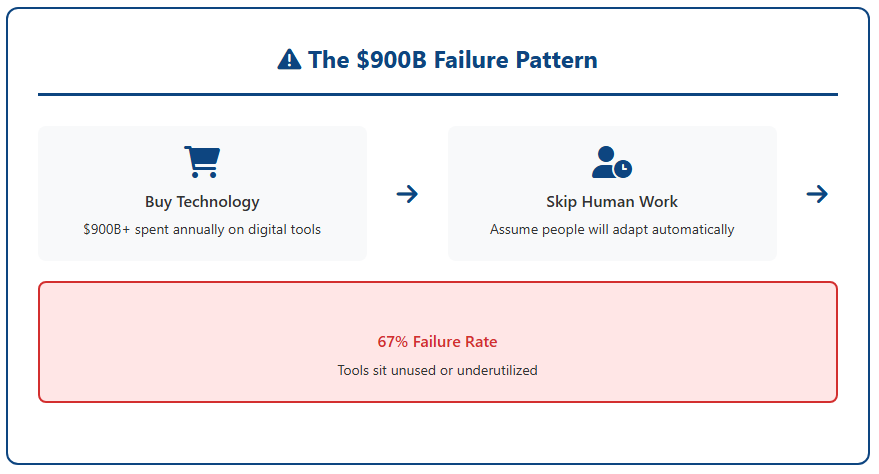
Despite $900+ billion in annual digital spending, 67% of transformation initiatives fail, not because of bad technology, but because leaders treat transformation as a tech upgrade instead of a people project. The uncomfortable truth is that there is no such thing as digital transformation. There is only human transformation, enabled by digital tools. Companies pour resources into new platforms, AI systems, and automation while the most critical operating system, the human one, continues running on outdated code.
Every organization runs on two operating systems: the Digital OS (platforms, AI, automation) and the Human OS (beliefs, behaviors, culture, skills). Most leaders obsess over upgrading the Digital OS, assuming better tools automatically lead to better results. But it's the Human OS that determines whether those upgrades stick. When employees don't believe in the purpose, don't adapt their behaviors, or don't feel reinforced for new ways of working, even the most sophisticated technology underperforms. It's like installing advanced apps on a phone with an outdated operating system, they crash, lag, or never fully function.
The solution isn't more technology, it's upgrading the human operating system first. This requires investment in areas traditional transformation playbooks ignore: helping people unlearn outdated assumptions, building sensemaking capabilities to navigate complexity, creating reinforcement loops that sustain behavioral change, and aligning culture with strategy. The organizations that thrive will treat human transformation as the heart of their digital strategy, recognizing that people and culture drive outcomes, not platforms and code. Technology becomes the accelerator, but human change is the engine.
Key Takeaways
- Invest in Your Human Operating System - The Human OS (beliefs, behaviors, culture) determines whether your Digital OS (platforms, AI, automation) delivers value. Successful transformation requires upgrading both, starting with people.
- Build Unlearning Capability - Competitive advantage isn't learning faster, it's unlearning faster. Create systems that help people identify and let go of outdated assumptions before they learn new approaches.
- Abandon Linear Change Models - Traditional change models assume transformation has an endpoint. Digital transformation is like fitness. It's ongoing, adaptive, and requires continuous reinforcement, not one-time implementation.
- Align Strategy with Culture - Strategy sets direction, but culture determines whether you move. A "data-driven" strategy can't survive in a culture that rewards intuition over insights. Fix the alignment first.
- Measure Human Transformation ROI - Technology-only initiatives average 3x ROI while human-led transformation delivers 12x ROI. Track behavioral changes, decision-making patterns, and cultural shifts, not just platform adoption metrics.