AI did not end the data literacy crisis. It changed it. As machines move from providing information to interpreting it and recommending what to do, the scarce skill is becoming judgment: knowing what to trust, what to question, and what decisions are still ours to make.
Evidence does not make decisions. People interpret it, weigh it, challenge it, and make judgments. A courtroom reveals what leaders can learn about evidence, expertise, confidence, and data-informed decision-making.
Feeling sure doesn't mean you're right. Learn five simple ways to question what feels true, spot what might be influencing you, and make better decisions about what to believe.
Your Org Chart Is a Decision Architecture (And It’s Hurting Your Decisions)
Your org chart is not just how your company is organized. It is a machine that produces decisions of a particular quality, speed, and shape. Most leaders never designed it that way. Here is how to audit the architecture you are actually running.
Your company is quietly running a decision factory. Nobody designed it. Nobody audits it. Nobody owns it. And it's producing everything you ship.
90 Second Wisdom Audio Brief
0:00
/325.218685
What You Need To Know About
Your org chart is not a neutral backdrop. It is a machine that produces decisions of a particular quality, speed, and shape. Most leaders treat structure and decision-making as separate concerns, reviewed on different cycles and owned by different people. That separation is why most organizations are accidentally optimizing for slow, over-consulted, low-quality decisions without anyone ever choosing to. The real shift is to see your structure for what it is. A decision architecture. And to ask whether yours was designed, or whether it simply accumulated.
Why This Matters to You Every late call, every over-consulted meeting, every decision that gets made twice because the first version lacked context is not a leadership failure. It is a predictable output of the architecture you are running. Once you see that, the story changes. You stop blaming people for outcomes the system guaranteed. You start asking better questions. Where does authority actually sit? What information reaches the decision-maker, and what gets filtered out? How fast does signal become action, and does that speed match the stakes? The difference between an accidental architecture and a designed one shows up as missed opportunities, strategic drift, and the quiet burnout of working inside a system where good decisions require too much friction to make.
Who This Applies To This article is written for senior leaders who have the authority to shape how decisions get made in their part of the organization. Not only CEOs. Function heads, division presidents, team leads with discretion over their own decision-making practices. If you have ever sat in a meeting wondering why a simple call is taking three weeks, or watched a strategic decision get made by the wrong person because the right person never saw the signal, this is for you. The cognitive challenge is not a lack of intelligence or effort. It is working inside a structure you inherited and never thought to audit.
What You'll Gain from Reading A diagnostic frame for seeing your organization as a decision machine instead of a reporting structure. A three-part model for understanding any architecture. Authority, information flow, and decision velocity. A practical audit you can run on your last ten meaningful decisions to surface the pattern your structure is actually producing. And three structural moves that change decision quality faster than any reorganization. After reading, you will be able to name the architecture you are running and start designing the one you want to run instead.
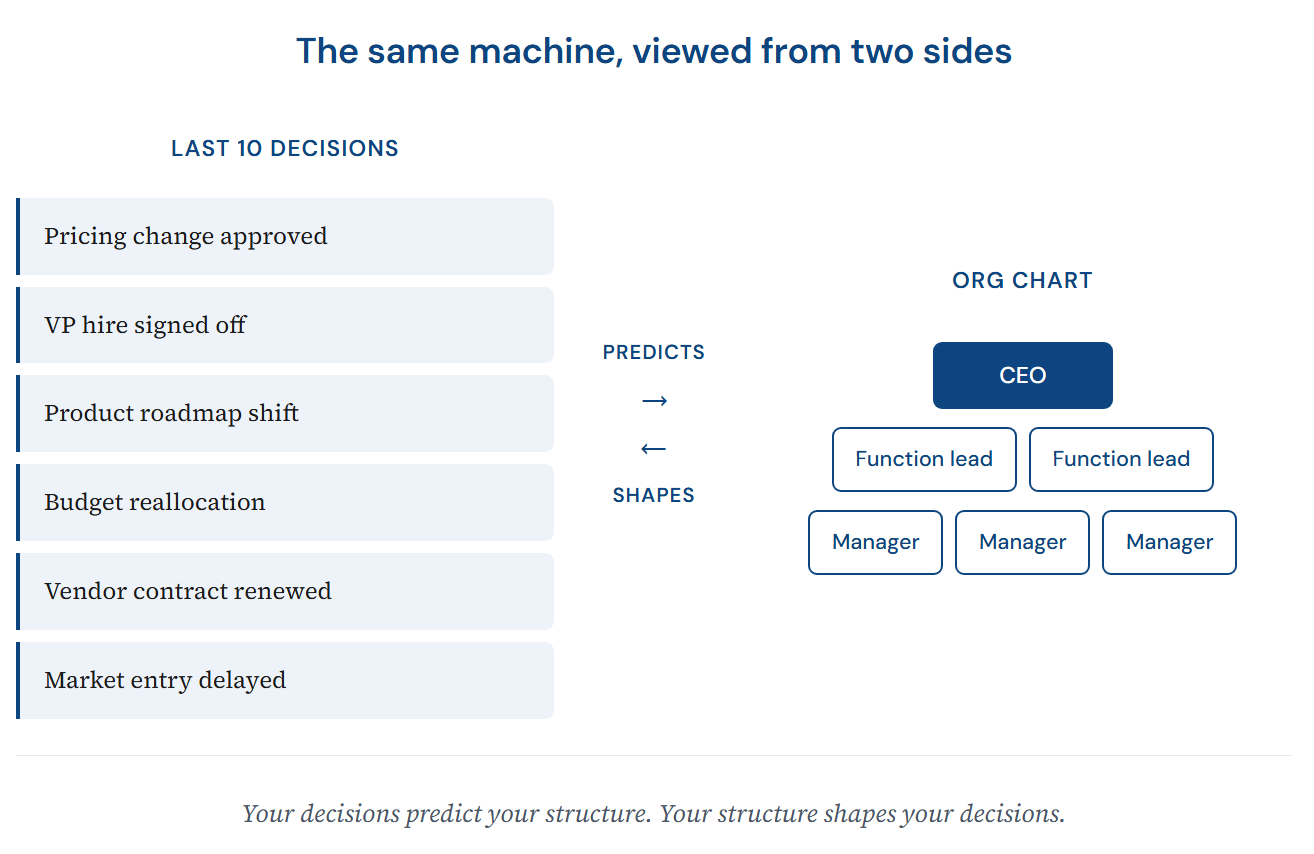
If I spent an afternoon mapping your organization's last ten meaningful decisions, I could draw your org chart with uncomfortable accuracy. I would look at who was consulted, who actually decided, how long it took from surfacing to resolution, what information was available at the moment of choice, and what got escalated versus resolved in place. From that pattern alone, I could probably tell you which roles were added in the last two years, which functions report into which executives, and where the political weight sits.
That should bother you. It should bother you because the reverse is also true. Your org chart is shaping those decisions. Every reporting line is a statement about who gets consulted. Every approval threshold is a statement about what speed of decision you can tolerate. Every layer between a signal and a decision-maker acts as a filter. It removes nuance. It adds delay. It distorts information on the way through.
The structure you think of as "how the company is organized" is actually a machine for producing decisions of a particular quality, at a particular speed, with particular blind spots.
Most leaders have never looked at it that way. They treat the org chart as a separate concern from decision-making. Structure is an HR topic. Decision-making is a leadership topic. They get reviewed on different cycles, owned by different people, discussed in different meetings. That separation is the single biggest reason most organizations are accidentally optimizing for slow, over-consulted, low-quality decisions.
Let me say that more directly. Your organization is not producing the decision quality it is capable of. It is producing the decision quality its structure allows. And in most cases, nobody designed that structure with decisions in mind.
Your best decisions are not being made by your best people. They are being made by your org chart.
The Accidental Architecture
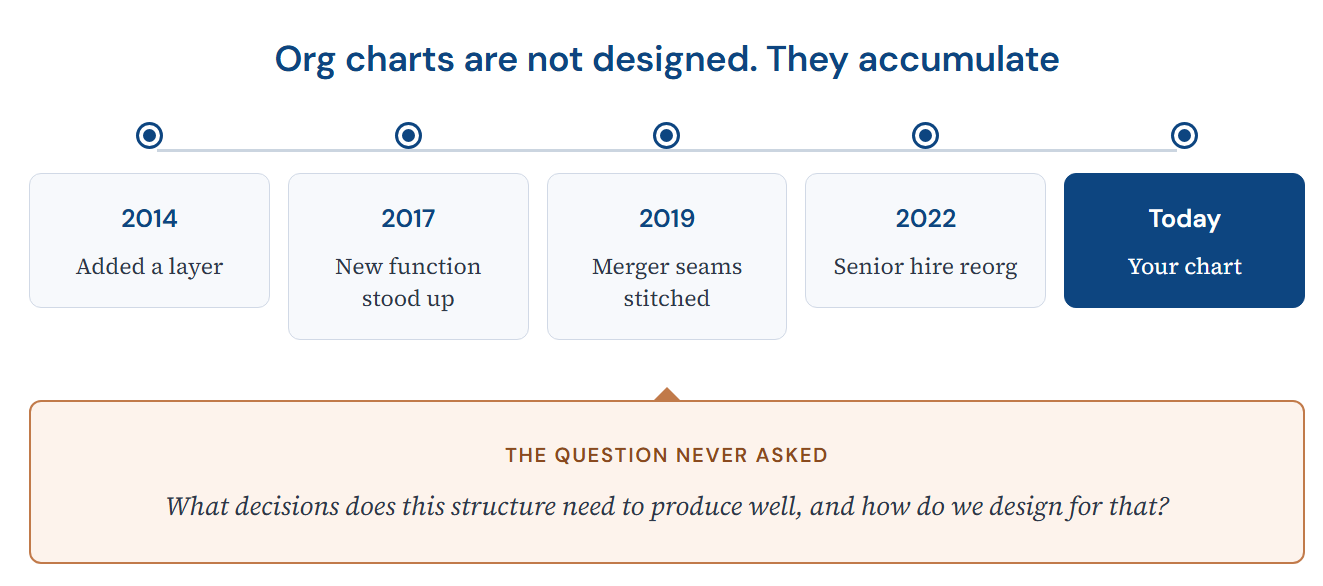
Org charts are not designed. They accumulate.
A company grows. Someone adds a layer because a manager has too many direct reports. A new function gets stood up because a capability gap becomes urgent. An executive reorganizes their team to reflect a new strategy, to accommodate a senior hire, or to resolve a political tension. A merger happens, and two structures get stitched together with whatever seams the integration team can manage.
Nowhere in that process does anyone stop to ask the question that actually matters. What kinds of decisions does this structure need to produce well? How should information move to what level, at what speed, with what fidelity? Where should judgment sit, and where should execution sit, and what separates them? Which decisions should be reversible and fast, and which should be deliberate and consultative? Does our structure make that distinction possible?
This ends the free preview.
The rest of this
content is for paid subscribers
Become a paid subscriber to get full access and unlock all paid content.
Evidence does not make decisions. People interpret it, weigh it, challenge it, and make judgments. A courtroom reveals what leaders can learn about evidence, expertise, confidence, and data-informed decision-making.
Feeling sure doesn't mean you're right. Learn five simple ways to question what feels true, spot what might be influencing you, and make better decisions about what to believe.
We teach data literacy as a ladder: data at the bottom, wisdom at the top, climb step by step. But the rungs are not where the work happens. The judgment lives in the gaps between them, and that is exactly where AI now carries us straight past.
Every organization keeps one scoreboard for mistakes and none for missed opportunities. So people optimize the one they can see, and the largest losses never appear as losses at all. They appear as things no one tried.