AI did not end the data literacy crisis. It changed it. As machines move from providing information to interpreting it and recommending what to do, the scarce skill is becoming judgment: knowing what to trust, what to question, and what decisions are still ours to make.
Evidence does not make decisions. People interpret it, weigh it, challenge it, and make judgments. A courtroom reveals what leaders can learn about evidence, expertise, confidence, and data-informed decision-making.
Feeling sure doesn't mean you're right. Learn five simple ways to question what feels true, spot what might be influencing you, and make better decisions about what to believe.
AI Myths vs. Reality - Separating Hype from Practical Business Applications
Think AI is infallible, all-knowing, or able to replace every job? Think again. This article debunks the most common myths about AI and reveals what’s actually true so you can make smarter, hype-free decisions for your business.
The real danger isn’t AI itself—it’s the hype that clouds how we use it.
High-Level Summary and Key Takeaways
Artificial Intelligence (AI) is transforming business landscapes, but widespread misconceptions can lead to unrealistic expectations and missed opportunities. Despite popular beliefs, AI is not a sentient, infallible solution that will completely replace human workers. Instead, it serves as a powerful tool that enhances productivity and decision-making while requiring careful implementation and ongoing human oversight.
AI's capabilities are often overstated. It does not think like humans, but rather processes data and identifies patterns based on training models. The technology is not 100% accurate and can perpetuate biases present in its training data. Rather than eliminating jobs, AI typically automates repetitive tasks, allowing professionals to focus on higher-value work that demands critical thinking and emotional intelligence.
Contrary to common assumptions, AI is becoming increasingly accessible to businesses of all sizes through cloud-based services and pre-built tools. It is not a passing trend, but a fundamental shift in how organizations leverage data and automation. The most successful approach involves viewing AI as a collaborative tool that augments human expertise, rather than a replacement for human judgment and strategic thinking.
Businesses that understand AI's true potential and limitations can strategically integrate this technology to gain a competitive edge in an increasingly data-driven world.
Key Takeaways
AI is a Powerful Tool, Not a Sentient Being. AI mimics intelligence through pattern recognition, but it does not truly understand or think like humans. It lacks creativity, emotions, and independent reasoning, making human oversight crucial for effective implementation.
Accuracy and Objectivity Require Constant Vigilance. AI systems are not infallible and can perpetuate biases from their training data. Businesses must regularly audit AI models, ensure diverse and up-to-date datasets, and maintain human oversight to minimize errors and maintain ethical standards.
AI Transforms Jobs Rather Than Eliminating Them. Instead of replacing workers, AI automates repetitive tasks, allowing professionals to focus on higher-value work that requires critical thinking, emotional intelligence, and strategic decision-making. The most successful approach integrates AI as a collaborative tool that enhances human capabilities.
AI is Everywhere—But What’s Real and What’s Hype?
Artificial intelligence (AI) is one of the most talked-about technologies today, with promises of revolutionizing industries, automating jobs, and transforming decision-making. While AI’s potential is real, so is the hype and misinformation surrounding it.
Many business professionals feel pressured to adopt AI but aren’t sure what’s true and what’s exaggerated. Is AI really replacing entire industries? Can it think like a human? Is it 100% accurate?
The reality is that AI is a powerful tool, but it has limits. Understanding what AI can and can’t do helps businesses set realistic expectations, avoid costly mistakes, and leverage AI effectively.
Myth 1 - AI Thinks Like a Human
AI predicts patterns—it doesn’t possess purpose.
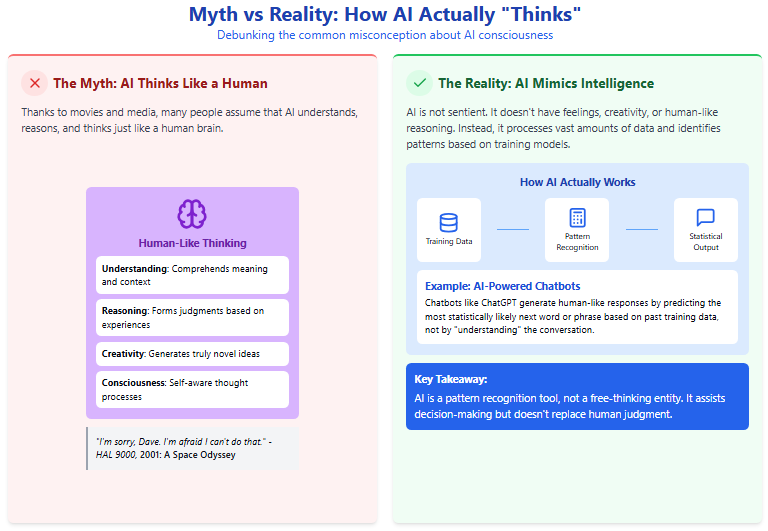
The Myth: AI is “intelligent” in the same way that humans are Thanks to movies and media, many people assume that AI understands, reasons, and thinks just like a human brain.
The Reality: AI Mimics Intelligence, But It Doesn’t Think AI is not sentient. It doesn’t have feelings, creativity, or human-like reasoning. Instead, it processes vast amounts of data and identifies patterns based on training models.
Example
AI-powered chatbots (like ChatGPT) generate human-like responses, but they don’t “understand” conversations like humans. They predict the most statistically likely next word or phrase based on past training data.
Key Takeaway: AI is a pattern recognition tool, not a free-thinking entity. It assists decision-making but doesn’t replace human judgment.
Myth 2 - AI is 100% Accurate and Objective
AI reflects the data it’s fed—flaws, gaps, and all.
This ends the free preview.
The rest of this
content is for paid subscribers
Become a paid subscriber to get full access and unlock all paid content.
AI did not end the data literacy crisis. It changed it. As machines move from providing information to interpreting it and recommending what to do, the scarce skill is becoming judgment: knowing what to trust, what to question, and what decisions are still ours to make.
We teach data literacy as a ladder: data at the bottom, wisdom at the top, climb step by step. But the rungs are not where the work happens. The judgment lives in the gaps between them, and that is exactly where AI now carries us straight past.
A bad decision can produce a good outcome. A good decision can produce a bad outcome. Organizations that judge leaders by results without inspecting the reasoning reward luck and punish discipline, and many have done so for years without knowing.
When a decision fails, leaders point to the model. The analysis had already removed the judgment that would have caught the mistake, long before the call was made. This is how analytics stops being a tool you use and becomes one you hide behind.