AI did not end the data literacy crisis. It changed it. As machines move from providing information to interpreting it and recommending what to do, the scarce skill is becoming judgment: knowing what to trust, what to question, and what decisions are still ours to make.
Evidence does not make decisions. People interpret it, weigh it, challenge it, and make judgments. A courtroom reveals what leaders can learn about evidence, expertise, confidence, and data-informed decision-making.
Feeling sure doesn't mean you're right. Learn five simple ways to question what feels true, spot what might be influencing you, and make better decisions about what to believe.
Before the Scores: Why Parents Know Something the Data Doesn't Show
When school reports say "fine" but your child struggles daily, that gap is real. Your observations aren't anecdotal, they're longitudinal evidence. This journey helps you trust what you see, complete the data schools collect, and advocate with grounded confidence. Start here.
The most important signal in education is often the one the report doesn’t capture.
There's a moment most parents recognize.
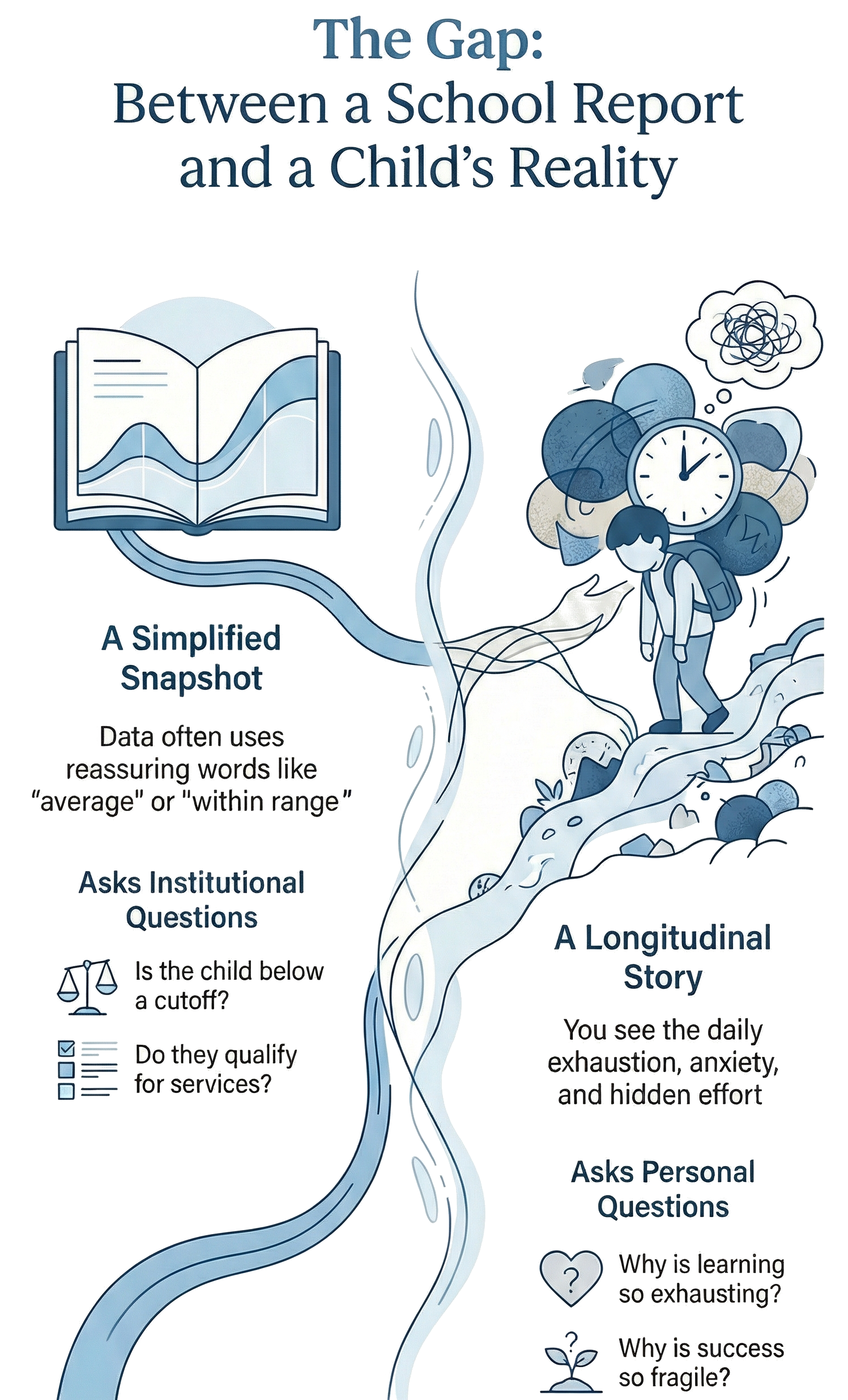
You're sitting with a school report, an evaluation, or a progress update. The numbers look fine. Maybe even reassuring. Words like average, within range, or no major concerns appear in bold.
And yet, your stomach drops. Because the report doesn't match what you see every day. You see the exhaustion after school. The homework that takes three times as long as it should. The anxiety before reading out loud. The shutdowns that appear without warning. The effort your child is putting in just to stay afloat.
Averages are designed to simplify decisions, not explain struggle
When the data and your lived experience don't align, it creates a quiet kind of doubt. Not just about the report, but about yourself. You start to wonder:
Am I overreacting?
Am I missing something?
Why does it feel like I'm the only one worried?
This learning journey starts there. In that gap between the numbers and what you know to be true.
When Something Feels Off, It Usually Is
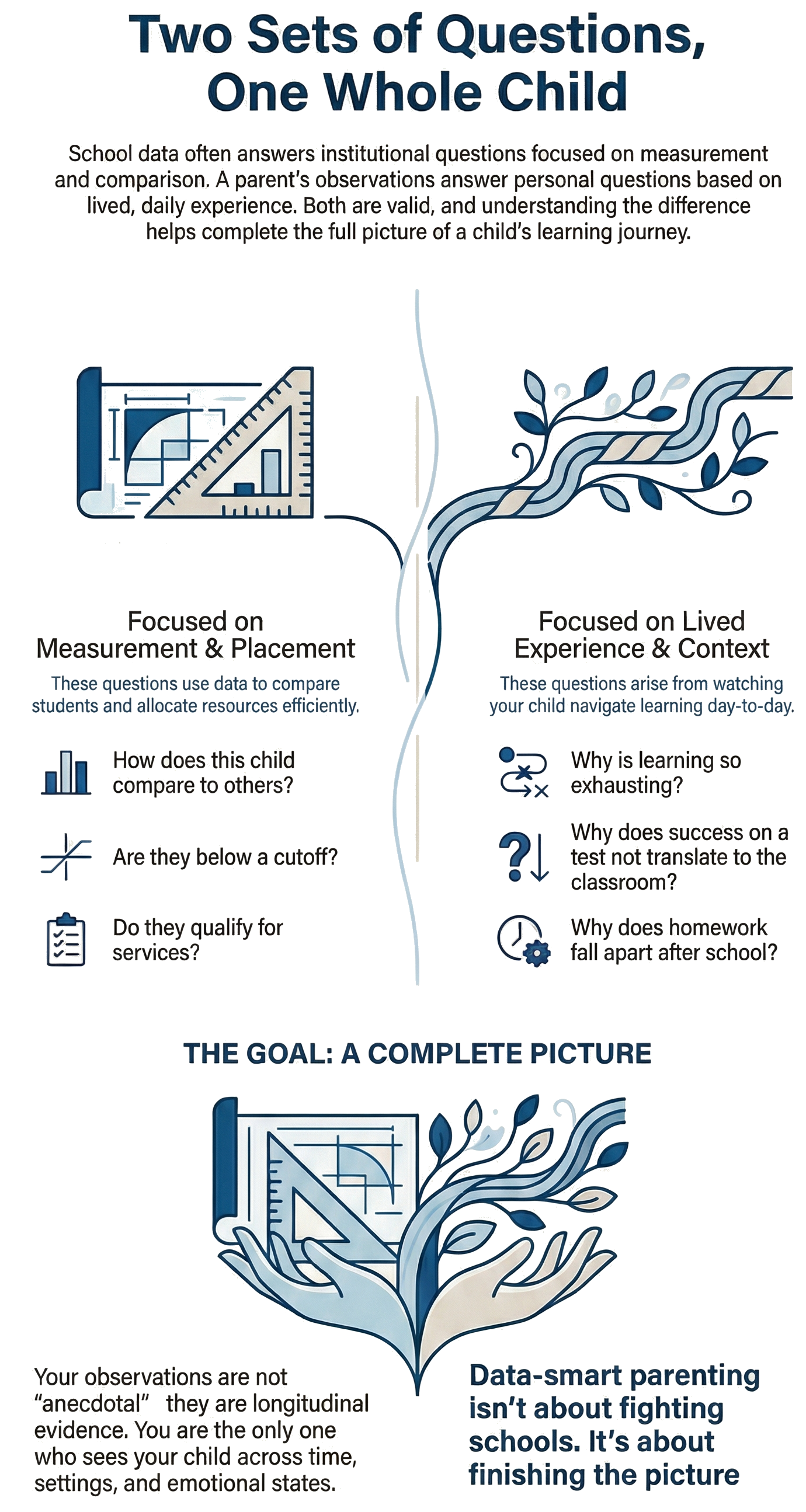
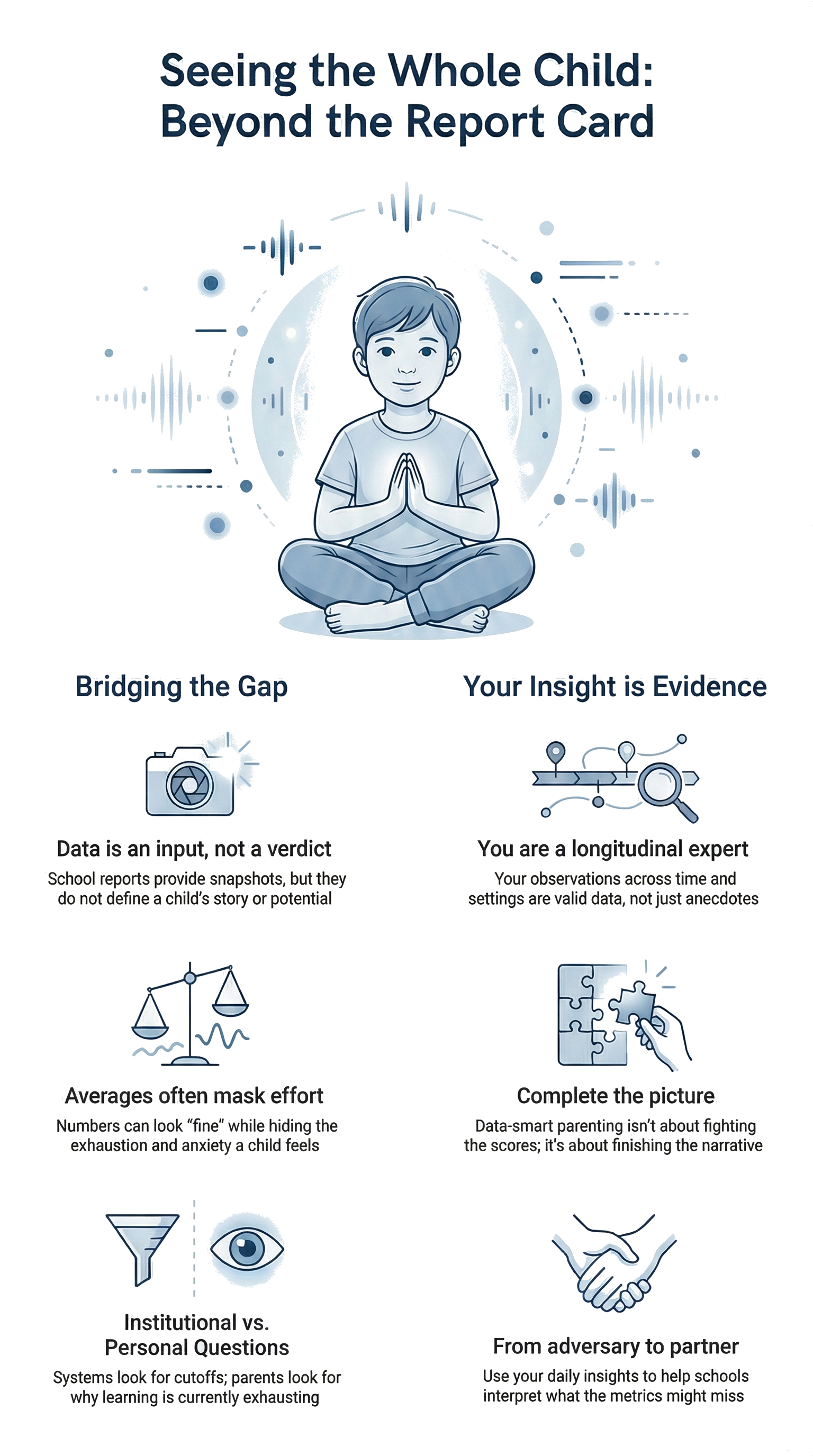
Schools rely on data to make decisions. That's not a bad thing. Data can reveal patterns, highlight needs, and guide support. But school data is often designed to answer institutional questions, not personal ones.
It asks:
How does this child compare to others?
Are they below a cutoff?
Do they qualify for services?
Parents are asking different questions:
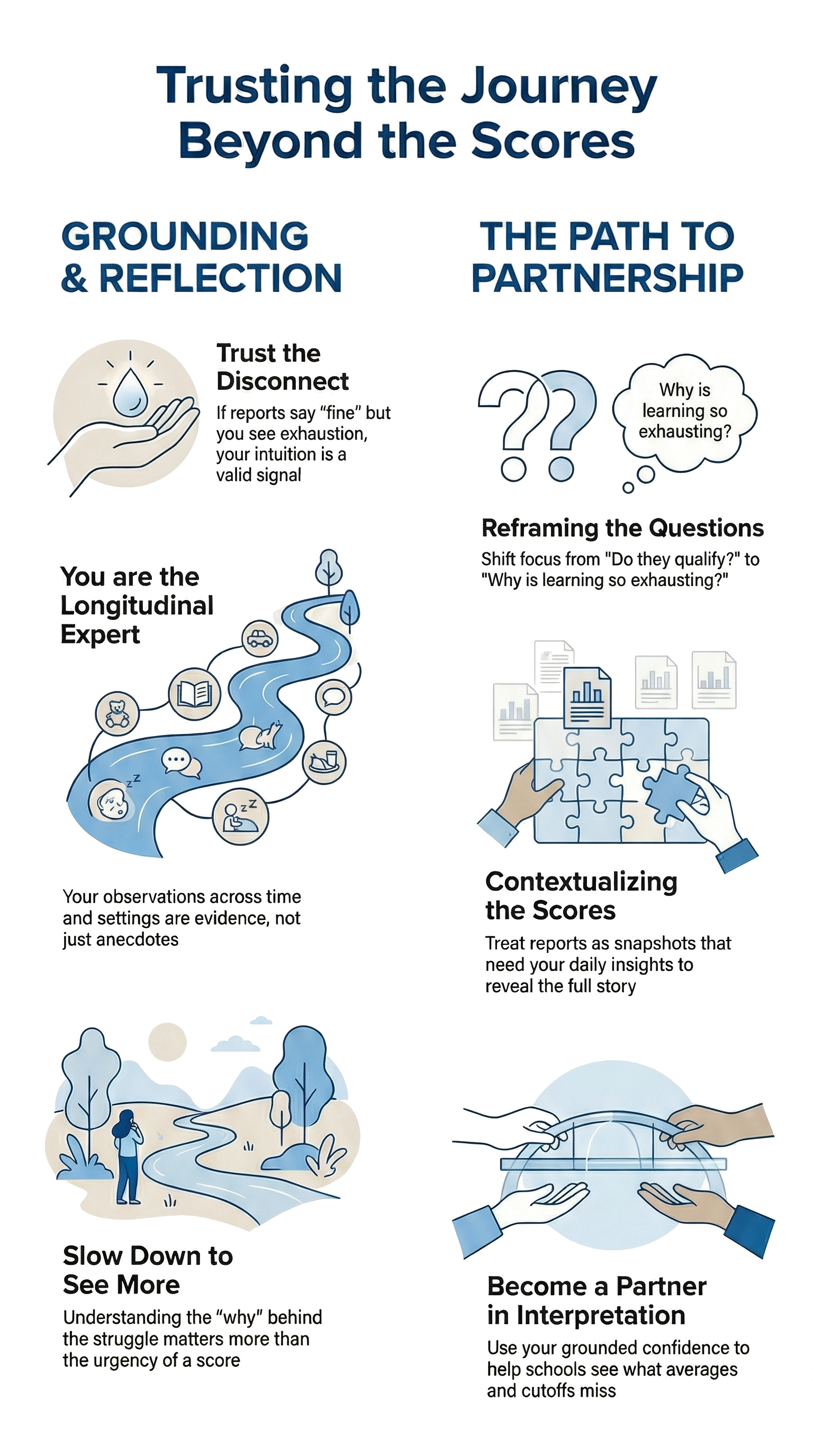
Why is learning so exhausting?
Why does homework fall apart after school?
Why does success on a test not translate to the classroom?
When those questions collide, parents are often told (directly or indirectly) to trust the numbers. And when the numbers say "fine," parents are expected to stand down. This journey exists because that expectation is unrealistic. And often inaccurate.
Your Observations Are Not "Anecdotal"
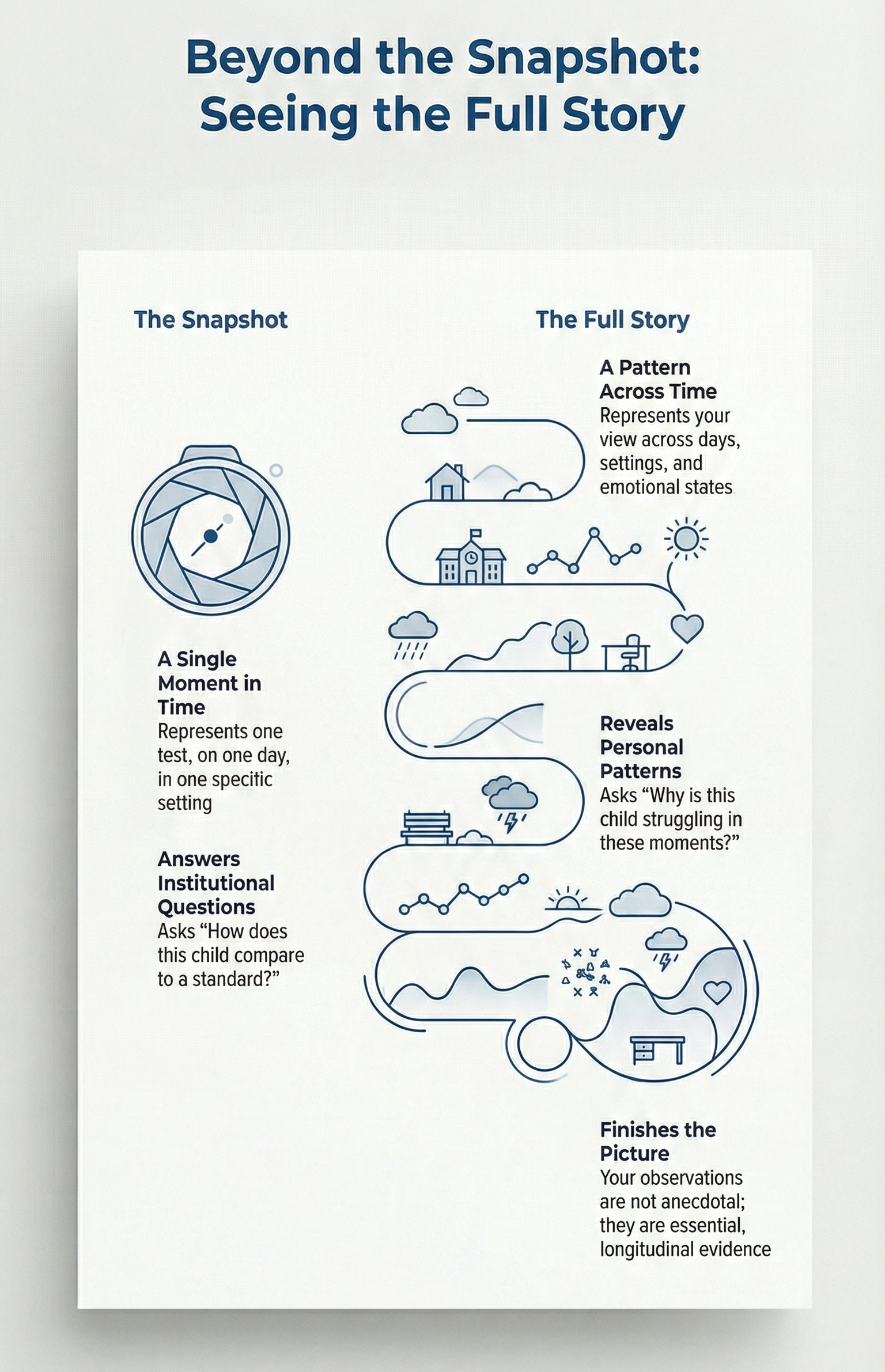
You are the only person who sees your child across time, context, and capacity.
One of the quietest failures in modern education is how parental insight gets labeled. Parents are told their observations are subjective. Meanwhile, a single test taken on a single day in a single environment is treated as objective truth.
But you are the only person who sees your child:
across time
across settings
across emotional states
across good days and hard ones
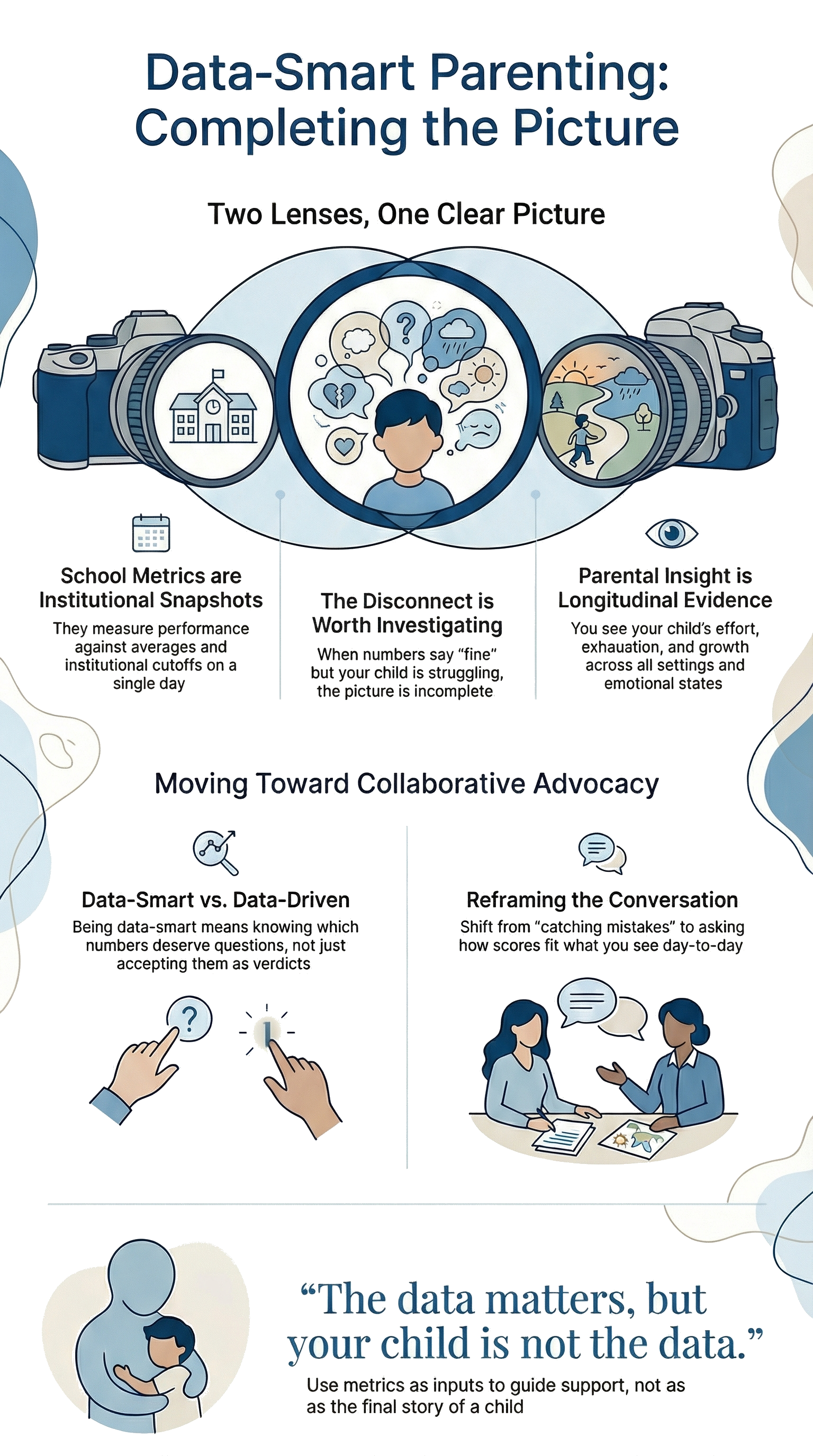
That is not anecdotal data. That is longitudinal evidence. The problem is not that parents lack insight. The problem is that the system lacks a framework for listening. Data-smart parenting isn't about rejecting school data. It's about completing it.
This Is Not About Fighting Schools
It's important to say this clearly. This journey is not about:
catching schools in mistakes
arguing with teachers
turning meetings into confrontations
becoming an amateur psychologist
Most educators are doing their best within tight constraints. The issue is not intent. The issue is interpretation. Data does not speak for itself. It requires judgment. And when judgment relies too heavily on summaries, averages, or cutoffs, important signals get lost.
Being a data-smart parent means becoming a better partner in interpretation. Not an adversary.
Why This Journey Starts Before the Scores
Most parent resources jump straight into:
how to read test reports
what percentiles mean
how to request services
Those tools matter. You'll get them. But if you start there, you miss the most important shift: trusting what you already see. Before you learn how to decode an evaluation, you need permission to believe that the disconnect you feel is real. And worth investigating.
Before you analyze scores, you need to understand that struggle doesn't always show up where systems are looking. Before you advocate, you need language that reframes the conversation from deficit to design.
That's what this journey is designed to build.
Data-smart parenting isn’t about fighting schools. It’s about finishing the picture.
What This Learning Journey Will Give You
As you move through this journey, you will learn how to:
Read assessment data for patterns, not headlines
Recognize when "average" masks real effort or hidden gaps
Understand why some children perform well in testing but struggle in classrooms
Identify cognitive bottlenecks like working memory, processing speed, and fatigue
Use your observations as legitimate data in school conversations
Track what supports actually help (and which ones don't)
But more importantly, you'll gain something harder to quantify: Confidence. Not the loud kind. The grounded kind. The kind that lets you say, calmly and clearly: "Help me understand how this conclusion fits what we're seeing day to day."
One Principle Guides Everything Here
Throughout this journey, one idea stays constant:
The data matters. And your child is not the data.
Scores are inputs, not verdicts. Reports are snapshots, not stories. And no single measure can capture how hard a child is working just to function.
This journey helps you hold both truths at the same time.
Start Here
You don't need to become an expert in education, psychology, or statistics. You just need a framework that helps you:
trust what you see
ask better questions
and make sure no important signal gets ignored
That's what comes next.
Continue the Learning Journey
This article is one piece of a larger learning journey designed for parents who want to move from quiet concern to clear understanding without turning advocacy into conflict.
Across the full series, you’ll find connected articles, short presentations, podcasts, guides, tools, and practical frameworks that help you go deeper into the patterns introduced here. Each piece builds on the last, helping you make sense of assessment data, classroom behavior, cognitive load, and support decisions as part of one coherent picture.
The learning plan is designed to be flexible. You can follow it start to finish, or jump to the topics that match what you’re facing right now. Some pieces are reflective, helping you trust what you already see. Others are practical, giving you language, visuals, and questions you can bring into school conversations. All of it is built around the same principle:
Scores don’t tell the whole story. But together, data and lived experience can.
If this article resonated, if it put words to something you’ve been feeling but couldn’t quite name, the rest of the journey is there to support you. Not to tell you what to think, but to help you interpret, ask better questions, and make sure the most important signals don’t get lost.
You don’t need to have all the answers to take the next step. You just need a place to keep learning.
Kevin is an author, speaker, and thought leader on topics including data literacy, data-informed decisions, business strategy, and essential skills for today. https://www.linkedin.com/in/kevinhanegan/
When kids ace drills but break down on word problems, it’s not effort or ability, it’s cognitive load. This article explains how executive function demands overwhelm capacity, and how the right scaffolds restore access to learning.
Data clarifies patterns but can't capture a whole child. Balance test scores with stories, observations, and your child's voice. Make decisions that honor growth as a person, not just academic metrics. Being data-smart means using numbers to understand your child, never to define them.
That report card doesn't match what you're seeing at home. You're not imagining it. A test is just a photograph. Your observations are years of footage. Discover how to replace fear with curiosity and use four data sources to see your child's full story.
"Low average" scores often don't trigger support, yet predict real struggle. When working memory or processing speed falls in this range, children can't access curriculum without scaffolding. Advocacy means connecting scores to daily function and demanding equity, not emergency.