AI did not end the data literacy crisis. It changed it. As machines move from providing information to interpreting it and recommending what to do, the scarce skill is becoming judgment: knowing what to trust, what to question, and what decisions are still ours to make.
Evidence does not make decisions. People interpret it, weigh it, challenge it, and make judgments. A courtroom reveals what leaders can learn about evidence, expertise, confidence, and data-informed decision-making.
Feeling sure doesn't mean you're right. Learn five simple ways to question what feels true, spot what might be influencing you, and make better decisions about what to believe.
Data-Smart Parenting. You Are Your Child's Best Data Detective
That report card doesn't match what you're seeing at home. You're not imagining it. A test is just a photograph. Your observations are years of footage. Discover how to replace fear with curiosity and use four data sources to see your child's full story.
When we average a child's strengths and weaknesses, we don't get clarity. We get invisibility.
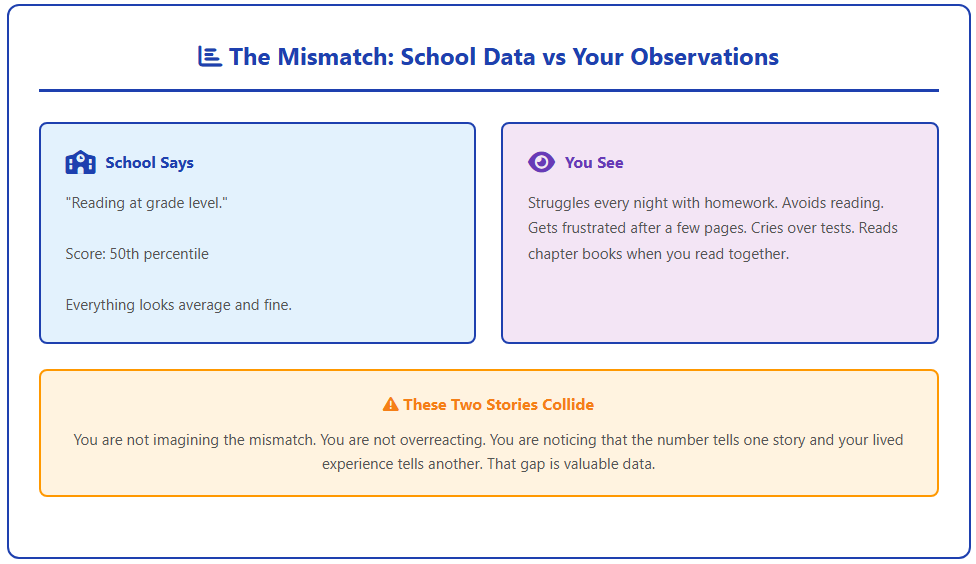
Picture this: Your child brings home a report that shows they are "performing at grade level," or maybe the scores look "average". Yet, you’ve watched them struggle with homework every night, seen the tears over reading, or noticed the intense avoidance when it's time for math. If you’ve ever felt like the numbers the school presents simply don’t match what you’re seeing at home, you are not alone, and you are not imagining things.
When the school speaks in scores, but your lived experience speaks in patterns, something critical is often missing. This gap is why every parent needs to become their child’s best Data Detective.
School says average. You see struggle. Both are true. This is not a contradiction. This is data calling for deeper investigation.
The Goal: Translator, Not Statistician
The idea of educational "data" might sound technical or intimidating, especially if you felt scared of or uncomfortable with data in the past. But becoming a data-smart parent does not mean you need a degree in education or statistics. Your goal is simpler and far more human: to become a translator.
You need to translate the school’s language of numbers, percentiles, and technical terms into the language of empathy, context, and lived experience. While professionals provide technical data, you bring longitudinal data: the evidence of how your child performs across time and setting.
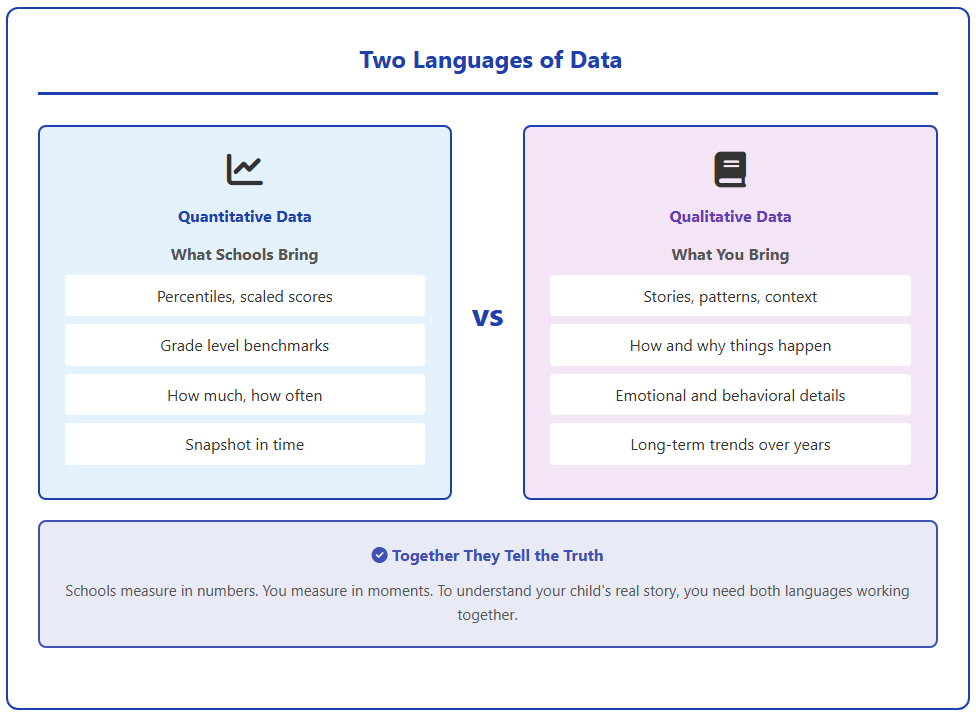
Schools speak numbers. You speak moments. Each language tells only half the story. When you bring both to the conversation, you get the whole truth.
Data should inform your decisions and understanding, but it should never replace your unique knowledge of who your child is as a learner and as a person.
Parents aren't supposed to be data analysts. We're supposed to be advocates. And advocates need to know when something doesn't add up.
Why Your Instincts Are Data
When a school report states that everything is "average" or "fine," it can feel intimidating to challenge that conclusion. However, your parental instinct, the feeling that "something still doesn’t sit right", is actually based on the richest dataset of all: daily observations, patterns, emotions, and contexts.
A test score is a photograph taken in one moment under specific conditions. Your observations are a movie. A photograph can be very clear and very wrong.
Schools rely on quantitative data (scores, grades, charts) which tells you how much or how often. You, however, rely on qualitative data (stories, observations, relationships) which tells you how and why. To get the truth, you need both.
The most dangerous moment in a child's education is when a parent stops trusting their own observations.
If a score is a snapshot of performance on one specific day, under controlled conditions, your observations are the long-term trend data. When your lived data contradicts a test report, that observation is not merely anecdotal, it is powerful long-term evidence.
A snapshot is incomplete. Your long-term trend is incomplete. But together? That is where the full truth lives. One without the other tells half the story.
The Limitations of Single Scores
The biggest trap in educational assessment is treating an individual test score or grade as the definitive word on your child’s abilities. A single data point, like a score, cannot capture the full picture of how your child learns, thinks, or performs.
For example, a child might score "average" on a reading assessment but still struggle to follow multi-step directions at school, even if they devour chapter books at home. Why? Because test scores can confirm what’s obvious, but they can also bury what matters.
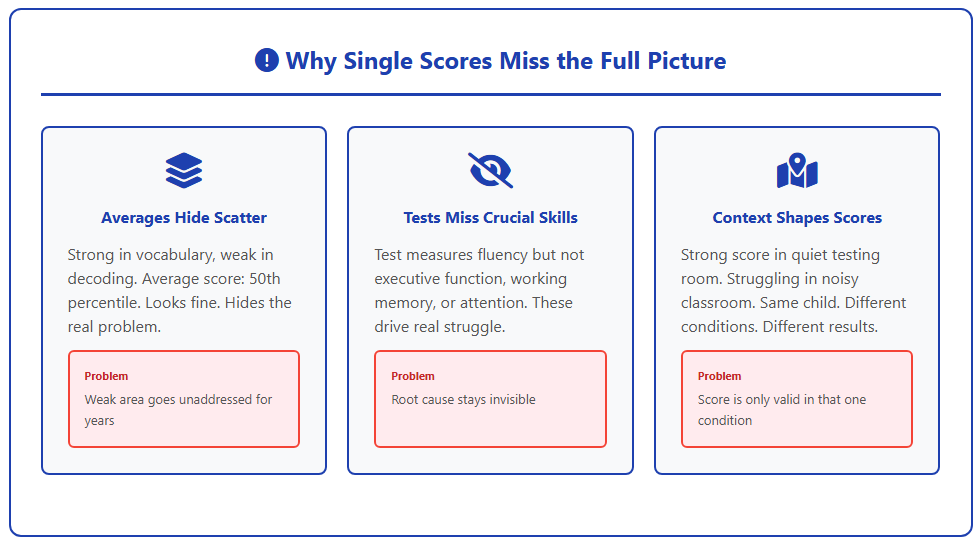
A single score hides three things: buried scatter, missed skills, and context-dependent results. One number cannot capture all three. You need to look deeper.
This happens because:
Averages Lie: A composite score that looks fine can hide significant gaps or "scatter" where your child is gifted in one sub-area but struggles severely in another. For example, strong vocabulary scores can mask a significant weakness in decoding.
Tests Miss Crucial Skills: Many tests measure only isolated academic content (like calculation or fluency) but fail to assess crucial underlying processing skills such as executive functioning (planning, organization), working memory, or attention, which are often the true drivers of difficulty.
Context Matters: A score is only valid in relation to the conditions under which the data was collected. A strong score achieved in a quiet, one-on-one testing environment may not transfer to a noisy, busy classroom filled with distractions and time pressure.
A child can pass every test and still be drowning. The test isn't designed to see that.
Your Data Detective Tool: Triangulation
To move beyond the limitations of any single score, you need to employ data triangulation. This is a simple concept that means using three or more different sources of information to understand your child more completely.
Data triangulation creates a comprehensive profile by combining four essential sources:
1. Standardized Test Performance
These are the formal assessments designed to compare your child's performance against thousands of same-age peers across the country.
What Standardized Tests Tell You
What Standardized Tests Miss
How your child performs on specific skills under controlled, timed conditions compared to peers.
How they perform in real-world applications or in a busy classroom.
Performance scatter (big differences between sub-skills), which can signal uneven cognitive demands.
Strategy use, persistence, anxiety, or their performance when stress is reduced.
A numerical snapshot of ability on one day.
Their motivation, creativity, curiosity, or emotional regulation.
Actionable Insight: Always ask for subtest scores. A composite score (the average) can hide huge gaps, often called "scatter", which are diagnostic gold.
2. Classroom Performance Data
This is the information generated by daily demands, assignments, and curriculum-based measures.
What Classroom Performance Data Tells You
What Classroom Performance Data Misses
How your child handles day-to-day academic demands, works with peers, and applies skills in realistic contexts.
Performance under low-pressure conditions or with one-on-one support.
Patterns in mistakes or areas of confusion over time.
Contextual factors like sensory sensitivity or severe anxiety that the child might manage better in a quiet testing room.
Their ability to sustain effort over long periods.
Whether success is due to pure skill or reliance on peer scaffolding.
Actionable Insight: Collect work samples and quiz scores over time, paying attention to patterns in mistakes. Look for tasks that consistently pose challenges.
3. Teacher Observations
Teachers provide professional insights into learning patterns, social interactions, and how your child responds to different instructional methods.
What Teacher Observations Tell You
What Teacher Observations Miss
How your child approaches challenging tasks and what strategies they use when stuck.
How your child behaves in less structured environments (like home) or their performance capabilities when stress is significantly reduced.
How they interact with peers during academic tasks.
Contextual factors like fatigue, deep anxiety, or complex family situations that may affect performance.
What time of day or types of activities bring out their best performance.
Their cognitive capacity outside of the specific teaching environment and methods used.
Actionable Insight: Use the teacher's professional insight to confirm or contradict your own data. Ask specific questions, such as, "How does my child approach tasks requiring planning?".
4. Home and Life Observations (Your Data)
This is the unique qualitative data that only you, the parent, possess. This longitudinal data, evidence of your child’s performance across time and setting, is often the most critical piece of the puzzle.
What Home and Life Observations Tell You
What Home and Life Observations Miss
Your child's natural learning style, interests, and performance when they are relaxed and supported.
How they'll perform under academic pressure or with peers.
Patterns in emotional response, motivation, and time required for tasks.
Formal assessment criteria or standardized benchmarks.
How they approach problem-solving in daily life and their response to different types of help.
Professional pedagogical insight.
Actionable Insight: Document when your child struggles, what preceded it, what the environment was like, and what supports were (or weren't) in use. This behavioral and contextual data transforms your intuition into evidence.
You already have access to all four sources. Most schools only look at one or two. That is your advantage as a detective.
When data from these four areas doesn't align, for instance, high test scores but poor classroom work, or average scores but significant homework struggles, that discrepancy is a valuable clue. It is a red flag that demands deeper investigation.
Setting the Stage for Advocacy
Your advocacy journey starts right here: recognizing that you are the expert on your child. You are the keeper of the most comprehensive and continuous data record, the longitudinal data, showing how they have performed across years and settings.
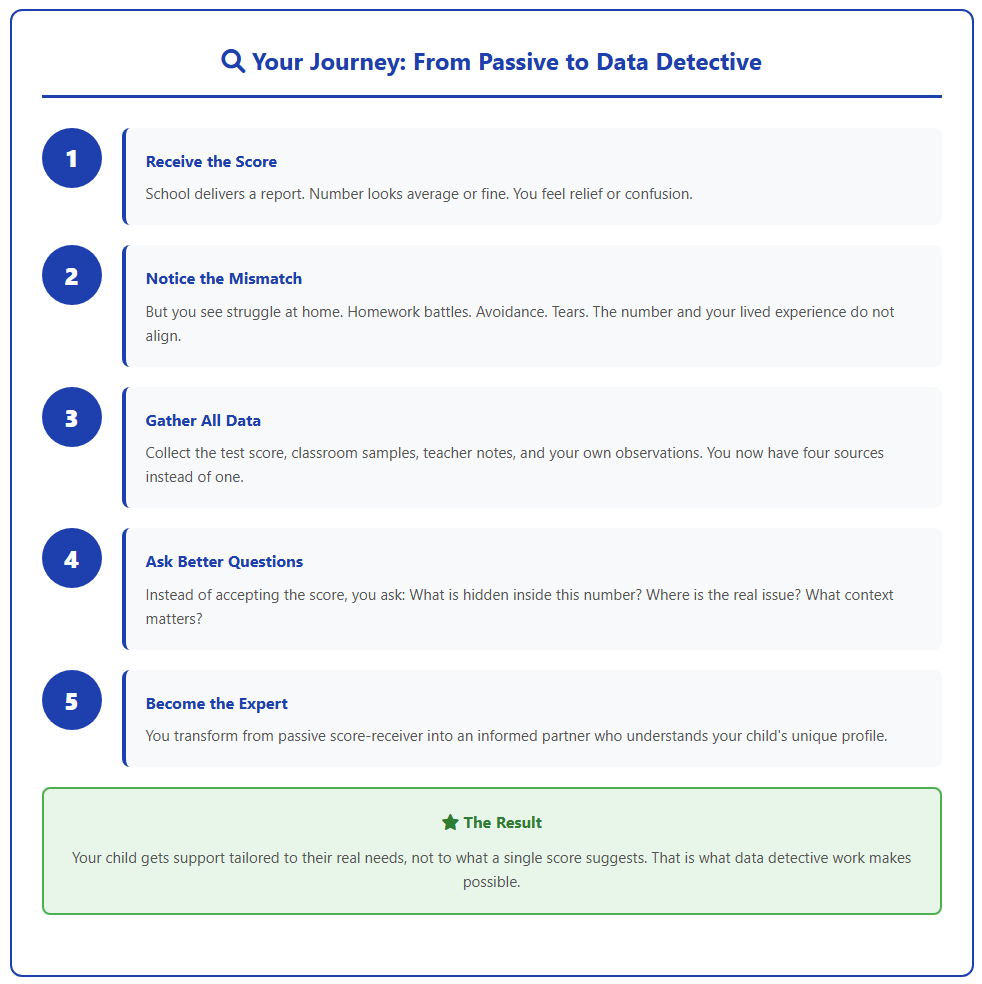
Collecting and using this data, even simple observations like how long homework takes or what precedes a meltdown, will transform you from a passive recipient of scores into an informed partner and a credible collaborator.
This is the transformation waiting for you. From receiving scores passively to actively investigating your child's real story. Five steps to becoming the expert.
The goal of this series is to help you move from feeling confused or scared about scores to understanding them as tools for insight, not definitions of worth. When you ask targeted questions about context, subscores, and patterns over time, you are better equipped to ensure your child receives the specific, individualized support that matches their unique learning profile.
Action Steps for This Week
Gather Data: Collect recent data from all four sources (a recent test score, a few classroom work samples, a piece of teacher feedback, and your notes on a recent homework session).
Look for Discrepancies: Do the scores match your home observations? Note one pattern or mismatch you hadn't noticed before.
Write Down One Question: Based on this initial analysis, write down one question you would like to explore further with a teacher or evaluator.
You are not just a parent; you are a data detective working to understand your child's unique learning profile. That detective work is the most important thing you can do to support their educational success.
Parents aren't supposed to be data analysts. We're supposed to be advocates. And advocates need to know when something doesn't add up.
Kevin is an author, speaker, and thought leader on topics including data literacy, data-informed decisions, business strategy, and essential skills for today. https://www.linkedin.com/in/kevinhanegan/
Feeling sure doesn't mean you're right. Learn five simple ways to question what feels true, spot what might be influencing you, and make better decisions about what to believe.
When an institution cites a measurement you cannot see, it hands you a conclusion and calls it evidence. Two World Cup rulings show why that gap matters far beyond sport, and why the fix is not better technology but a different question.
When kids ace drills but break down on word problems, it’s not effort or ability, it’s cognitive load. This article explains how executive function demands overwhelm capacity, and how the right scaffolds restore access to learning.
When school reports say "fine" but your child struggles daily, that gap is real. Your observations aren't anecdotal, they're longitudinal evidence. This journey helps you trust what you see, complete the data schools collect, and advocate with grounded confidence. Start here.