Accurate data and credible evidence don't always lead to good decisions. The challenge is recognizing when evidence that appears relevant doesn't fully apply to our circumstances. Learn four practical tests to identify hidden assumptions and determine whether the evidence is sufficient.
Organizations demand evidence before making a change, but rarely apply the same scrutiny to doing nothing. What if our efforts to reduce risk are actually limiting innovation? Explore the hidden costs of inaction and why better decisions require evaluating the status quo, too.
Data quality is a property of the data. Evidence fitness is a relationship between the data, the question, and the cost of being wrong. Stewardship has mastered the first. As AI systems move from displaying data to recommending action, organizations need the second.
Accurate data and credible evidence don't always lead to good decisions. The challenge is recognizing when evidence that appears relevant doesn't fully apply to our circumstances. Learn four practical tests to identify hidden assumptions and determine whether the evidence is sufficient.
Why accurate evidence isn't always enough to support the decision you're making
TL;DRWhy accurate, credible evidence can still mislead a specific decision
What you need to know
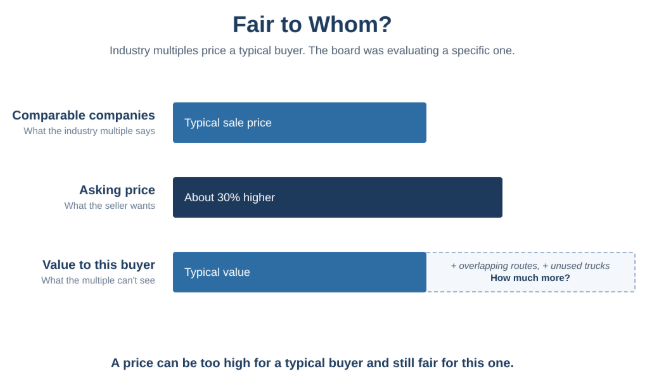
We teach people to check whether evidence is accurate. We rarely teach them to check whether it fits the decision in front of them. A board asks whether an acquisition price is fair. Industry valuations say the price runs 30% above comparable deals, so the board walks away. The valuations were sound. They described what a typical buyer would pay, and this buyer had overlapping routes and unused trucks that a typical buyer would not. I call the missing check evidence-to-decision fit: how well the assumptions behind the evidence match the decision you are making.
Why this matters to you
You probably use benchmarks, rankings, and industry averages to make decisions that are specific to your organization. When the source is credible, few people think to ask what it assumes. That is what makes this problem hard to catch. The question is right, the numbers are accurate, and the answer looks clear. AI raises the stakes, because its recommendations arrive polished and well supported, with their assumptions out of view.
Who this applies to
Executives and boards weighing investments, acquisitions, and strategic bets. Managers who rely on benchmarks to set budgets, targets, or priorities. Analysts asked to turn industry data into a recommendation. Anyone using AI to evaluate options where the details of their own situation matter.
What you'll gain from reading
Five warning signs that tell you when general evidence deserves a closer look. Four tests of evidence-to-decision fit: Question Match, Assumption Match, Alternatives, and Decision Reversal. A worked example applying all four to the acquisition. And a way to separate how much you trust a piece of evidence from how much it applies to your decision, so one judgment doesn't quietly stand in for the other.
Imagine a regional distributor is considering acquiring a smaller competitor. Before moving forward, the board asks a sensible question: Is the asking price fair? To help answer that question, the company's advisers compare the proposed price against industry valuation multiples and similar acquisitions. Their analysis shows that the price is approximately 30% higher than what comparable companies typically sell for. That looks like a significant overpayment, so the board decides not to proceed.
A few months later, another distributor acquires the company at roughly the same price. The new owner begins improving profitability as it integrates the acquisition into its existing operations. The original board concludes that the other buyer must have been willing to overpay. After all, the industry valuations still suggest the price was too high.
That doesn't necessarily mean the original board made the wrong decision. But it raises a question about what the original valuation might have missed. In this case, the evidence not only shaped the original decision, but also shaped how the board interpreted what happened afterward.
What I find interesting is that the original analysis wasn't necessarily wrong. The valuation data appeared credible, the calculations were sound, and the board asked a perfectly reasonable question. The evidence appeared to answer it directly. Nothing about the process looked careless or obviously irrelevant.
The problem was what those valuations represented. They reflected what similar businesses were generally worth to buyers in the market. But this particular distributor already operated delivery routes that overlapped with the acquisition target's customers, and many of its trucks had unused capacity. Acquiring the smaller company could have allowed it to serve additional customers without adding nearly as much operating cost as another buyer might face. That potential advantage wasn't reflected in the general valuation multiples.
The board thought it was evaluating whether the acquisition was worth the asking price. In reality, it was evaluating whether the price was reasonable for a typical buyer. Those are related questions, but they aren't the same. A company that looks overpriced using general market valuations might be an attractive investment for a buyer whose circumstances allow it to create additional value.
I have written often about decisions that go wrong because we ask the wrong question. This is a different problem, and a harder one to catch. The board asked the right question. The evidence helped answer it for the general case, but the decision involved a specific buyer with circumstances that the evidence didn't fully account for.
Sometimes the question is right, the data is accurate, and the evidence appears to support the decision. But that doesn't mean the evidence is sufficient. It may be based on assumptions that don't fully reflect our circumstances.
A Problem That Looks Like Good Practice
Nothing in that story looks wrong at the time, and that is what makes the problem hard.
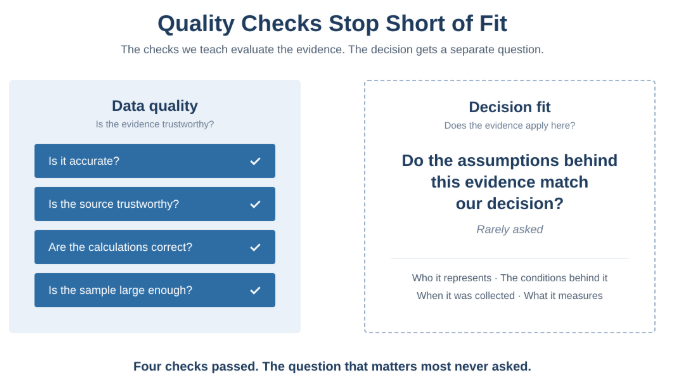
We teach people to check data quality. Is it accurate? Is the source trustworthy? Are the calculations correct? Is the sample large enough? In our acquisition example, the valuation appears credible. The data comes from established sources, the calculations are sound, and the analysis seems to answer the question the board asked.
But there's something missing from those checks. They tell us whether the evidence is trustworthy, not necessarily whether it tells us enough about the decision we're making. The issue isn't data quality, it's how well the evidence fits the decision. I call this the evidence-to-decision fit.
What makes this tricky is that evidence doesn't have to be irrelevant to be insufficient. Those industry valuations were useful. The board needed to understand what similar companies typically sell for, and the analysis gave them that information. But knowing what other buyers paid doesn't tell them everything about what this acquisition might be worth to their company. The evidence was relevant, just not enough on its own to justify the conclusion.
And I think we're particularly vulnerable to this when the evidence comes from a source we trust. Things like a published benchmark or an established ranking can give us confidence that we're making an informed decision. We may spend time checking whether the numbers are correct without ever questioning whether the assumptions behind those numbers apply to our situation. That's what makes this so difficult to recognize. The data doesn't have to be wrong for us to give it more weight than it deserves.
So how do we recognize when evidence that looks perfectly reasonable might not be sufficient for the decision we're making?
When to Look Closer
We can't investigate every assumption behind every piece of data we use, nor should we need to. General benchmarks, industry averages, and other commonly used statistics can be perfectly reasonable starting points. The challenge is knowing when they might not be enough. There are a few situations where I think we should be especially careful.
The evidence is general and the decision is specific. This is when we are using information about a broad population to make a decision about a very specific situation. An industry average might describe what typically happens, but how much does that tell us about what will happen in our organization, with our customers, or under our particular constraints?
Your circumstances differ from those behind the data. Maybe we're operating in a different market, working under different rules, or making a decision in conditions that have changed since the data was collected. Those differences might matter very little, or they might change the conclusion entirely.
The data describes performance and says nothing about the effect of choosing. How something is performing and what would actually happen if we made a particular choice aren't always the same thing. Knowing which product generates the most revenue doesn't necessarily tell us where the next dollar of investment will create the most value.
The answer arrives without visible assumptions. When an insight or evidence gives us a clear answer, do we know what it's based on? This is increasingly important with AI, where we can receive a convincing recommendation without necessarily seeing the conditions or assumptions behind it.
The decision is costly or hard to reverse. We need to consider what's at stake. A decision that's easy to reverse probably doesn't justify spending days investigating every limitation in the evidence. But if we're making a substantial investment, changing an operating model, or committing to something that's difficult to undo, we should be more demanding about what the evidence can actually support.
None of these situations means the data is wrong or that we shouldn't use it. They simply give us reasons to look more closely before allowing it to carry too much weight in a decision.
Four Tests of Evidence-to-Decision Fit
Recognizing that evidence might not be sufficient is one thing. Figuring out whether that matters for our decision is another.
The situations we just discussed give us reasons to look more closely, but they don't tell us what to do next. A general benchmark might be adequate for one decision and misleading for another. Different circumstances might change the conclusion, or they might make no meaningful difference at all.
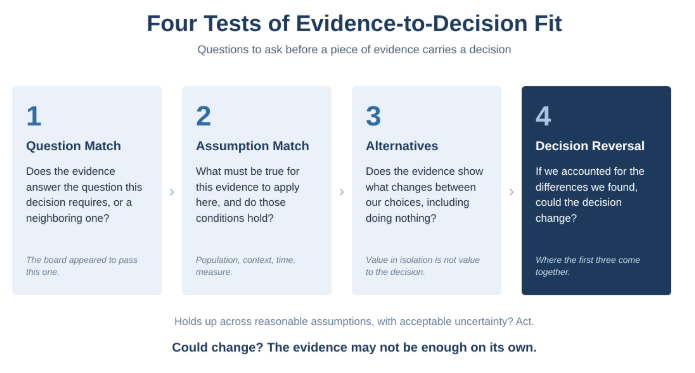
I find four questions useful for figuring that out. They help us examine whether the evidence answers our question, whether its assumptions apply, whether we're comparing the actual consequences of our choices, and whether any of those differences could change the decision. The tests overlap, and the more consequential the decision, the more carefully we should apply them.
1. Question Match
Does the evidence answer the question this decision requires, or a neighboring one?
A quick check: if the evidence is completely accurate, does it establish the conclusion we're drawing from it? An engagement survey tells us how employees feel about their workplace, but it doesn't explain why they leave. A sales dashboard shows which products generate the most revenue, but not which ones deserve more investment.
The board in our acquisition example appeared to pass this test. It wanted to know whether the price was fair, and the industry valuations seemed to provide an answer. The problem became visible when we examined what those valuations assumed about the buyer.
2. Assumption Match
What must be true for this evidence to apply here, and do those conditions hold?
Some of the most important assumptions involve who or what the data represents, the circumstances behind it, when it was collected, and what it measures.
Population. A national customer survey may be accurate but poorly represent the needs of older customers in a small rural community.
Context. Two organizations operating under different regulations, technologies, or business models may have very different productivity levels for reasons unrelated to performance.
Time. Last year's sales may help predict demand until a competitor opens nearby or the company changes its pricing.
Measure. Training completion isn't the same as capability. Dashboard usage doesn't establish better decisions. AI adoption doesn't demonstrate AI readiness.
You don't need to know which assumptions are wrong to recognize that they matter. Sometimes asking what a benchmark or model assumes is enough to reveal why it might not fully apply to your decision.
3. Alternatives
Does the evidence show the difference between our choices, or only describe each option on its own?
A company has a successful product, and leadership assumes it deserves more investment. Its revenue may be impressive, but that doesn't tell us whether the same investment could generate greater returns elsewhere.
The value of something in isolation isn't always the value it contributes to a particular decision. What matters is what changes when we choose one option over another, including doing nothing.
4. Decision Reversal
If we accounted for the differences we've identified, could the decision change?
This is where the earlier tests come together. Identifying differences between our circumstances and the evidence is useful, but not every difference matters. What matters is whether those differences could change our conclusion.
We can test this by adjusting assumptions, examining specific segments, calculating incremental value, or comparing alternatives more directly. If reasonable adjustments could change which option we prefer, the original evidence may not be sufficient on its own.
If the decision holds up across reasonable assumptions, and the remaining uncertainty is acceptable given what's at stake, we probably have enough evidence to move forward. At some point, we need to act.
Running the Tests on the Acquisition
Let's return to the distributor considering the acquisition. Before rejecting the deal as overpriced, the board could have asked four questions
Test
Question to Ask
What It Shows
Test 1Question Match
Does comparing industry valuation multiples tell us whether this acquisition is worth the asking price?
It provides a useful starting point, but doesn't establish what the acquisition is worth to this particular buyer.
Test 2Assumption Match
What do these valuations assume about a typical buyer, and how are our circumstances different?
The distributor has overlapping delivery routes and unused capacity that could make the acquisition more valuable to it.
Test 3Alternatives
What would our business look like if we acquired the competitor compared with continuing without it?
The relevant comparison includes additional revenue, operating costs, integration costs, and the value of other uses for the capital.
Test 4Decision Reversal
Could accounting for those additional benefits and costs change our conclusion that the price is too high?
Possibly. The industry valuations alone aren't sufficient to reject the deal confidently.
The board didn't need to know exactly how much the overlapping routes and unused capacity were worth to recognize that the industry valuations had limitations. It simply needed to question whether those valuations accounted for the circumstances that made this acquisition different.
That doesn't mean the board should have approved the deal. A more detailed analysis might still show that the price was too high.
But it would have been rejecting the acquisition based on what it was actually worth to the company, rather than relying primarily on what similar businesses were worth to other buyers.
A Different Kind of Trade with the Same Problem
I actually encountered this same problem recently in a much less consequential setting: a fantasy football league. For those unfamiliar with fantasy football, managers assemble teams of NFL players and earn points based on their performances. Players can be traded between teams, and there are published rankings and player-value charts designed to help people evaluate whether those trades are fair.
This ends the free preview.
The rest of this
content is for free members
Create a free account to get full access. No payment required.
Organizations demand evidence before making a change, but rarely apply the same scrutiny to doing nothing. What if our efforts to reduce risk are actually limiting innovation? Explore the hidden costs of inaction and why better decisions require evaluating the status quo, too.
Data quality is a property of the data. Evidence fitness is a relationship between the data, the question, and the cost of being wrong. Stewardship has mastered the first. As AI systems move from displaying data to recommending action, organizations need the second.
AI did not end the data literacy crisis. It changed it. As machines move from providing information to interpreting it and recommending what to do, the scarce skill is becoming judgment: knowing what to trust, what to question, and what decisions are still ours to make.
Evidence does not make decisions. People interpret it, weigh it, challenge it, and make judgments. A courtroom reveals what leaders can learn about evidence, expertise, confidence, and data-informed decision-making.