AI did not end the data literacy crisis. It changed it. As machines move from providing information to interpreting it and recommending what to do, the scarce skill is becoming judgment: knowing what to trust, what to question, and what decisions are still ours to make.
Evidence does not make decisions. People interpret it, weigh it, challenge it, and make judgments. A courtroom reveals what leaders can learn about evidence, expertise, confidence, and data-informed decision-making.
Feeling sure doesn't mean you're right. Learn five simple ways to question what feels true, spot what might be influencing you, and make better decisions about what to believe.
The Thinking Skills That Will Set You Apart in the AI Age
AI is changing how we think—but have our thinking skills kept up? Discover the four mindset shifts that will set modern professionals apart in an AI-powered world.
As artificial intelligence becomes a standard business tool, professionals must adapt not just technically but cognitively. The most effective leaders will be those who think alongside AI rather than merely using it extensively.
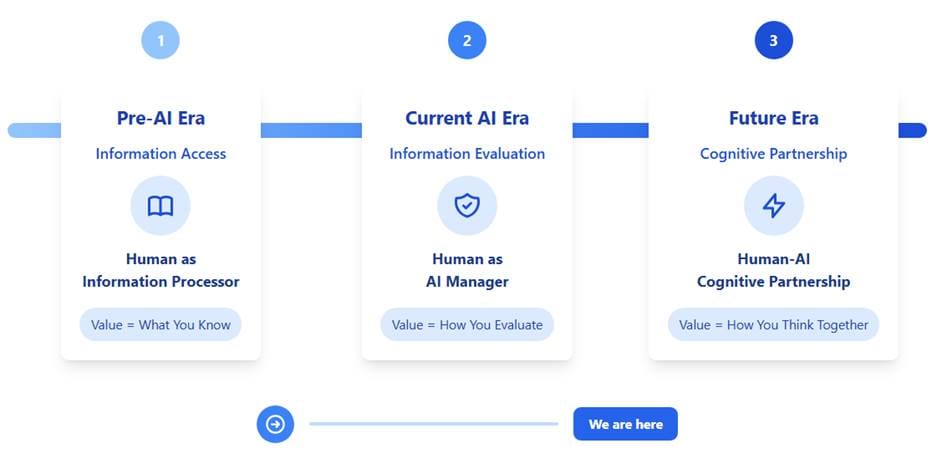
Four essential thinking shifts define this new leadership edge: First, evolving from information retrieval to rigorous information evaluation, questioning assumptions, detecting gaps, and maintaining healthy skepticism of AI outputs. Second, developing metacognitive awareness, understanding when human judgment adds unique value beyond AI capabilities. Third, strengthening complementary intelligence through systems thinking, ethical judgment, and creative synthesis that AI cannot replicate. Fourth, practicing collaborative cognition by designing workflows that effectively combine human and AI strengths.
Organizations must foster cultures where these cognitive approaches flourish by redefining expertise as quality of thinking rather than knowledge possession, encouraging thoughtful dissent from AI recommendations, creating space for reflection, leveraging cognitive diversity, and measuring thinking quality alongside production metrics.
The true frontier of leadership lies not in tool adoption but cognitive adaptation. Those who excel won't simply know how to deploy AI, they'll master thinking effectively in a world where artificial intelligence increasingly shapes our cognitive landscape.
Key Takeaways
In the AI age, the competitive advantage shifts from using AI tools to thinking effectively alongside them. The best leaders won't be those who use AI most but those who know how to collaborate with it cognitively.
Four critical thinking shifts are essential: evolving from information retrieval to evaluation, developing metacognitive awareness about when to trust human judgment, strengthening complementary human intelligence (ethics, intuition, systems thinking), and structuring collaborative cognitive workflows with AI.
Organizations must foster cultures that value quality of thinking over mere knowledge, encourage thoughtful questioning of AI outputs, allow time for reflection, embrace cognitive diversity, and develop metrics that measure thinking quality rather than just production volume.
The real transformation isn't technical adoption but cognitive adaptation. Professionals must intentionally upgrade their thinking skills to remain relevant and effective in a world where AI increasingly shapes our cognitive landscape.
Listen to AI Narration
0:00
/632.016
We're entering a new era. One where artificial intelligence doesn't just support our thinking, but starts to shape it. Tools that generate content, predict behavior, and optimize decisions are becoming as common as spreadsheets. But as AI handles more cognitive load, a critical question emerges:
Have our thinking skills kept up with our tools?
In a previous article, we explored a growing concern. Business professionals are at risk of outsourcing their intelligence, blindly accepting AI outputs without applying human judgment, curiosity, or ethical reasoning. But simply avoiding that trap isn't enough.
To thrive in the age of AI, we need to go further.
We need to evolve how we think. We've spent decades optimizing our tools. Now it's time to optimize the humans who use them. Welcome to the age of Cognitive Partnership.
It's Not Just About Learning AI, It's About Leading With Intelligence
AI is no longer a future technology, it's a present-tense force in business. It's writing reports, scoring candidates, forecasting sales, and answering strategic questions. But this wave of capability doesn't just demand technical adoption, it demands cognitive adaptation.
The best leaders won't be the ones who use AI the most. They'll be the ones who know how to think alongside it.
Four Thinking Shifts That Set Modern Leaders Apart
Here are four thinking skills that matter more now than ever and why they represent the new edge in business decision-making.
This content is for free members
Create a free account to get full access. No payment required.
AI did not end the data literacy crisis. It changed it. As machines move from providing information to interpreting it and recommending what to do, the scarce skill is becoming judgment: knowing what to trust, what to question, and what decisions are still ours to make.
We teach data literacy as a ladder: data at the bottom, wisdom at the top, climb step by step. But the rungs are not where the work happens. The judgment lives in the gaps between them, and that is exactly where AI now carries us straight past.
A bad decision can produce a good outcome. A good decision can produce a bad outcome. Organizations that judge leaders by results without inspecting the reasoning reward luck and punish discipline, and many have done so for years without knowing.
When a decision fails, leaders point to the model. The analysis had already removed the judgment that would have caught the mistake, long before the call was made. This is how analytics stops being a tool you use and becomes one you hide behind.