AI did not end the data literacy crisis. It changed it. As machines move from providing information to interpreting it and recommending what to do, the scarce skill is becoming judgment: knowing what to trust, what to question, and what decisions are still ours to make.
Evidence does not make decisions. People interpret it, weigh it, challenge it, and make judgments. A courtroom reveals what leaders can learn about evidence, expertise, confidence, and data-informed decision-making.
Feeling sure doesn't mean you're right. Learn five simple ways to question what feels true, spot what might be influencing you, and make better decisions about what to believe.
What 2025 Forced Individuals to Unlearn to Stay Relevant
The rules changed in 2025, though not everyone noticed. Static expertise, credentials, and execution speed became brittle. Value shifted to judgment, sensemaking, and continuous learning. Staying relevant now depends less on what you know and more on what you’re willing to unlearn.
The professional of the future is not a better machine but a more capable human. One who uses uncertainty as a catalyst for insight and understands that in an age of automated answers, the most valuable contribution is the ability to ask the right question.
90 Second Audio Recap
0:00
/90.929342
What You Need To Know
2025 didn’t make people obsolete. It made many forms of expertise less differentiating. As AI absorbed more routine cognitive work, value quietly shifted away from execution and toward judgment, sensemaking, and adaptation. The real disruption wasn’t automation it was the erosion of skill-based identities that no longer matched how work now gets done.
Why This Matters to You If your value has been tied to speed, output, or mastery of a specific tool or domain, you may have felt productive but increasingly uncertain. Many professionals stayed busy in 2025 while losing influence, clarity, or confidence in their decisions. The risk isn’t being replaced by AI, it’s continuing to optimize skills that no longer shape outcomes while judgment becomes the true bottleneck.
Who This Applies To This applies to anyone whose work depends on thinking, interpreting, deciding, or advising, especially those in environments flooded with information, AI outputs, or constant change. If you’re expected to “figure it out,” explain trade-offs, or make decisions without clear answers, this shift is already affecting you. The challenge is cognitive, not technical.
What You’ll Gain from Reading This article helps you recognize what needed to be unlearned based off changes in 2025 to stay relevant. You’ll gain language for why certain skills stopped compounding, clarity on what actually differentiates work now, and a clearer picture of the capabilities that endure when execution is abundant. Most importantly, you’ll leave with a sharper sense of where to invest your attention, learning, and identity going forward.
2025 was not kind to comfortable expertise. A lot of people did everything right. They built skills. Earned credentials. Became efficient. Stayed busy. And still felt a growing unease that something about their work identity was no longer stable. That discomfort wasn't personal failure. It was a signal.
2025 forced individuals to unlearn several deeply held assumptions about what makes someone valuable, especially in a world where AI can now perform large portions of routine cognitive labor.
Here are the most important ones.
1) Static Expertise Is Not a Long-Term Asset
The most destabilizing part of 2025 wasn’t skill loss. It was realizing that the identity built around those skills no longer fit the work.
For a long time, expertise felt durable. You learned a system, a tool, a methodology, or a domain. You became "the person" for that thing. Your value was clear. In 2025, that model cracked.
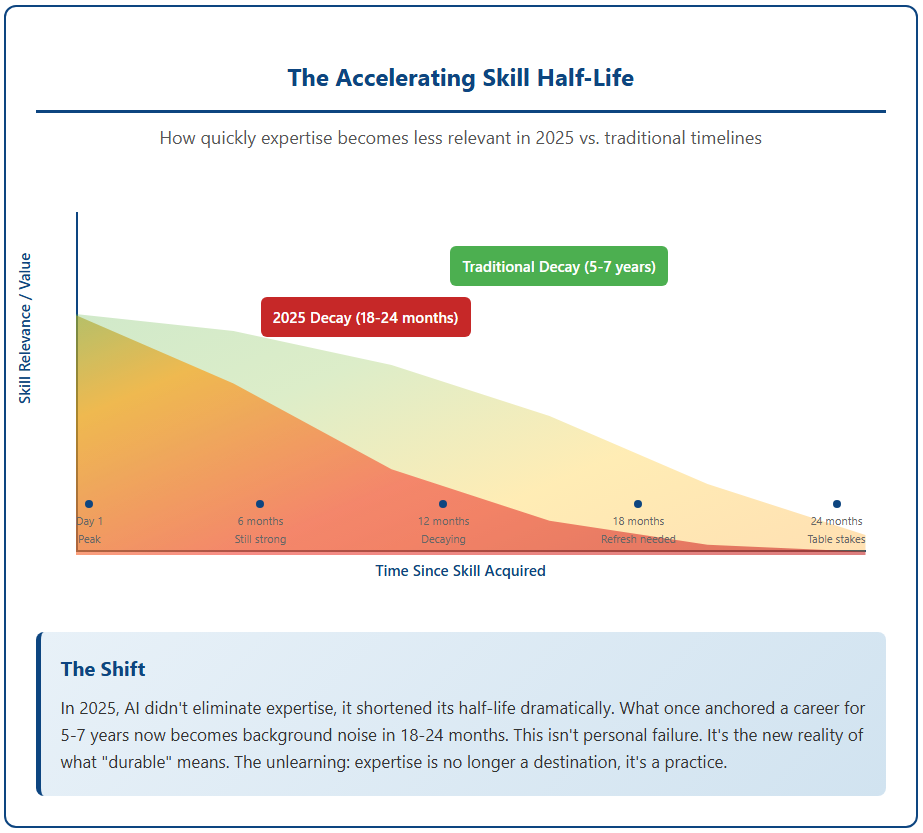
AI didn't eliminate expertise, but it shortened its half-life. Skills that once anchored careers became table stakes or background noise. Some were automated outright. Others became less differentiated as AI handled the heavy lifting.
Roles built around being “the Excel person,” “the SQL expert,” “the reporting lead,” or “the person who knows how this system works” quietly lost their edge. This was not because they disappeared, but because many more people (and machines) could now do the same work.
The unlearning was uncomfortable:
Expertise decays faster than it used to
Tool mastery is fragile
Titles lag behind reality
Part of what made this year hard was recognizing that the version of yourself you'd spent years building was no longer the version the work required. That's not failure. That's evolution under pressure.
What replaces static expertise is not panic or constant reinvention. It's skill fitness: the ability to refresh, recombine, and apply skills as contexts change.
The traditional timeline for skill relevance has collapsed. What once took 5-7 years to decay now becomes less relevant in 18-24 months, fundamentally changing what "expertise" means.
2) Doing the Work Is No Longer the Differentiator
Execution didn’t disappear. It just stopped being the reason anyone listened.
The second shift was even more subtle: where effort actually mattered.
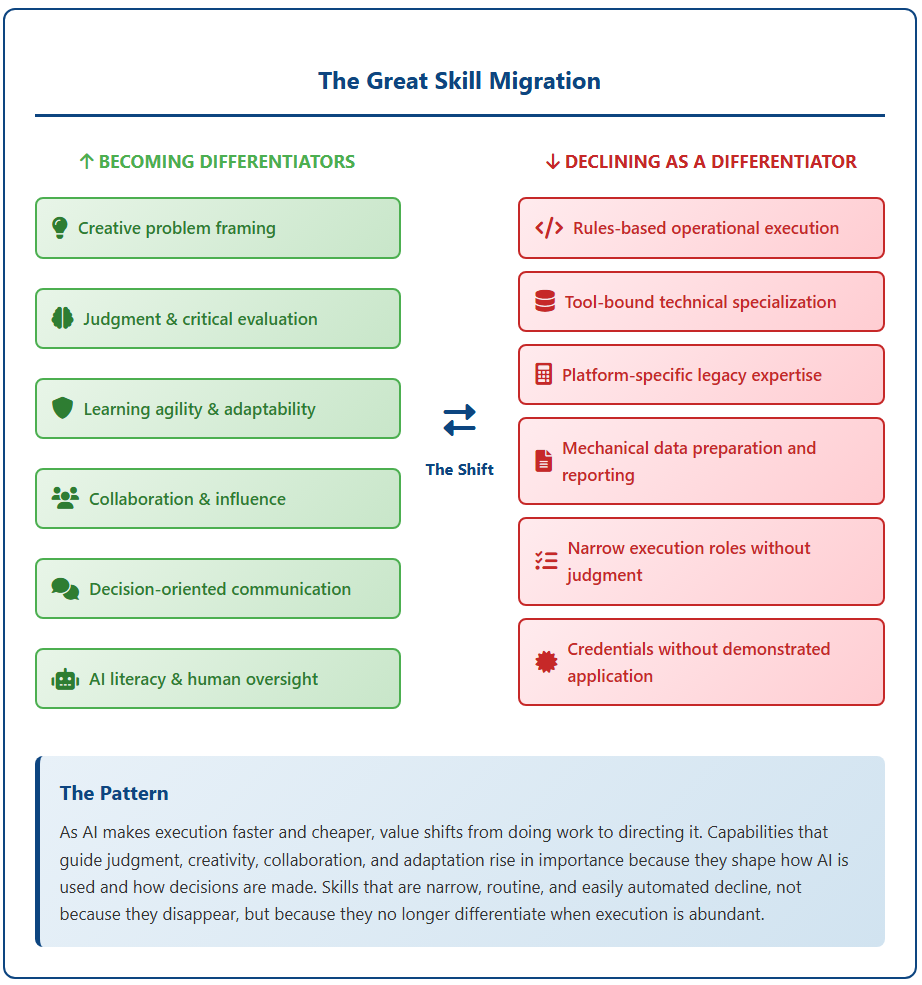
While technical execution skills flatten in value, adaptive judgment and cross-functional capabilities surge. The labor market is rewarding different human capabilities than it did even two years ago.
AI took over more of the "doing": drafting, summarizing, coding, cleaning, and synthesizing. People who defined their value by execution alone felt displaced, even when they were still productive.
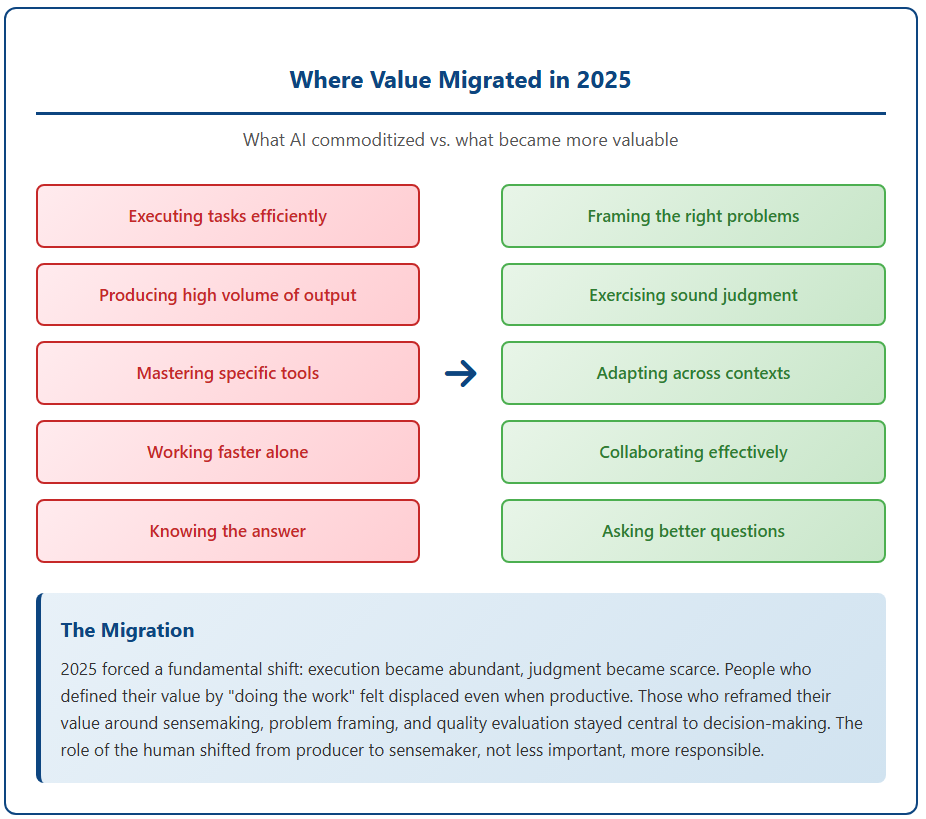
The unlearning here is subtle but profound: Execution is no longer the scarce resource. Judgment is.
What matters now is:
Framing the right problem
Interpreting outputs
Spotting weak logic or missing context
Deciding what to do next
The individuals who adapted fastest didn't resist AI outputs. They interrogated them. They used AI to surface options, then applied judgment to choose. They stayed in the driver's seat by redefining what driving meant.
The role of the human shifts from producer to sensemaker. Not less important. More responsible.
AI commoditized execution and made judgment scarce. Understanding this shift is essential to knowing where to invest your development energy.
3) Credentials Do Not Equal Readiness
Credentials age quietly. You don’t notice until the market stops responding to them.
Degrees, certifications, and courses still matter. But in 2025, they stopped being reliable proxies for readiness.
Many people discovered that:
What they learned a few years ago no longer mapped cleanly to current work
New tools and expectations emerged faster than formal education could adapt
Employers cared less about what you completed and more about what you could handle now
In 2025, hiring managers started asking "What have you learned in the last six months?" as often as "What degree do you have?" The credential still mattered, but it became a floor, not a ceiling. Competence became something you demonstrated through recent adaptation, not accumulated credentials.
The unlearning here is the idea of "finished education".
What replaces it is humility about permanence: what you know has an expiration date, and that's normal. Learning becomes an ongoing practice, not a phase. Capability is demonstrated through adaptation, not accumulation.
4) Solo Productivity Is Overrated
Productivity stopped being an individual problem and became a coordination problem.
For years, productivity advice focused on individual optimization: faster output, deeper focus, fewer interruptions. 2025 didn't eliminate the value of focus. It exposed the limits of working alone.
As AI handled more individual tasks, the real bottlenecks shifted to:
Coordination
Communication
Decision alignment
Shared understanding
Engineers who could ship features independently but couldn't explain trade-offs to product teams found themselves excluded from strategic decisions, regardless of output volume. Analysts who could build perfect models but couldn't translate implications for non-technical stakeholders became less central to decision-making.
People who could think clearly with others, not just independently, became more valuable than those who could do everything themselves.
Organizations that still rewarded solo heroics made this shift harder than it needed to be, but individuals who waited for organizational permission found themselves stuck.
The unlearning is this:
Hero work doesn't scale
Speed without alignment creates rework
Individual brilliance cannot compensate for collective confusion
Collaboration stopped being a soft skill when it became the primary bottleneck. Individual brilliance without collective alignment just produced expensive rework.
5) Technical Skill Without Context Is Risky
AI didn’t lower the bar for output. It raised the bar for judgment.
2025 revealed something uncomfortable: technical fluency without context is dangerous. AI made it easier to generate outputs that look correct, polished, and convincing. But without a mental model of what "good" actually looks like in context, people struggled to evaluate quality.
A data analyst could use AI to generate a regression model in minutes. But without understanding the business context, they couldn't tell if the variables made sense, if the correlations were meaningful, or if the recommendations were actionable. The output looked professional. The logic was invisible.
The unlearning here is critical: Knowing how to use a tool is not the same as knowing when to trust it.
Technical skill became table stakes. What separated competence from risk was:
Domain understanding
Ethical awareness
The ability to detect nonsense
Comfort saying "I don't know yet"
Without those, AI amplifies confidence without competence.
6) Volume of Learning Does Not Equal Capability
Feeling informed is not the same as being capable, especially when decisions are real and consequences are uneven.
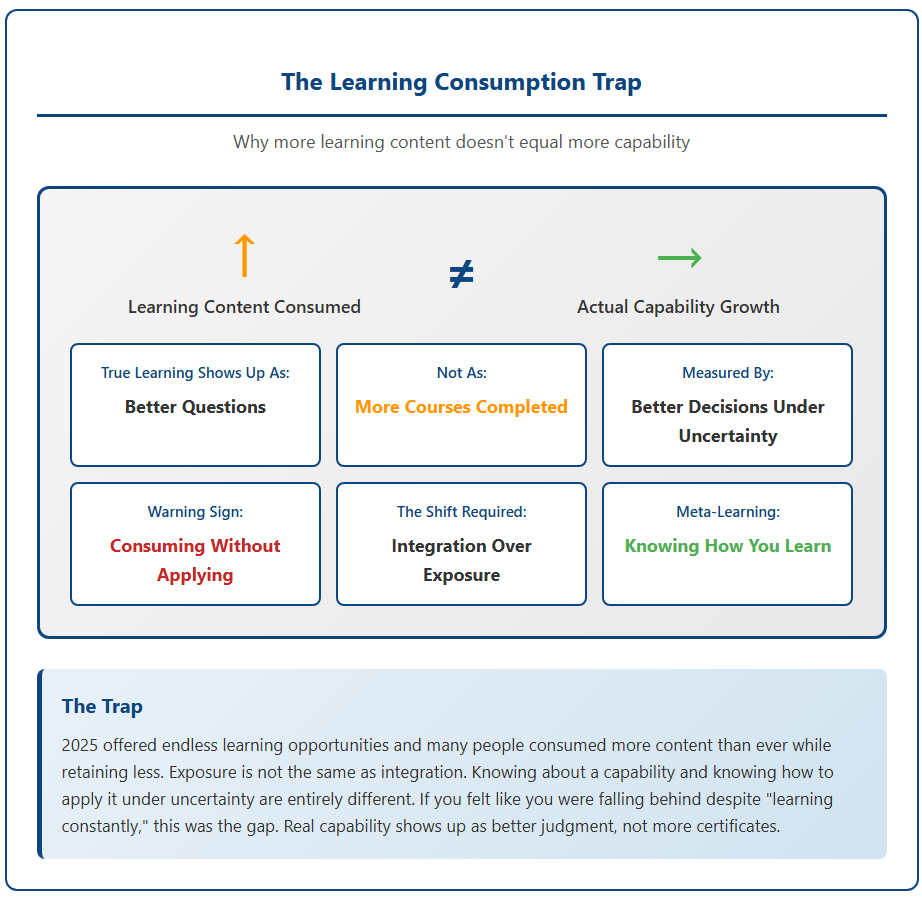
2025 offered no shortage of learning opportunities. Courses. Tutorials. Prompts. Frameworks. Playbooks. Many people consumed more learning content than ever and retained less of it.
People who consumed fifty AI tutorials but couldn't evaluate when to use AI in their actual work discovered a hard truth: exposure is not the same as integration. Knowing about a capability and knowing how to apply it under uncertainty are entirely different things.
The unlearning here is about mistaking consumption for capability.
More information does not equal more capability. Real learning shows up as:
Better questions
Better judgment
Better decisions under uncertainty
This requires meta-learning: understanding how you learn, what you forget, and where you are prone to overconfidence. It means recognizing the difference between familiarity and fluency.
If you felt like you were falling behind in 2025 or 2026, consider the possibility that everyone else felt that way too. The ground was moving. Feeling unsteady was the correct response.
Exposure doesn't equal integration. The gap between consuming learning content and developing actual capability is where most professionals lose ground.
What Durable Capability Looks Like Now
Durability is no longer about what you know. It’s about how early you notice that what you know is becoming insufficient.
After all the unlearning, a clearer picture emerged.
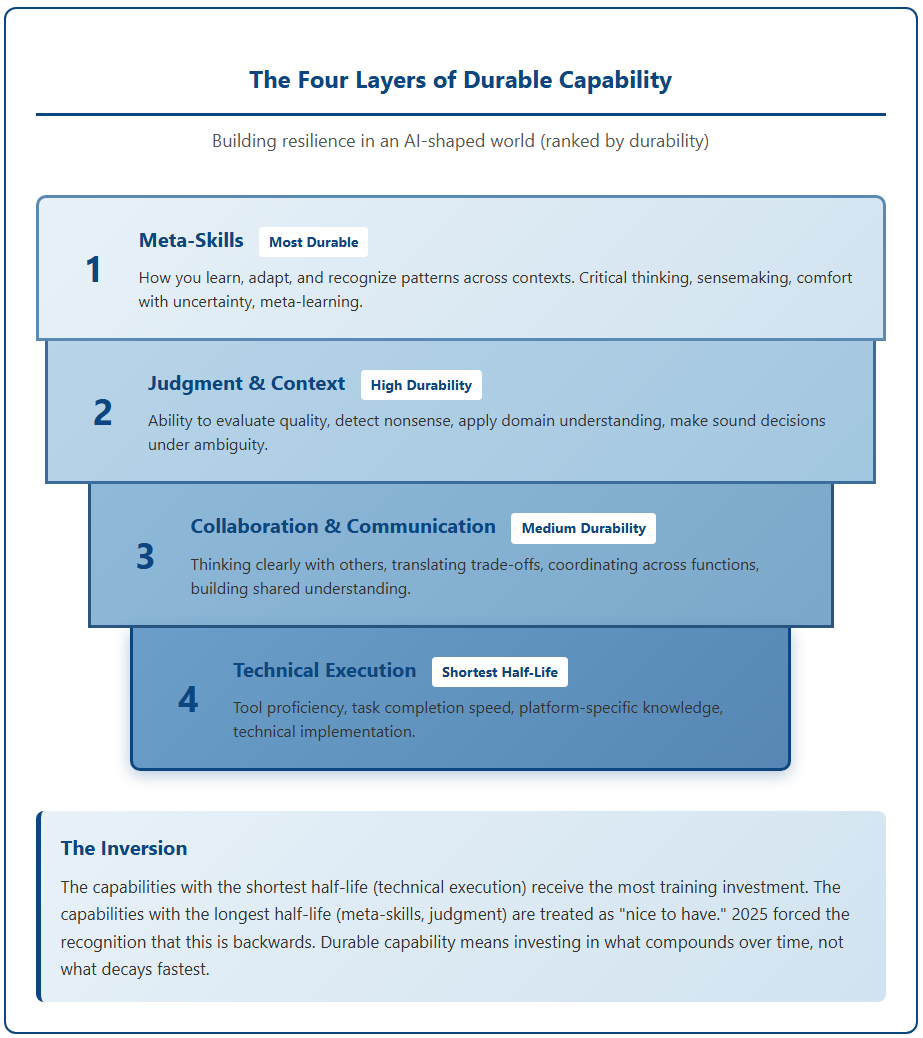
Building career resilience isn't about mastering one domain, it's about stacking capabilities across four layers, with foundational thinking skills at the base and technical skills at the top.
Building durable capability in an AI-shaped world is less about being exceptional at one thing and more about being reliably good at a few essential practices:
Framing problems clearly
Evaluating evidence critically
Integrating AI without surrendering judgment
Communicating trade-offs
Adapting without losing your center
These are not flashy skills. They are durable ones.
They don't show up on a resume as a single line item. They show up in how you approach ambiguity, how you respond when your tools change, and whether you can think effectively under pressure.
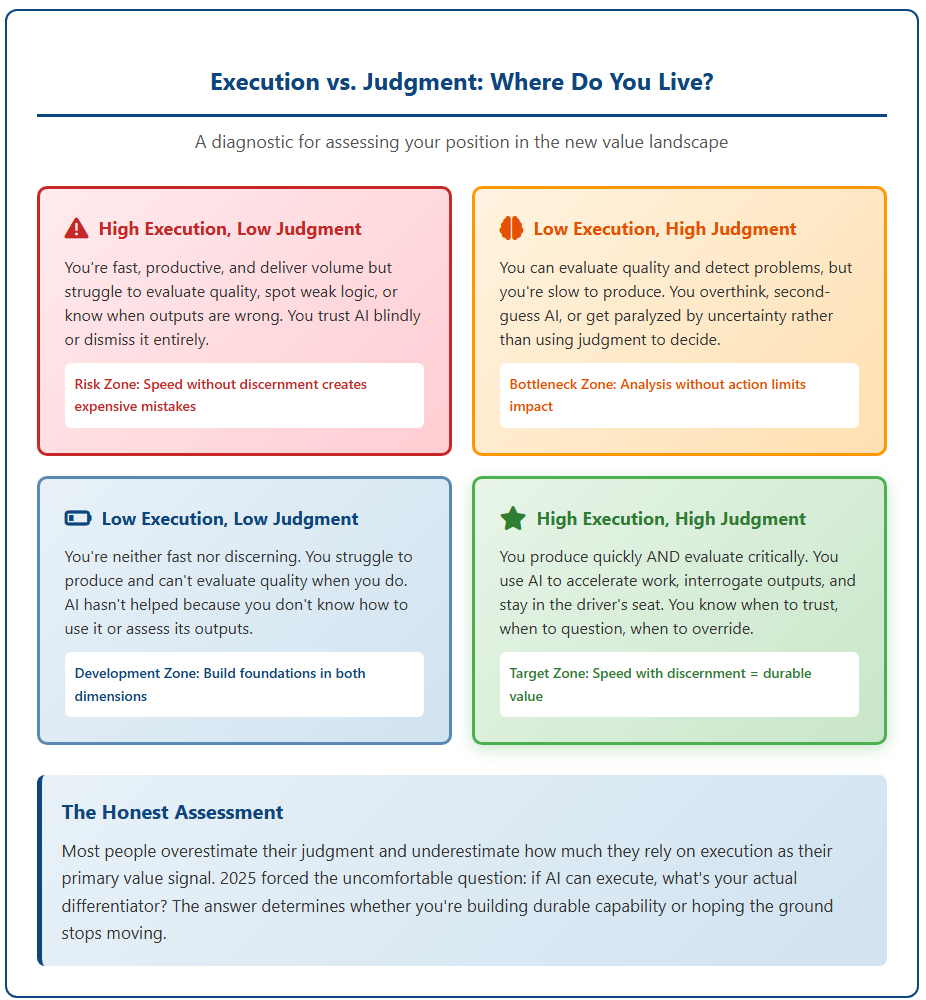
Where do you spend most of your time? This diagnostic helps you assess whether you're positioned in the high-value quadrants or stuck in the commodity zones.
A Simple Reflection to Close
If you felt unsettled at any point in 2025, ask yourself:
What part of my identity was tied to a skill that is changing fast?
Where do I default to execution instead of judgment?
When do I trust outputs more than my own reasoning, or dismiss them without evaluation?
Those questions are not weaknesses. They're signals that you're doing the real work of unlearning.
The people who struggled most weren’t outpaced by AI. They were anchored to identities that no longer matched the work
Where to Go Next
If any of this felt familiar, it’s likely because the friction isn’t abstract. It’s personal. And it’s systemic. To go further, we’ve created a few companion resources that pick up where this article leaves off.
The Unlearning Habits Interactive Guide explores five professional habits that quietly became liabilities. It’s designed to be worked through, not skimmed. Each habit includes reflection prompts, decision lenses, and practical signals to help you recognize when something that once worked is now holding you back.
For those earlier in their careers, or advising people who are, Your Career in the Age of AI: A Guide for New Graduates reframes employability around judgment, adaptability, and sensemaking rather than static skills or credentials. It’s less about picking the “right” path and more about learning how to stay relevant as paths keep changing.
We’ve also included two short diagnostics. One looks at individual unlearning, helping you surface where identity, habits, or assumptions may be creating friction. The other looks at organizational unlearning, focusing on where systems, incentives, or operating models are amplifying drag instead of value.
None of these are about fixing yourself or your organization. They’re about seeing more clearly where redesign is needed.
In our next article, we'll focus on leadership unlearning: what leaders had to let go of as control, performance identity, and certainty stopped producing the results they once did. Because individual growth only goes so far if the system around you refuses to evolve.
Kevin is an author, speaker, and thought leader on topics including data literacy, data-informed decisions, business strategy, and essential skills for today. https://www.linkedin.com/in/kevinhanegan/
Evidence does not make decisions. People interpret it, weigh it, challenge it, and make judgments. A courtroom reveals what leaders can learn about evidence, expertise, confidence, and data-informed decision-making.
Feeling sure doesn't mean you're right. Learn five simple ways to question what feels true, spot what might be influencing you, and make better decisions about what to believe.
We teach data literacy as a ladder: data at the bottom, wisdom at the top, climb step by step. But the rungs are not where the work happens. The judgment lives in the gaps between them, and that is exactly where AI now carries us straight past.
Every organization keeps one scoreboard for mistakes and none for missed opportunities. So people optimize the one they can see, and the largest losses never appear as losses at all. They appear as things no one tried.