AI did not end the data literacy crisis. It changed it. As machines move from providing information to interpreting it and recommending what to do, the scarce skill is becoming judgment: knowing what to trust, what to question, and what decisions are still ours to make.
Evidence does not make decisions. People interpret it, weigh it, challenge it, and make judgments. A courtroom reveals what leaders can learn about evidence, expertise, confidence, and data-informed decision-making.
Feeling sure doesn't mean you're right. Learn five simple ways to question what feels true, spot what might be influencing you, and make better decisions about what to believe.
Bias in the System: When Numbers Reflect Inequity, Not Ability
Your child's low test score feels like a verdict on their ability. But what if the problem is not your child? What if it is the test? Learn why bias, culture, and context are baked into every assessment, and why the problem might not be your child. It might be the test.
When data feels wrong, don’t assume the child is the problem. Check the system.
You’ve done what data-smart parents are taught to do. You’ve looked beyond a single score. You’ve compared results across tests, classrooms, and real-world performance. You’ve noticed patterns that don’t quite line up.
And still, something feels off.
When assessment results conflict with what you see every day, the issue is not always your child’s ability. Often, the issue is the design of the test itself. Tests are not neutral measurements. They are tools, built by people, using assumptions about what matters, how learning should look, and what “typical” performance means.
This article helps you recognize when assessment data reflects design limitations rather than learning limitations and how to raise those concerns accurately and constructively.
Achievement gaps are not mysteries. They are predictable outcomes of a system designed by and for one narrow slice of humanity.
Three Invisible Filters Built Into Every Test
Every assessment includes design choices that act as filters on performance.
It is easy to think of a test score as a precise, objective measurement, but test design often contains biases related to culture, language, and prior experience.
A test is designed to measure a narrow slice of performance, and from that sample, educators make inferences about broader skills. However, those inferences are vulnerable to factors that have nothing to do with intelligence or skill mastery:
Cultural and Linguistic Context: Standardized norms are based on population samples that may not fully represent your child’s lived experience. For instance, a test might include a question about baseball, assuming familiarity with the sport, or use vocabulary that is more common in some households than others. These factors can unintentionally disadvantage certain groups, making the results reflect background exposure rather than true ability.
Test Format Mismatch: Every assessment operates on assumptions about the learner (e.g., attention span, motor control, comfort with timed settings). When those assumptions clash with how your child learns, the scores can underestimate ability. Language-heavy tests, for example, can penalize children with strong reasoning skills who may struggle with weaker verbal expression or comprehension speed.
Instructional Mismatch: Scores often reflect whether your child has been exposed to the material being tested (criterion-referenced tests). If the school environment enforces only one "right" way to learn or demonstrate knowledge, students who could succeed through alternative pathways are excluded. This leads to the fundamental question: Does the test measure what your child actually knows or only what they have been exposed to in a very specific format?
As a data detective, you must ensure the assessment tools and conditions are appropriate for your child’s unique profile, considering their processing speed, anxiety levels, attention needs, and communication differences.
Every test has three invisible filters built into its design. Cultural assumptions. Format preferences. Instructional alignment. Each one can mask true ability. A "low" score might reflect the filters, not your child's actual understanding.
When Context Changes Performance, That’s a Data Signal
In our discussion of data triangulation, we emphasized that context matters. If a test result seems disconnected from your child’s daily life, it often means the conditions of the test itself introduced a form of bias.
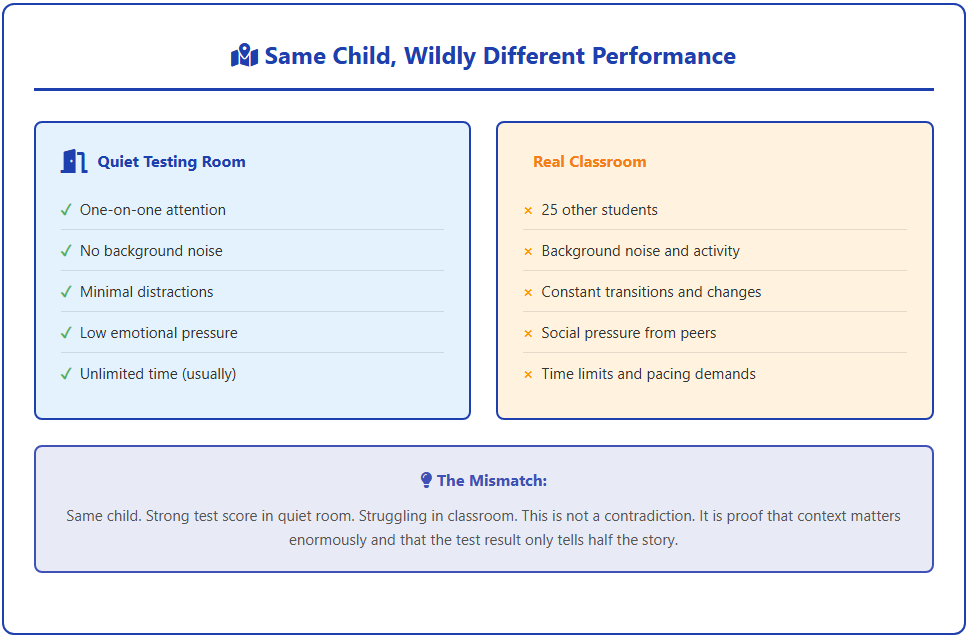
One child. Quiet testing room: strong performance. Busy classroom: struggling. This is not a contradiction. It is proof that the test only measures one condition, not the full picture of what your child can do.
Test performance is shaped by variables besides what a child knows. The testing environment is usually a quiet room with one-on-one attention, designed to isolate variables. This ideal setting may not predict how your child performs in a complex system like a busy classroom, which is filled with noise, time pressure, and distractions.
If a child struggles with performance in the classroom but performs well in a quiet testing room, the data signals that environmental factors (such as sensory sensitivity, attention issues, or social pressure) are interfering with their ability to show what they know.
When Conditions Create False Skill Gaps
Tests measure performance under one set of conditions. Children live under many.
Crucially, testing conditions can turn a performance inconsistency into what looks like a skill deficit:
Time Pressure: Speeded tests can disadvantage children who are deep, meticulous thinkers but who trade accuracy for time. They reveal cognitive endurance or processing speed issues, not necessarily a lack of math or reading skill.
Emotional Load: For children with anxiety, the perceived evaluation pressure can freeze their thinking, leading to a low score that reflects emotional load more than cognitive ability. A strong performance, conversely, might represent what a child can achieve only when anxiety and distractions are minimal.
If test data is used to deny support because the scores look "average" or "fine," the team is ignoring the real-world evidence of how context suppresses your child's ability to learn. The mismatch between test results and lived experience isn’t a contradiction, it’s a clue.
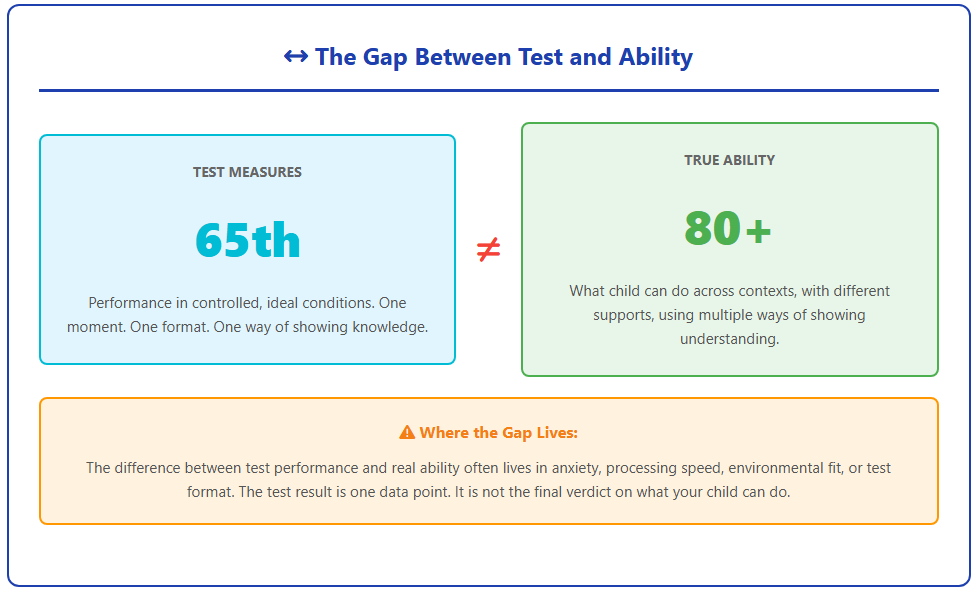
The test says 65th percentile. Your observations suggest much higher ability. This gap is not your imagination. It is where anxiety, processing speed, environmental fit, and test format all live.
The Myth of the “Average” Child
When schools say ‘average,’ parents should ask: average under which conditions?
The education system often uses standardized tests to compare students to a statistical norm, or the "average learner". But there is no such thing as an average child. Every learner is an individual with a jagged profile, strong in some areas, developing in others.
Reliance on standardized norms is often what creates the perception of inequity.
If your child has a high cognitive potential but performs consistently at the middle of the pack, that “average” score may represent under-support or an unmet need. They might be using massive effort to compensate for underlying processing challenges. In this scenario, the test is not measuring their full ability; it's measuring their high effort level.
By focusing on norms (comparison), schools risk mistaking population averages for personal truths. But comparison doesn't improve learning, comprehension does.
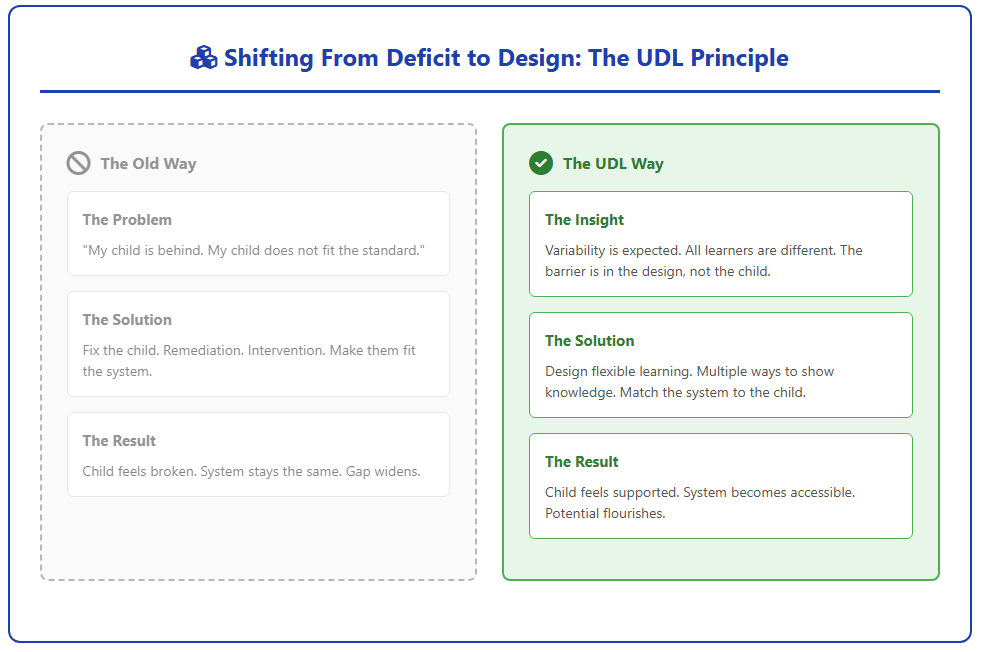
The old system asked: How do we make children fit the test? UDL asks: How do we design so the test (and all learning) fits diverse children? The difference is everything.
Universal Design for Learning: A Better Interpretive Lens
The framework of Universal Design for Learning (UDL), which views variability as the rule, not the exception, provides a powerful counter-argument to the one-size-fits-all mentality. UDL emphasizes that barriers are in the environment, not the child.
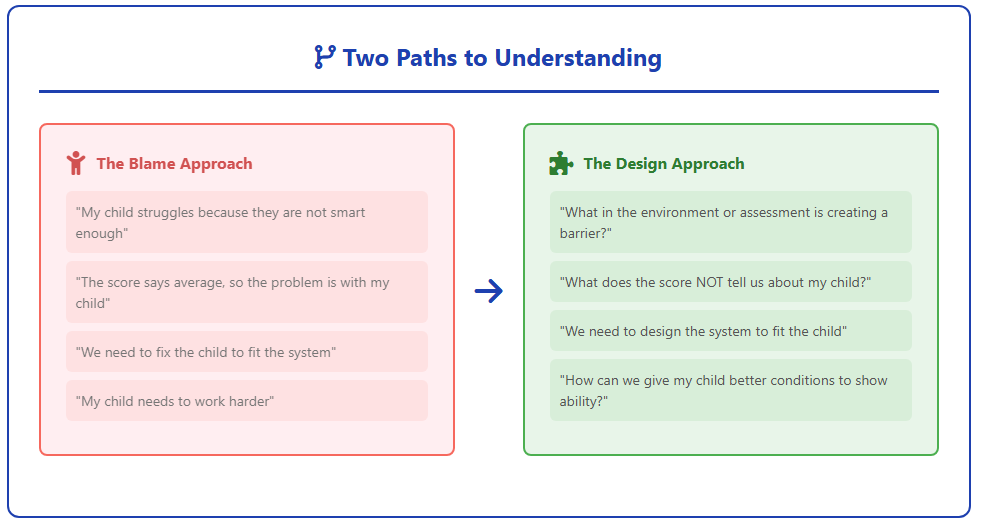
One path blames the child. One path redesigns the system. The difference is not just philosophy. It is the difference between crisis and support, between learned helplessness and flourishing.
Advocacy Shift: From Blame to Design
When you suspect that the numbers reflect inequity or flawed design rather than your child’s ability, your advocacy must shift from pointing out problems to designing solutions that fit their unique pattern.
You are not rejecting expertise; you are ensuring accuracy. You must bring your qualitative data like your observations about context, anxiety, and compensation to the conversation to complete the picture beyond the test score.
Advocacy is teamwork. You succeed by reframing the discussion: from “my child is broken” to “my child’s learning environment/assessment needs adjustment”. This is about ensuring that your child’s difference is treated as design feedback, not dismissal.
Stop asking how to fix your child to fit the test. Start asking how to design conditions so your child can show what they know.
Questions That Improve Accuracy and Equity
When reviewing assessment data with the school team, use these questions to bring context and fairness to the conversation:
Questioning Test Validity and Bias
"Does this test measure what my child actually knows or what they’ve been exposed to?".
"Are the assessment tools and conditions appropriate for my child’s known profile, considering their processing speed or anxiety levels?".
"What cultural, linguistic, or environmental factors might have affected these results?".
Questioning Contextual Fit
"What data do we have showing how my child performs in the actual classroom, compared to the testing room conditions?".
"What types of tasks were these problems, and were the high-load elements (time pressure, multi-step directions) causing the low scores?".
"How can we adjust the learning environment to match how my child learns best, rather than asking them to fix themselves to fit the system?".
Questioning the Use of Scores:
"What does this score not tell us about my child?".
"If the scores are used to deny support, what other forms of evidence (teacher observations, parent data, work samples) were considered?".
Focusing on accuracy, documentation, and respectful inquiry will help you go from feeling powerless to being a credible partner. You are ensuring that decisions are based on the whole child, not just numbers that may have been filtered through an inequitable system. Your voice, backed by your unique data, is necessary to make sure that the education system designs learning experiences that support your child’s individual variability, allowing them to truly flourish.
Final Reframe: Check the Starting Line
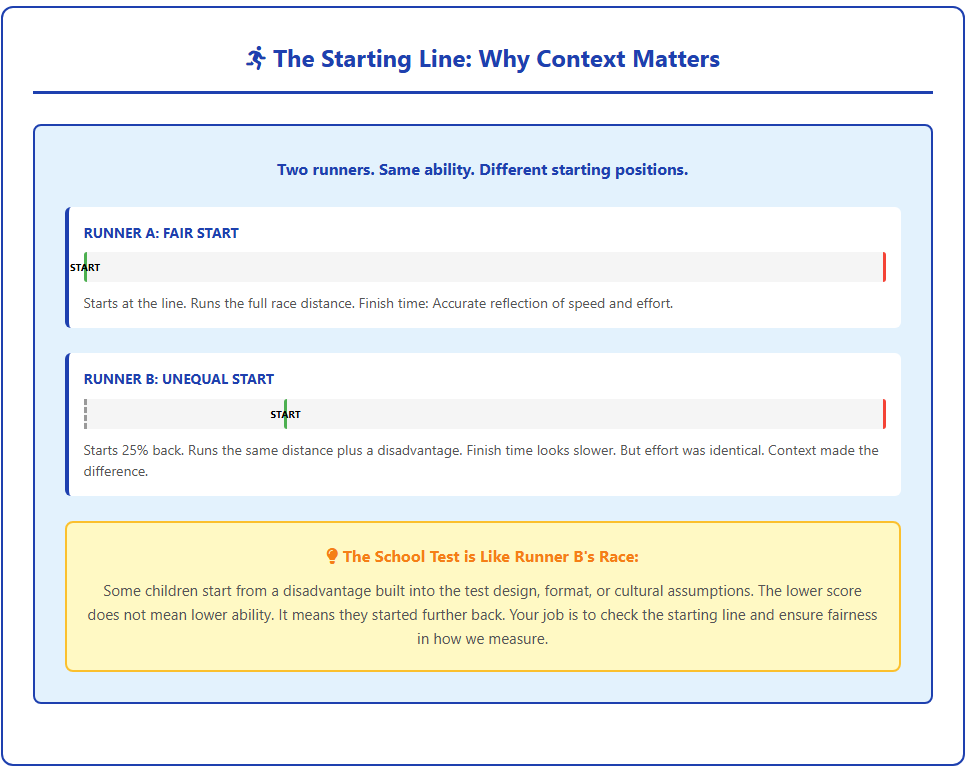
A single test score used to define a child is like trying to judge the fairness of a race when half the runners started ten feet behind the line. The final time might look objective, but it was shaped by an unequal starting condition. Your job is to check the starting line: the context, the design, and the cultural assumptions, to ensure the data truly reflects your child's effort and ability.
Same speed. Different starting positions. The slower finish time does not mean slower ability. It means the race was not fair. Test design works the same way. Some children are asked to start behind the line.
When data doesn’t match the child you know, the problem is rarely the child.
Kevin is an author, speaker, and thought leader on topics including data literacy, data-informed decisions, business strategy, and essential skills for today. https://www.linkedin.com/in/kevinhanegan/
When kids ace drills but break down on word problems, it’s not effort or ability, it’s cognitive load. This article explains how executive function demands overwhelm capacity, and how the right scaffolds restore access to learning.
When school reports say "fine" but your child struggles daily, that gap is real. Your observations aren't anecdotal, they're longitudinal evidence. This journey helps you trust what you see, complete the data schools collect, and advocate with grounded confidence. Start here.
Data clarifies patterns but can't capture a whole child. Balance test scores with stories, observations, and your child's voice. Make decisions that honor growth as a person, not just academic metrics. Being data-smart means using numbers to understand your child, never to define them.
That report card doesn't match what you're seeing at home. You're not imagining it. A test is just a photograph. Your observations are years of footage. Discover how to replace fear with curiosity and use four data sources to see your child's full story.